
How to Change Company Registered Address: A UK Guide
Learn how to change company registered address in the UK: Companies House AD01 filing, 14-day deadline, HMRC updates and sample board resolution wording.
You signed the new lease last week. The team is already working from the Edgware office, and the old Colindale keys are in a drawer. Then a court letter, or a Companies House reminder, lands at the address you have already left.
That gap is the whole problem. Learning how to change a company registered address is not an internal admin note. It is a timed filing, a board record, and a short period when official documents can still be served at the premises you think you have finished with. Treat it as governance, with a paper trail, or you will miss letters you are deemed to have received.
Table of Contents
- Key Rules and Costs at a Glance
- Approving the Move with Board Resolution Wording
- How to File the Change Online with Companies House
- Paper Filing on Form AD01 and When to Choose It
- Notifying HMRC and Third Parties in the Right Order
- Timing, Transition Period and Pitfalls to Avoid
- Confirm the Register and Settle Your Next Step
Key Rules and Costs at a Glance
| Rule | What It Means in Practice |
|---|---|
| Filing deadline | Notify Companies House within 14 days of the change taking place |
| Forms | AD01 online or on paper; AD01c is the Welsh-language equivalent for Welsh companies |
| Filing fee | £0 for the online change of registered office |
| Jurisdiction | An England and Wales company stays in England or Wales; Scottish and Northern Irish companies stay in their own nation |
| Acceptable address | A physical location; a standalone PO Box, DX number or LP number is not accepted |
| Effective date | When Companies House registers the notice, not when directors decide or the form is posted |
| Old address on record | Stays visible for the company's lifetime and for 20 years after dissolution |
The official filing carries no charge, so cost is not an excuse to wait. The point that catches people out is the effective date. The change is not legally effective when the directors agree, and it is not effective when the form is posted. It takes effect only once the registrar registers the notice.
Say an England and Wales company leaves a Colindale office for new premises in Edgware. That move stays inside England and Wales, so it is permitted. A filing that tries to place the same company in Scotland is invalid for that purpose.
Before you submit, run three checks. The postcode must match the premises. The jurisdiction must match the nation of incorporation. The address must be a physical place where post can be delivered and company records inspected. Note the date you want the change to take effect, because that date starts the clock.
Practical rule: Diary the intended effective date the same day the board agrees it. Memory is not a compliance system.
Approving the Move with Board Resolution Wording
Directors decide the registered office, usually at a board meeting or by written resolution. Record that decision before anyone files. A bank, a buyer, or a later dispute will ask for the minute, and an undocumented decision is the first thing they query.
Check the articles of association before you treat the board decision as enough. Most private companies do not need shareholder approval for this change. Some articles add conditions, such as a reserved matter or notice to a particular class of shareholder. If the articles are silent, the board can proceed. If they are not, get the extra approval first. The roles and responsibilities of the board of directors show who may pass the resolution and who should sign the minute.
What the minute must contain
Date. Use the day of the meeting, or the day the last director signs a written resolution.
Attendance. Name the directors present, or those who consented in writing. A blank attendance line is how minutes get challenged.
Addresses. Write the full old registered office and the full new one, including the postcode, exactly as they should appear on the form.
Effective date. This is the date you intend the change to run from, and the date you will diary. It is not the date you hope a late form might be processed.
Filer. Name the director or company secretary who will submit the form, so nobody assumes someone else has done it.
Use this wording, then replace every bracket before anyone signs.
'IT WAS RESOLVED that the registered office of the Company be changed from [old address] to [new address] with effect from [date], and that any director or the company secretary be authorised to file form AD01 with Companies House.'
'IT WAS FURTHER RESOLVED that these minutes be approved and filed with the company's statutory records.'
[old address] is the address currently on the public register, written in full. [new address] is the premises you have already checked for post and jurisdiction. [date] is the intended effective date. Leave a bracket in and the minute is useless.

Keep the signed minute with the statutory records. If a lender later asks who authorised the move, you should be able to produce it the same day.
How to File the Change Online with Companies House
The filing costs nothing, so the only real expense is the time you lose fixing a preventable slip. The Companies House WebFiling fee schedule lists "Change of registered office address" under form AD01/AD01c with "No fee." Have the company's authentication code and access to the registered email ready before you start. A confirmation email generally arrives within a few minutes, and the address changes only once the registrar registers the notice.
One warning on the record itself. Every earlier registered office stays visible on the public register for the life of the company and well beyond dissolution, so a new filing adds a line to the history rather than rubbing one out. Pick the address you are happy to see listed for years.
The screen path is short. The mistakes are predictable.
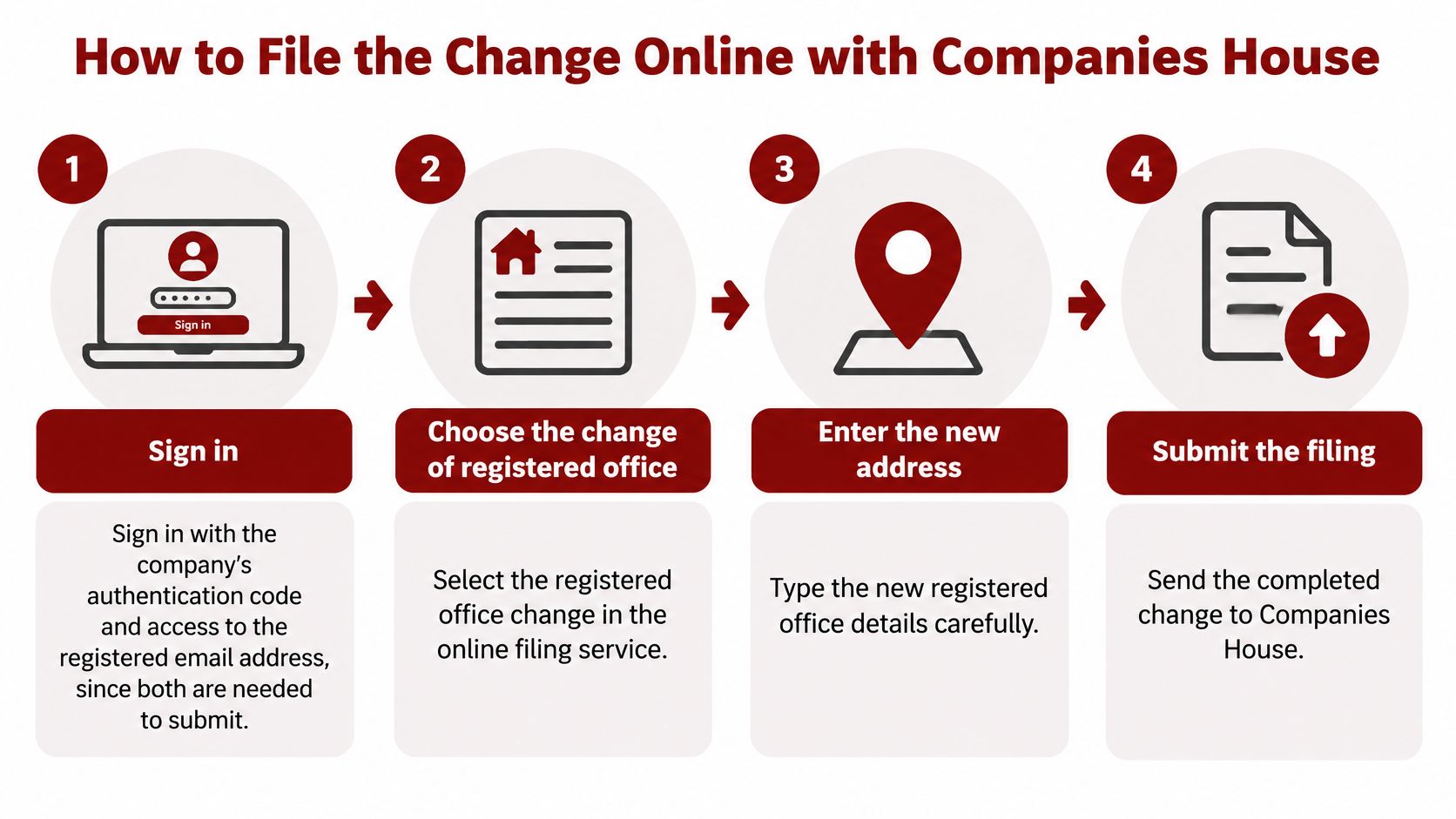
- Sign in with both credentials. The authentication code and the registered email are both needed to submit. A code that has gone astray is the usual reason this filing stalls, so order a replacement before the deadline is close.
- Choose the registered office change for the right company. Select the AD01 option against the correct company number if you control more than one. Filing against the wrong entity wastes the day you thought you had saved.
- Enter the new address and test the postcode. Type it against the premises details, not from memory of a letterhead. A wrong postcode sends statutory post to the wrong door afterwards.
- Confirm it is a physical location. Documents must be deliverable there and records inspectable. A standalone PO Box, DX number or LP number will fail.
- Match the jurisdiction to the nation of incorporation. An England and Wales company cannot use this form to move its registered office into Scotland or Northern Ireland.
- Review the summary and submit. There is no fee to pay at this step. Read the postcode one last time before you send it.
- Save the confirmation email and note the submission date. The email proves you filed. Registration is a separate event, so diary the date and expect to check back.
- Check the public register after registration. The company secretarial duties around this filing include keeping that register printout with the signed minute.
After the email arrives
Until the register updates, the old address is still where documents can properly be served, so run mail handling at both addresses rather than switching overnight. Update letterheads and the website once registration shows, and keep post forwarding in place through the transition so a statutory letter does not sit unopened at the premises you left.
A change of company name is a separate filing with Companies House, so do not expect this one to cover it. If a group company is rebranding at the same time, rebranding considerations for Florida business owners shows how an identity change leaves a trail on the public record in another jurisdiction. Before you treat the job as finished, verify the postcode and the jurisdiction on the live register.
A confirmation email means the form left your screen. It does not mean the registered office has moved.
Paper Filing on Form AD01 and When to Choose It
File online unless you cannot. Paper is the fallback, not the plan, when the change must take effect on a set date.
The paper route uses form AD01. Welsh companies can use AD01c. It suits a company that cannot complete the online filing, typically because the authentication code cannot be found and recovery would take longer than posting the form.
| Route | Fee | Speed | Main risk |
|---|---|---|---|
| Online AD01 | No fee | Same-day confirmation email, then registration | A missing authentication code delays the start |
| Paper AD01 or AD01c | No separate charge listed for the form | Effective only once registered, not when posted | A form posted late in the window can miss the deadline |
Why the postmark does not save you
A paper form counts from the day Companies House registers it, not from the day you posted it. Send it late in the reporting window and the deadline can pass while the envelope is still in transit. Post by a trackable method, keep a copy of the signed form, and diary the date you posted it so you know when to chase registration.
If the change must be effective on a set date, such as a lease start, file online so you can check the register straight away.
Notifying HMRC and Third Parties in the Right Order
Companies House notifies HMRC when the change is approved. That does not finish the job. Agent authorisations and correspondence settings often fail to sync, so you should confirm each tax account yourself, in this order.
Start with HMRC, covering VAT, PAYE, Corporation Tax, and CIS correspondence. Then the bank, lenders, and insurers, because they send statements and renewal notices. Then the landlord, if the lease defines a notice address. Then clients and suppliers, so invoices and remittance details change before the next run. Then agents, advisers, and online accounts. Finish with the website, legal notice page, letterheads, and email signatures.
| Party | What to Update | Watch Out For |
|---|---|---|
| HMRC | VAT, PAYE, Corporation Tax and CIS correspondence addresses | Companies House notifies HMRC, but confirm each tax account yourself |
| Bank and lenders | Statement and lending correspondence addresses | Old statements can keep arriving and need forwarding |
| Insurers | Policy and certificate addresses | Cancellation or renewal notices can go to the old address |
| Landlord or lease | Notice address under the lease | Check whether the lease defines the notice address |
| Clients and suppliers | Invoice templates, terms and remittance address | Update templates before the next invoice run |
| Agents and advisers | Authorisations and online account details | Agent authorisations may not sync automatically |
| Website and letterheads | Legal notice page, footer and email signatures | An old address on terms can conflict with the register |
A notice that arrived too late
A construction contractor moved premises and updated the shopfront, but CIS correspondence still went to the old address. The notice only surfaced when it arrived late, after the response window had narrowed. The fix is dull and effective. Open each HMRC account, read the correspondence address, and change it before you assume the registrar's notification did the work. Your accountant can update agent authorisations and CIS settings in the same pass, which is safer than hoping the systems match.
Do the website and letterheads last, not first. An old address on terms of business can conflict with the register, and clients will quote whichever version they printed.
Timing, Transition Period and Pitfalls to Avoid
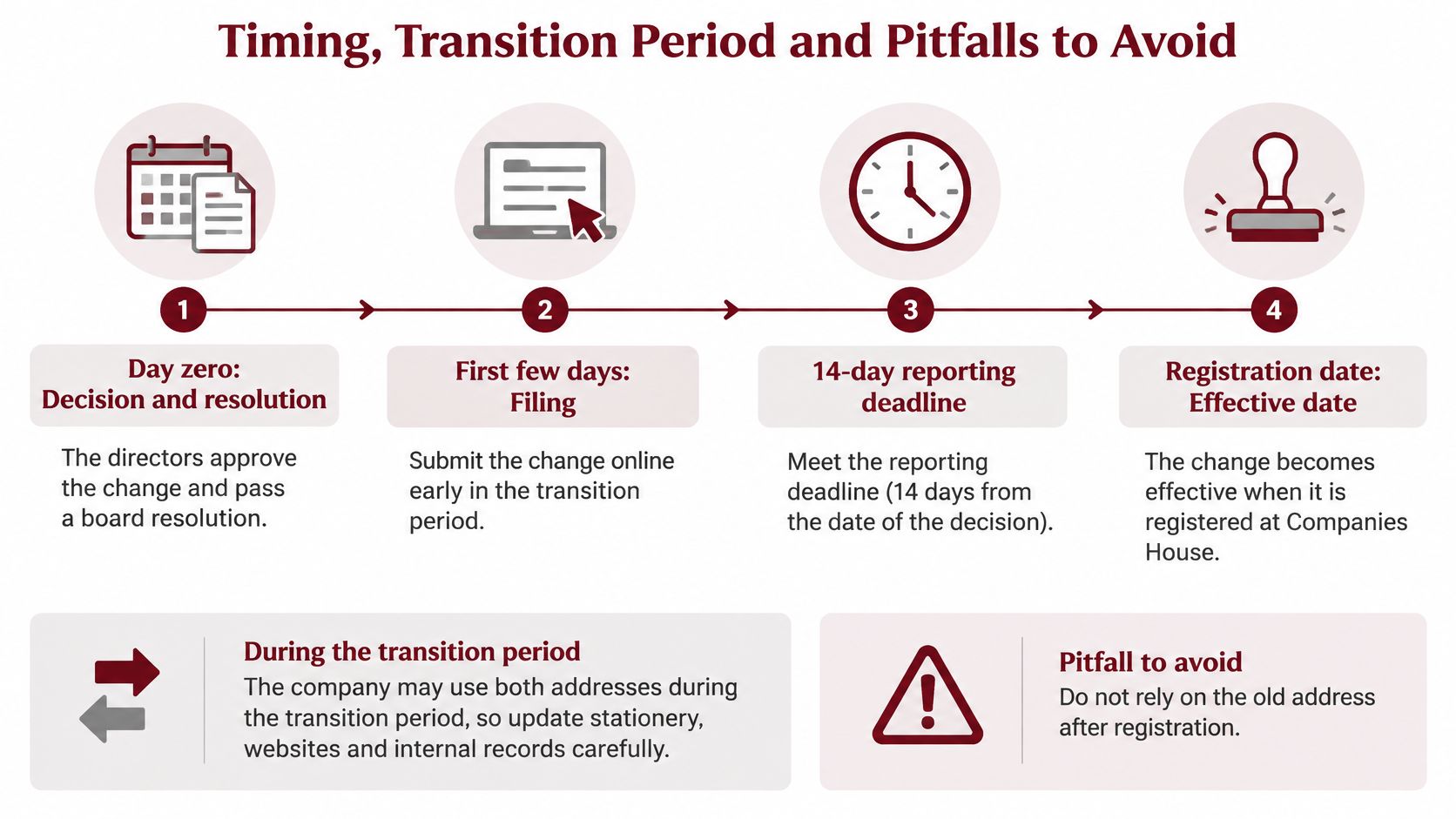
The expensive mistake is a filing that looks done and is not yet effective. Directors agree the move, someone posts a form, and everyone behaves as if the new office is already the registered office. It is not. Companies House guidance on form AD01 is clear that the change takes effect only once the notice is registered, and that a document may validly be served at the previous registered office for 14 days after the new address has been registered.
| Stage | What Happens |
|---|---|
| Day 0 | Board resolution recorded and effective date diarised |
| First few days | Form AD01 filed online with confirmation saved |
| Day 14 | Last day for the Companies House notification |
| On registration | New address takes effect and the old address still accepts documents for 14 more days |
Work the dates backwards from the lease start. Resolve on day zero and diary the effective date in the same minute. File in the first few days, not on the last morning. Day 14 is the last day for the notification, not a target. Registration is the effective date, and only then does the further 14-day service window at the old address begin.
Pitfalls and the fix for each
Posted, not registered. A form in the post is not a completed filing. Use online filing when the date matters, and chase the register if you had to use paper.
Wrong nation. An England and Wales company cannot move its registered office to Scotland. Keep the address inside the incorporation jurisdiction or the filing fails for that purpose.
A mail-drop dressed up as an office. A standalone PO Box, DX number, or LP number will be rejected. Use a real premises.
A home address filed without a privacy check. The registered office is public. Decide that before you submit, not after neighbours start receiving statutory post.
No register check. An email or a postal receipt is not the public entry. Open the register and read the address back.
Arrange mail forwarding and check the old post every day through the service window. If furniture and files are moving in the same fortnight, a firm that can keep your business running while relocating stops the practical move from outrunning the legal one. Before the next confirmation statement, read the registered office on the draft. A late filing is easy to avoid if the date is diarised at the moment the board resolves.
Confirm the Register and Settle Your Next Step
Open the public register once Companies House has registered the change. A confirmation email or postal receipt proves you filed. It does not prove the change is live.
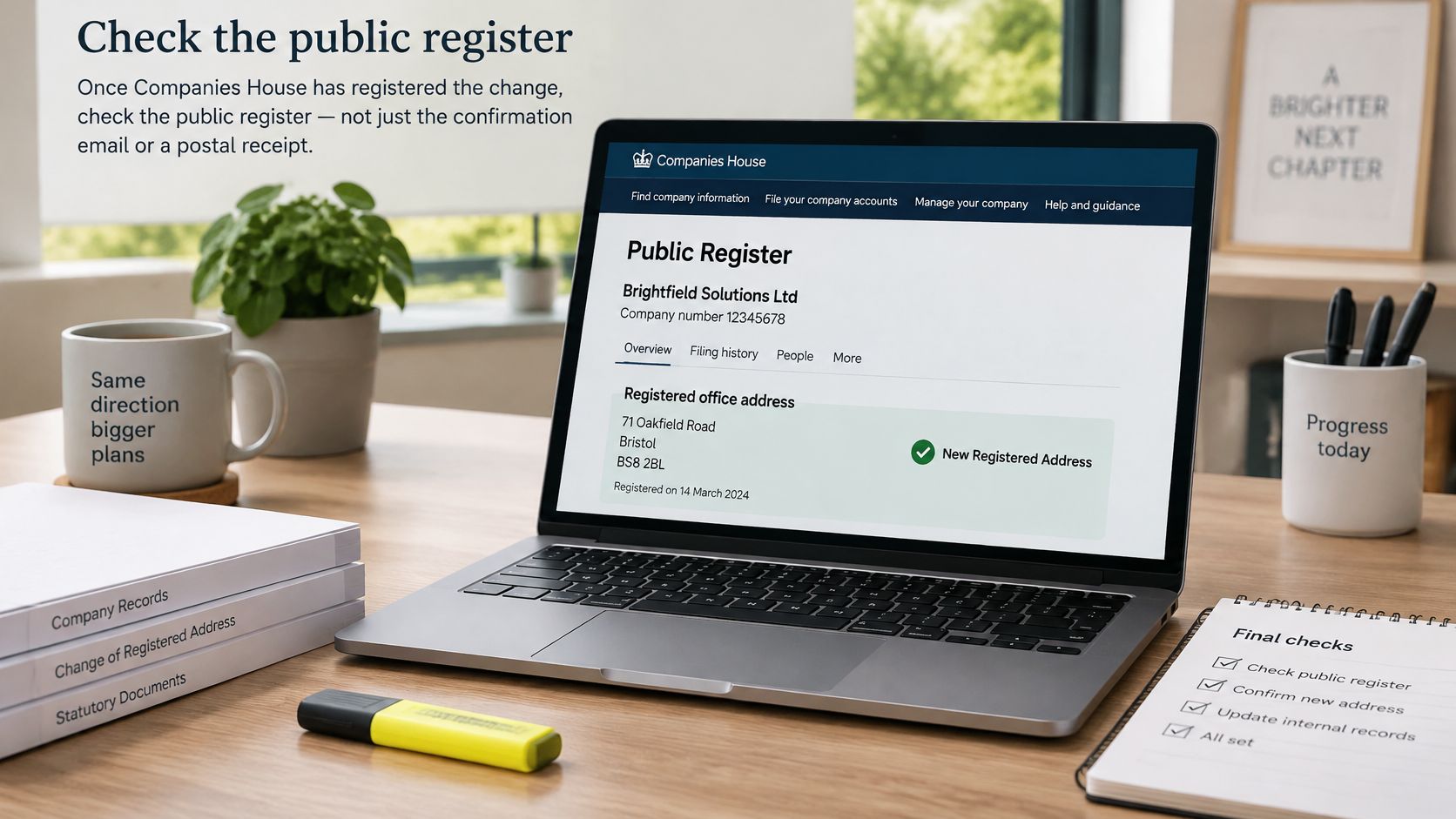
Read the entry line by line. The new address should appear as the registered office and the old one should sit in the historic record. Companies House guidance on your personal information identifies changing the registered office as the prerequisite for removing a current address from the public register. If you filed a home address, it is publicly visible, and moving to a proper business address is the step that takes it off the current entry.
Keep the filing confirmation and a printout of the updated entry with the company's records, alongside the other statutory registers. Date the printout. It fixes the day the public record changed, which matters while letters and legal documents can still reach the old address during the transition. If the move also involves a lease, a new bank, or a payroll change, settle that sequence before you file so nothing is left pointing at the old door.
The registrar's own screen sequence is worth ten minutes if you have not filed an AD01 before.
Action Accountants Limited, based in Colindale, helps founders and SMEs across North West London and the wider UK with company formation, company secretarial support, and CIS-aware accounts. If you want the board minute, the AD01 filing, and your HMRC settings reviewed together before you submit, speak to Action Accountants Limited.