
Rental Income Tax Return: UK Landlord Guide 2026
Rental income tax return rules for UK landlords: the £1,000 allowance, SA105, allowable costs, and Making Tax Digital from April 2026.
The most common advice about a rental income tax return is to total your rent, subtract expenses and file once a year. That skips the first question: does your income require a return, and which reporting calendar applies to this tax year? Get those decisions right before you start sorting receipts. The rules depend on your gross rental income, your profit after allowable costs, the kind of property you let and, increasingly, your combined property and self-employment income.
Table of Contents
- When a Rental Income Tax Return Is Required
- What Counts as Taxable Rental Income
- Allowable Costs and Restricted Finance
- How to Calculate Profit and Complete the Return
- Holiday Lets and Other Property Cases
- Making Tax Digital Deadlines by Tax Year
- Choose to File Alone or Use an Accountant
When a Rental Income Tax Return Is Required
| Situation | Figure | What to do |
|---|---|---|
| Property allowance | First £1,000 of gross property income | No return solely for that income; don't also deduct actual expenses |
| Borderline gross rent | Over £1,000 and no more than £2,500 | Contact HMRC; reporting depends on your circumstances |
| Profit test | More than £2,500 after allowable expenses | File Self Assessment |
| Gross-income test | Over £10,000 before allowable expenses | File Self Assessment |
| New to Self Assessment | By 5 October after the tax year | Notify HMRC that a return is required |
| Record keeping | Five years after the 31 January deadline | Keep your property-income records |
Read the table from the top and act on the row that fits. The £1,000 property allowance applies to gross property income, but you must choose between that allowance and claiming actual expenses for the same tax year. Work out both methods before you decide which gives you the lower taxable result. If your gross rent is more than £1,000 but no more than £2,500, don't assume you can ignore it: contact HMRC, because your other income and filing circumstances can affect what you must report.
The filing test has two measures. You generally need to file if your rental profit after allowable expenses is more than £2,500, or if your gross rental income before expenses is over £10,000. So a large repair bill doesn't automatically remove a filing obligation triggered by gross rent. The thresholds, notification rules and record-retention requirements are set out in HMRC's guidance on working out rental income.
Put notification and records in the calendar
If you don't normally file a return but your rental income means you now need to, notify HMRC by 5 October after the end of the tax year. For rent received in the tax year ending 5 April 2025, the general notification deadline for someone newly required to file was 5 October 2025. The same October rule applies after later tax years. Keep property-income records for at least five years after the relevant 31 January return deadline.
Practical rule: Don't wait until you've calculated your final tax bill to check whether you needed to notify HMRC. The reporting duty can arise even when your eventual tax liability is modest.
If you're newly liable to file, this guide to registering for Self Assessment can help you prepare the registration step. Landlords with short-term or holiday accommodation may also find this overview of reporting income from vacation rentals useful for identifying the receipts to gather.
Before you calculate detailed profit, match your gross rent and estimated profit to a row in the table. That tells you whether your next action is to contact HMRC, notify it, or prepare a return.
What Counts as Taxable Rental Income
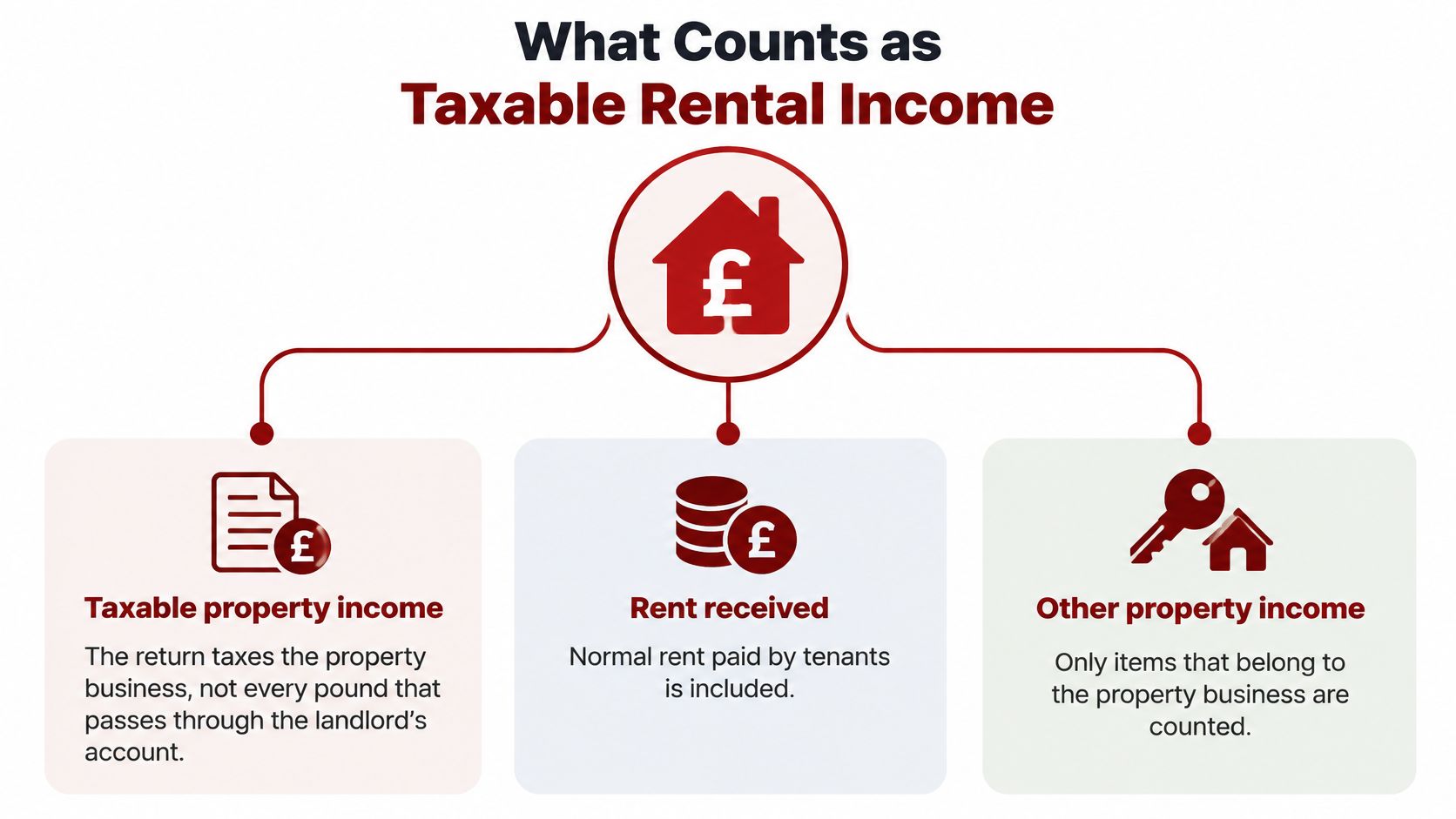
Your tax return is concerned with the property business, not every pound that happens to pass through your bank account. Think of your account as a busy inbox: rent, deposits, reimbursements and payments can all arrive there, but each receipt needs to be classified before you total taxable income.
| Receipt | Treatment | Action |
|---|---|---|
| Rent for a house, flat, room or parking | Taxable property income | Include in gross rent |
| Non-refundable deposit kept for damage | Taxable when kept | Include in gross rent |
| Refundable deposit still held for the tenant | Not income | Exclude |
| Tenant pays their own utility supplier directly | Not landlord income | Exclude |
| Lodger in your only or main home | Separate rent-a-room regime may apply | Check whether rent-a-room relief is appropriate |
| Jointly owned let | Report each owner's beneficial share | Include your share only |
| Rent received by a company | Corporation tax | Outside this individual return |
For example, if your tenant pays rent and separately pays their own electricity supplier, include the rent in your property receipts but leave the electricity payment out. A refundable deposit still held for the tenant isn't yours to report as rent. If you keep a deposit to cover damage, include it when it becomes non-refundable and is retained.
A landlord may also receive taxable property income from parking or storage, charges for furniture or services connected with the letting, or a non-refundable amount kept from a deposit. A room let in your home can involve a different treatment: rent-a-room relief may be available instead of ordinary property pages, so don't automatically treat a lodger as a standard separate rental. Joint owners report their beneficial share, while company rental income belongs outside an individual's return.
Start with a complete gross-receipts total
HMRC's Self Assessment figures show the scale of income declared through individual and other unincorporated landlords: 2.88 million unincorporated landlords declared rental income in the UK for 2024–25, and individuals declared £49.81 billion in property income, according to HMRC's property rental income statistics. The figures come from tax-return reporting, exclude incorporated companies, and don't cover every person whose property income didn't require Self Assessment. They reinforce why your gross receipts need to be accurate before you start deducting costs.
Make a list of rent received, rent paid on your behalf, parking or storage charges, relevant service or furniture charges, and deposits you kept. Don't include refundable deposits still held or utility bills a tenant pays directly to a supplier. That clean total is the starting point for the profit calculation.
Allowable Costs and Restricted Finance
A replacement boiler that restores heating to the property is normally a repair; an extension that adds a new room is capital. That distinction matters because revenue costs can reduce rental profit, while capital improvements aren't deducted from rent in the same way. Don't label every large invoice a repair just because it was paid to a builder.
| Cost | Tax treatment | Practical test |
|---|---|---|
| Letting agent and management fees | Allowable expense | Wholly for finding or managing the tenant |
| Landlord insurance | Allowable expense | Buildings, contents or rent guarantee for the let |
| Repairs and redecoration | Allowable expense | Restores the previous condition |
| Void council tax and utilities paid by landlord | Allowable expense | Cost falls on the landlord, not the tenant |
| Accountancy for the property figures | Allowable expense | Related to the rental business |
| Replacement of domestic items | Replacement relief | Like-for-like replacement in a dwelling, not the first purchase |
| Mortgage interest and finance costs | 20% tax reducer | Not a full deduction for most residential individuals |
| Extension, conversion or upgrade | Capital | Not deducted from rent; keep records for capital gains |
Claim revenue costs only when they're wholly and exclusively for the letting. Agent fees, landlord insurance, tenant advertising, qualifying repairs, and utilities you pay during a void can fit. If you use a phone or car for both personal and rental purposes, apportion the cost and leave out the private share. Costs for a property you also occupy need the same careful separation.
A repair restores the asset to its previous condition. A replacement washing machine can qualify for replacement relief when it replaces an item in a let dwelling, but the first purchase for an initial fit-out doesn't. A superior kitchen, new loft conversion or extension is an improvement, so keep the paperwork for future capital gains calculations rather than treating the invoice as an ordinary rental expense.
Don't deduct residential mortgage interest in full
For individual landlords letting residential property, mortgage interest and other finance costs generally don't come off rental profit in full. Instead, they may qualify for a basic-rate tax reducer of 20%, subject to the rules and the landlord's overall position. That means your taxable property profit can be higher than the cash left after paying the mortgage. Don't enter interest as an ordinary expense just because your lender's statement shows it as a cost.
The property allowance is an alternative to actual expenses, not an extra deduction on top. Compare the results and keep a record of the approach you use. This guide to allowable rental-income expenses can help you sort common costs, but the invoice and the work done still determine the treatment.
Use this three-part test for each item:
- Revenue: Was it wholly for the letting and did it maintain or restore the property?
- Capital: Did it improve or add to the property rather than restore it?
- Finance: Is it a residential finance cost that belongs in the restricted tax-reducer calculation?
How to Calculate Profit and Complete the Return
A worked example makes the distinction between rent, allowable costs and mortgage interest clear. In the 2024 tax year, the median gross rental income received by English private landlords was £19,200, according to the English Private Landlord Survey 2024. The example below uses that amount as a practical scale, not as a tax allowance or a prediction of what your property should earn.

Suppose one flat brings in £19,200 in rent during 2025–26, and the landlord keeps a £400 deposit to cover damage. The landlord pays £1,536 in agent fees, £350 for insurance, £900 for repairs and £400 to replace a washing machine in the let. Assuming the costs qualify, the calculation is:
| Line | Amount | Where it goes |
|---|---|---|
| Gross rent received | £19,200 | SA105, UK property income |
| Retained deposit for damage | £400 | SA105, property income |
| Letting agent fees | £1,536 | SA105, allowable property expenses |
| Landlord insurance | £350 | SA105, allowable property expenses |
| Repairs | £900 | SA105, allowable property expenses |
| Washing-machine replacement | £400 | SA105, replacement of domestic items |
| Allowable costs total | £3,186 | SA105, expense total |
| Property profit before finance | £16,414 | SA105, property profit |
| Mortgage interest paid | £6,000 | Not deducted in profit |
| Finance cost reducer at 20% | £1,200 | Finance-cost tax reducer, subject to the rules |
Keep profit and finance costs in separate sums
Add rent and the retained deposit to get gross property income of £19,600. Add the four qualifying costs to get £3,186. Subtract those costs from the gross income, leaving £16,414 property profit before finance. The £6,000 mortgage interest stays out of that profit calculation; 20% of it gives a potential £1,200 reducer, but the amount usable can be limited by the rules and your overall tax position.
For an unincorporated property business, the cash basis is generally the default unless you elect to use accruals. Check that your bookkeeping follows the basis you use and that each expense matches the evidence you keep. If your actual expenses are below the property allowance, compare the two methods before choosing. You can't claim both.
The individual rental figures go on the SA105 UK property pages, which form part of the SA100 Self Assessment return. Use SA106 for foreign property, and partnership pages if the letting is carried on through a partnership. A UK property business loss can generally be carried forward against later profits of that same business.
The online filing and balancing-payment deadline is 31 January after the tax year. If payments on account apply, a further payment is due on 31 July. A return filed after 31 January attracts an automatic £100 penalty. Keep four figures ready to support your return: gross rent, allowable costs, property profit and the finance-cost reducer.
The following video offers a further overview of rental income tax returns.
Holiday Lets and Other Property Cases
Don't carry an old furnished holiday letting tax treatment into a new return. The furnished holiday lettings regime ended on 5 April 2025. For 2025–26 and the return covering that tax year, income from a former holiday cottage follows the ordinary property rules. The old regime's special treatment doesn't continue for new periods: don't assume you can still claim its former full finance-cost deduction, capital allowances on furniture or capital gains reliefs.
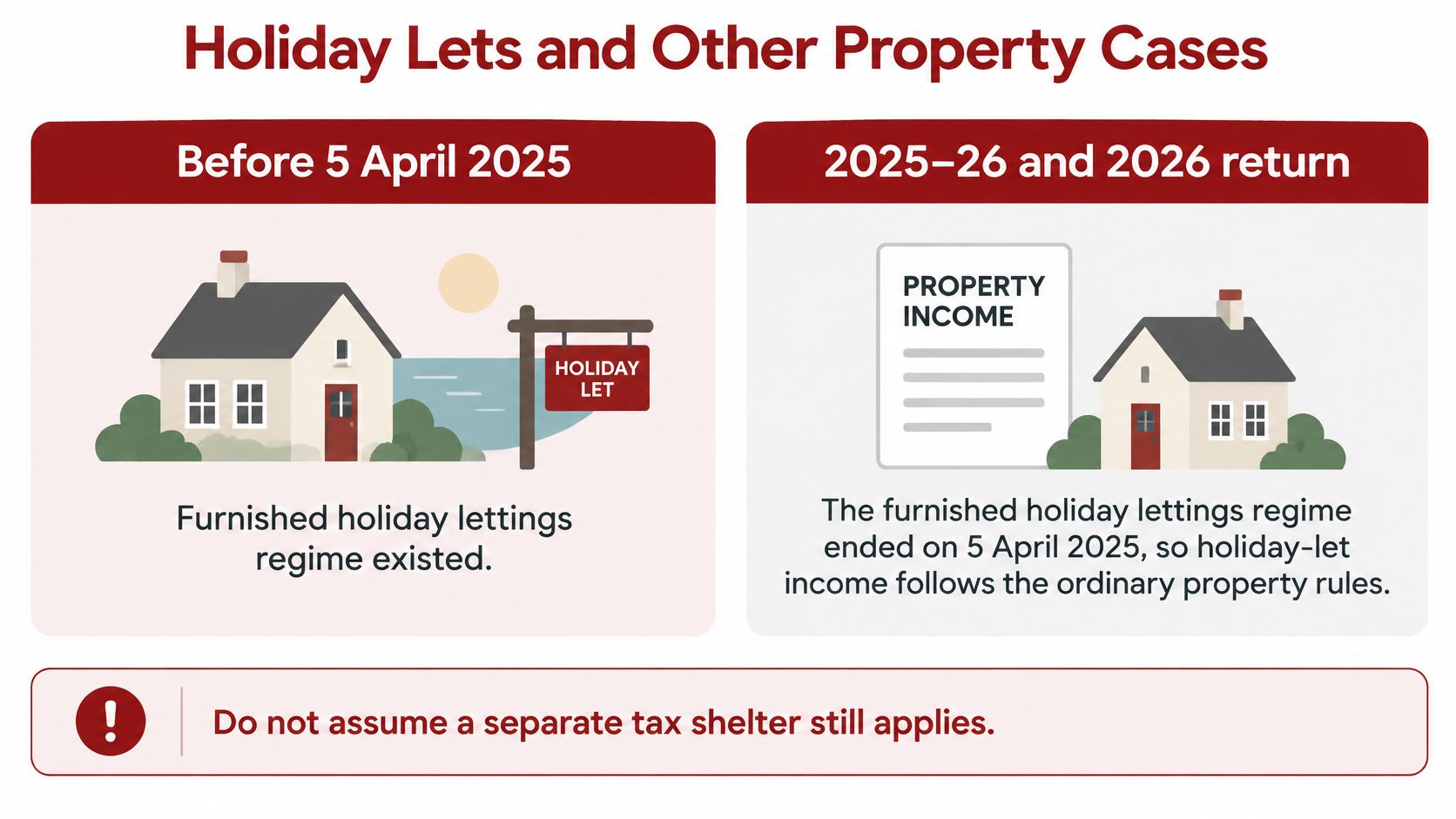
For a former holiday let treated as residential property, use the ordinary property-income approach. The residential finance-cost restriction applies, and replacement of domestic items may be relevant when qualifying items are replaced. A trading hotel or serviced-apartment operation can still be a trade rather than property income, but that classification depends on the services provided, not on the former holiday-let day-count tests. If your property used to qualify as a furnished holiday let, get advice before copying the prior-year treatment; this guide to furnished holiday let tax can help you identify the change.
Label the property before transferring last year's figures
A room in your only or main home may fall under rent-a-room relief rather than ordinary SA105 expense treatment. Non-resident landlords may have tax deducted under the non-resident landlord scheme unless HMRC approves payment without deduction, but they still need to report their profit. For joint owners, each person reports their own beneficial share.
Commercial property is different from residential property for finance costs: the residential restriction doesn't apply in the same way, so interest can remain deductible when calculating property profit. Don't copy the residential mortgage-interest treatment to a commercial let without checking its classification.
Before you start entering figures, label each property as residential, former holiday let now treated under ordinary property rules, rent-a-room, or commercial. That small classification step prevents last year's special treatment from following the property into a return where it no longer belongs.
Making Tax Digital Deadlines by Tax Year
Making Tax Digital hasn't already replaced the rental income tax return for every landlord. Quarterly updates are summaries of digital records, not four tax returns or four final tax calculations. The year-end submission remains where you bring together property results and the rest of the relevant tax information.
The threshold test looks at qualifying income, combining property and self-employment income. Don't test rent in isolation, and don't substitute taxable profit after expenses for the income measure HMRC uses. A landlord with both a business and a rental property needs to consider the combined qualifying income when deciding when the digital requirements apply.
The transition year is the point most easily missed. Even if you must start using Making Tax Digital for Income Tax from April 2026, you still submit your 2025–26 tax return through the existing Self Assessment system by 31 January 2027. HMRC sets out this transition in its guidance on preparing for Making Tax Digital.
Match each tax year to its reporting system
If your qualifying income was over £50,000 on your 2024–25 return, you must use compatible software, keep digital records and send quarterly updates from 6 April 2026. The threshold then applies to qualifying income over £30,000 for 2025–26, bringing those landlords into the requirements from 6 April 2027, and falls to over £20,000 for 2026–27. The timetable changes by year, so identify the return year and threshold before selecting your start date.
| Tax-year test | What it means for the landlord |
|---|---|
| Over £50,000 qualifying income in 2024–25 | Start digital records and quarterly updates from 6 April 2026 |
| Over £30,000 qualifying income in 2025–26 | Start from 6 April 2027 |
| Over £20,000 qualifying income in 2026–27 | The lower threshold applies for this tax year |
| 2025–26 tax return | File through existing Self Assessment by 31 January 2027 |
| 2026–27 onward, if qualifying | Use compatible commercial software for records, updates and final declaration |
From 2026–27, qualifying landlords won't be able to use HMRC's current online tax-return system or paper filing route for the final declaration. That changes how you report, not which rental expenses qualify. Your bookkeeping still needs to separate rent, agent fees, repairs, private use and finance costs correctly.
Start preparing with this checklist:
- Combine income: Add property and self-employment income to test the relevant threshold.
- Choose software: Select compatible software before you need to keep the records digitally.
- Set categories: Record rent, fees, repairs and private-use adjustments separately.
- Diarise updates: Put the quarterly update dates in your calendar once your start year is clear.
- Keep the annual deadline: Maintain a separate reminder for the year-end filing and payment deadline.
Choose to File Alone or Use an Accountant
A single residential let can be manageable as a self-file if you can reconcile tenant payments, agent statements, invoices and the SA105 totals without guesswork. The return becomes less straightforward when several properties, joint ownership, a former holiday let, non-residence or mixed business income enter the picture. Those are the situations where a review before filing can prevent a classification mistake or a missed digital-compliance trigger.
The difference in landlords' reported experience of filing is real but modest. In HMRC and Ipsos's 2025 UK landlords research, 62% of self-filing landlords said preparing the return was easy, compared with 68% of landlords who outsourced preparation of their tax information, according to the research executive summary. Don't hire an accountant just because a rental return sounds mysterious. Hire one when your facts make the figures hard to reconcile or the consequences of getting the treatment wrong are material.
If you can explain where every figure came from and why it belongs on SA105, self-filing may be a sensible choice. If you can't, get the calculation reviewed before submission.
Action Accountants Limited, based in Colindale and led by Georgie Zdrenghea, prepares property accounts and personal tax returns for landlords in North West London and across the UK. Whether you file alone or get help, gather your rent statements, mortgage interest certificate and repair invoices first. Then decide whether you can complete the SA105 confidently or should book a review before the applicable deadline.
Action Accountants Limited prepares rental accounts, landlord tax computations and Self Assessment returns, including support with property income, expenses and finance-cost treatment. Gather your rent statements, interest certificate and invoices, then visit Action Accountants Limited to discuss help with your rental income tax return and reporting calendar.