Redemption of Shares: UK Rules and Steps
Learn how redemption of shares works for a UK company: funding tests, Companies House filings, income or CGT treatment, and when a buyback is safer.
A founder in North West London wants an early investor off the cap table before the next round. The bank has the cash. Someone has already drafted a stock transfer form. That plan is wrong, and it will not redeem the shares.
Redemption of shares is the company paying the holder and cancelling shares that were issued as redeemable, at the company's option or the shareholder's option. It is not a sale to a friend, and it is not a dividend that leaves the holding standing. The shares come off the shelf. Issued share capital falls by their nominal value. Whether the shareholder is taxed like a seller or like a dividend recipient is a separate question, and the legal label on the board minute does not answer it.

Table of Contents
- Why a Company Redeems Shares at All
- What UK Law Requires Before Redemption
- Three Lawful Ways to Fund the Payment
- How a Private Company Completes a Redemption
- Income Tax or Capital Gains on the Proceeds
- Accounting Entries for a Redemption
- A Founder Exit That Fails on the Numbers
- When to Redeem and When to Choose Another Route
Why a Company Redeems Shares at All
Say that founder holds ordinary shares and the investor holds a small redeemable class written in at the seed round. The rights already name a date and a price. The founder assumes a bank payment plus a stock transfer form will tidy the register. It will not. A transfer moves the same shares to someone else. They stay in issue. A dividend sends cash and leaves the class standing. Neither honours a redemption right.
Think of a library. Selling a book to a friend leaves the book in circulation. Handing it back to the library takes it off the shelf. Redemption of shares works like the return. The company pays the holder and the shares disappear. The commercial point is to honour a date or price already written into the share rights, return money to a time-limited investor, or remove a class without hunting for a third-party buyer.
Three questions decide whether you can do it.
- Are these shares redeemable? The articles and the share rights have to say so.
- Where may the cash come from? A healthy bank balance is not a funding source.
- How is the shareholder taxed? Income treatment is the usual result, not a capital gain.
Read the articles and the share rights before anyone agrees a price. A number in an email is not a redemption right.
If the class was never issued as redeemable, stop. You are looking at a different transaction, not a late relabel of an ordinary holding.
What UK Law Requires Before Redemption
Treat the statute as a pass-or-stop test. Price talks come after the gates are open, not before.
Under Part 18, Chapter 3 of the Companies Act 2006, in force for these provisions from 1 October 2009, section 684 allows a limited company with share capital to issue shares that are redeemable at the company's option or the shareholder's option. The same provision replaced section 159(1) of the Companies Act 1985, so older articles can still use the old wording. Read them against the current Act, not against the memory of whoever drafted the subscription.
The gates directors actually fail
| Gate | What must be true | If it fails |
|---|---|---|
| Articles | Private company articles may exclude or restrict redeemable shares; a public company needs express authority | Redemption is blocked until the articles are changed |
| Non-redeemable capital | Some issued shares must remain non-redeemable | The company cannot be left with only redeemable shares |
| Fully paid | The shares must be fully paid before redemption | Unpaid amounts stop the redemption |
| Cancellation | Redeemed shares are cancelled and issued capital falls by nominal value | They are not transferred to another holder |
| Funding source | Distributable profits or a fresh issue; capital only by the private-company procedure | The wrong source can invalidate the payment |
| Registrar notice | Notice and a statement of capital within one month | The company and officers in default may be fined |
A private company's articles may exclude or restrict redeemable shares. A public company may issue them only where its articles authorise the issue. In either case the company must keep some issued shares that are not redeemable. You cannot redeem the last non-redeemable holding and leave a company made only of redeemable capital.
The shares must already be fully paid. An unpaid call, or a partly paid premium still outstanding, stops the redemption. Paying the holder and "sorting the unpaid amount later" is not a workaround.
Once redeemed, the shares are treated as cancelled. Issued share capital is reduced by their nominal value. They do not move to a nominee, the founder, or treasury as if this were a transfer. If your completion checklist still says "stock transfer form", you are running the wrong process.
Why the commercial price waits
The price in the term sheet is irrelevant until those gates are open. Directors should minute, in this order, that the articles permit the redemption, that a non-redeemable class will survive, and that the shares are fully paid. Only then is a funding source worth calculating.
If any gate is shut, change the articles or the cap table first. Do not pay and hope the paperwork catches up.
Three Lawful Ways to Fund the Payment
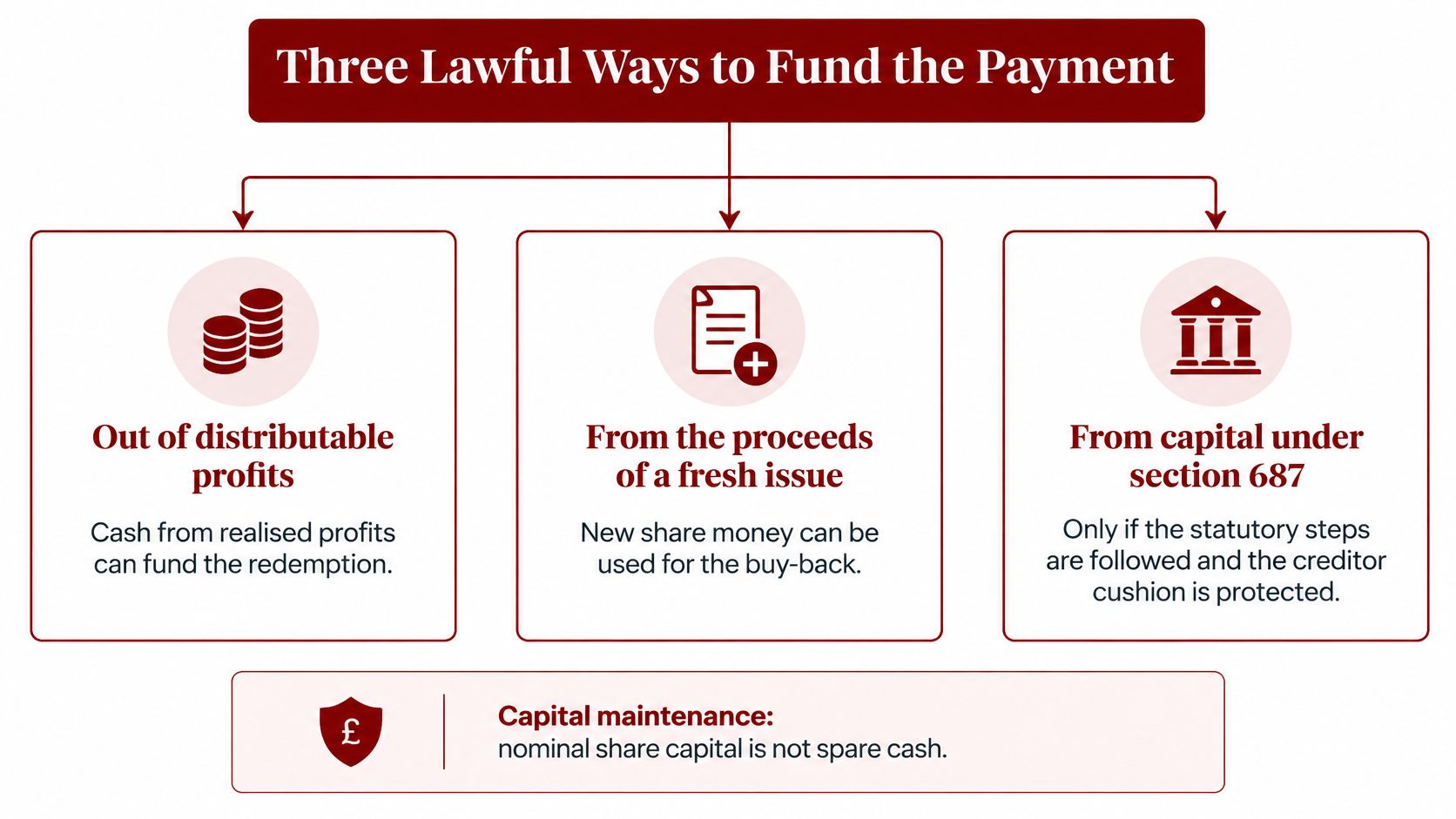
Nominal share capital is the creditor's cushion. It is not spare cash the directors can hand back because the bank looks healthy. Section 687 of the Companies Act 2006 allows a company to redeem redeemable shares only from distributable profits or the proceeds of a fresh share issue made for the redemption. A premium on redemption generally has to come from distributable profits as well. Fresh-issue proceeds may fund a premium only where the redeemed shares were originally issued at a premium.
Profits first
Distributable profits are not the cash in the account and not the profit on this month's management pack. Take the figure from relevant accounts. Accumulated losses come off. A company that has made money this year can still have nothing it may lawfully distribute if earlier losses have not been cleared.
Using profits preserves nominal share capital. That is the point of the rule. Creditors are meant to keep the cushion even while a shareholder is paid out.
A fresh issue next
A company with thin cash and willing investors can raise a fresh issue made for the redemption and apply those proceeds to the nominal amount. Some non-redeemable capital must remain, and the shares being redeemed must be fully paid.
Correct the common shortcut. A new issue does not automatically pay an investor's premium. If those redeemable shares were issued at par, the premium cannot come from the new money. It has to come from distributable profits, or from the private-company capital procedure. Minute which source covers the nominal amount and which source covers the premium before a penny leaves the account.
Capital only by the statute
A private company that still cannot cover the payment may use capital, but only through the statutory payment out of capital procedure, with the creditor-protection steps that go with it. It is not an informal substitute for a dividend, and it is not something you tidy after the bank transfer.
A company can look profitable and still be unable to redeem. If the reserves are not distributable and the capital procedure cannot be finished, stop. Paying from the current account because "the cash is there" is how a redemption gets challenged.
How a Private Company Completes a Redemption
A redemption can fail even after the board agrees the price. Follow the company-secretarial steps in order, and do not release the payment until the funding route and required approvals are in place.
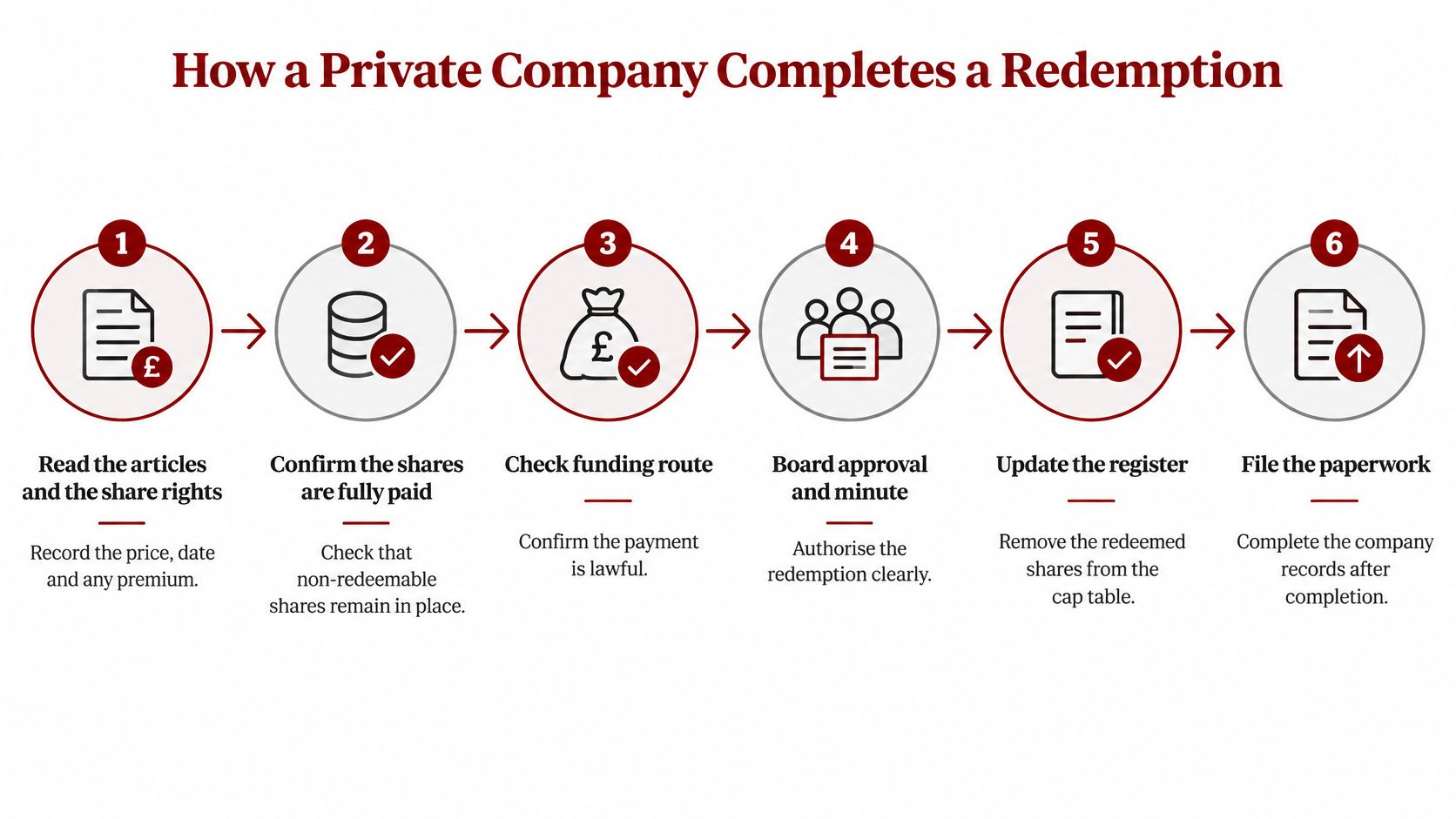
- Check the articles and share rights. Confirm that the shares are redeemable and record the price, payment date and any premium in the board papers.
- Confirm the shares are fully paid and that non-redeemable shares will remain in issue after the redemption.
- Set the funding route. Calculate distributable profits from the relevant accounts, or document the proceeds of a fresh issue made for the redemption. Record which source covers the nominal amount and any premium before money moves.
- Use the capital procedure only if other permitted sources are insufficient. For a private company, Part 18 of the Companies Act 2006 requires a directors' statement and an auditor's report, shareholder approval by special resolution, a notice of the proposed payment in the Gazette, and both documents to be available for inspection. Pass the special resolution on, or within the week immediately following, the directors' statement. Publish the Gazette notice within the week following the resolution.
- Complete the redemption. Hold the board meeting, pay the holder and cancel the shares. Cancellation completes the redemption; it is not a stock transfer.
- File within one month. Submit the notice identifying the shares redeemed with a statement of capital. The statement must show the total number of shares and their aggregate nominal value, the number and aggregate nominal value of each class, and the amount paid up or unpaid on each share, including amounts relating to nominal value or premium.
- Update the statutory records. Amend the register of members, cancel the share certificates and align the company's books with its new share capital.
What the solvency statement has to use
Base the directors' solvency assessment on current management accounts, cash movements since the last balance sheet, committed liabilities, tax and downside cases. Last year's statutory accounts alone do not show the company's current position.
Prepare the directors' statement, auditor's report and inspection copies before circulating the special resolution. The deadlines are short, and publishing the Gazette notice late does not fix the missed timetable.
Diarise the filing deadline when payment is made. If the notice is late, the company and every officer in default may commit an offence. Use a company secretarial duties checklist to keep the register and statement of capital updates alongside the filing.
Tax treatment comes from tax legislation, not company law. Before paying, assess whether the proceeds will be treated as a distribution, often taxable as income, or as a capital receipt. The board minute cannot determine that tax outcome.
Income Tax or Capital Gains on the Proceeds
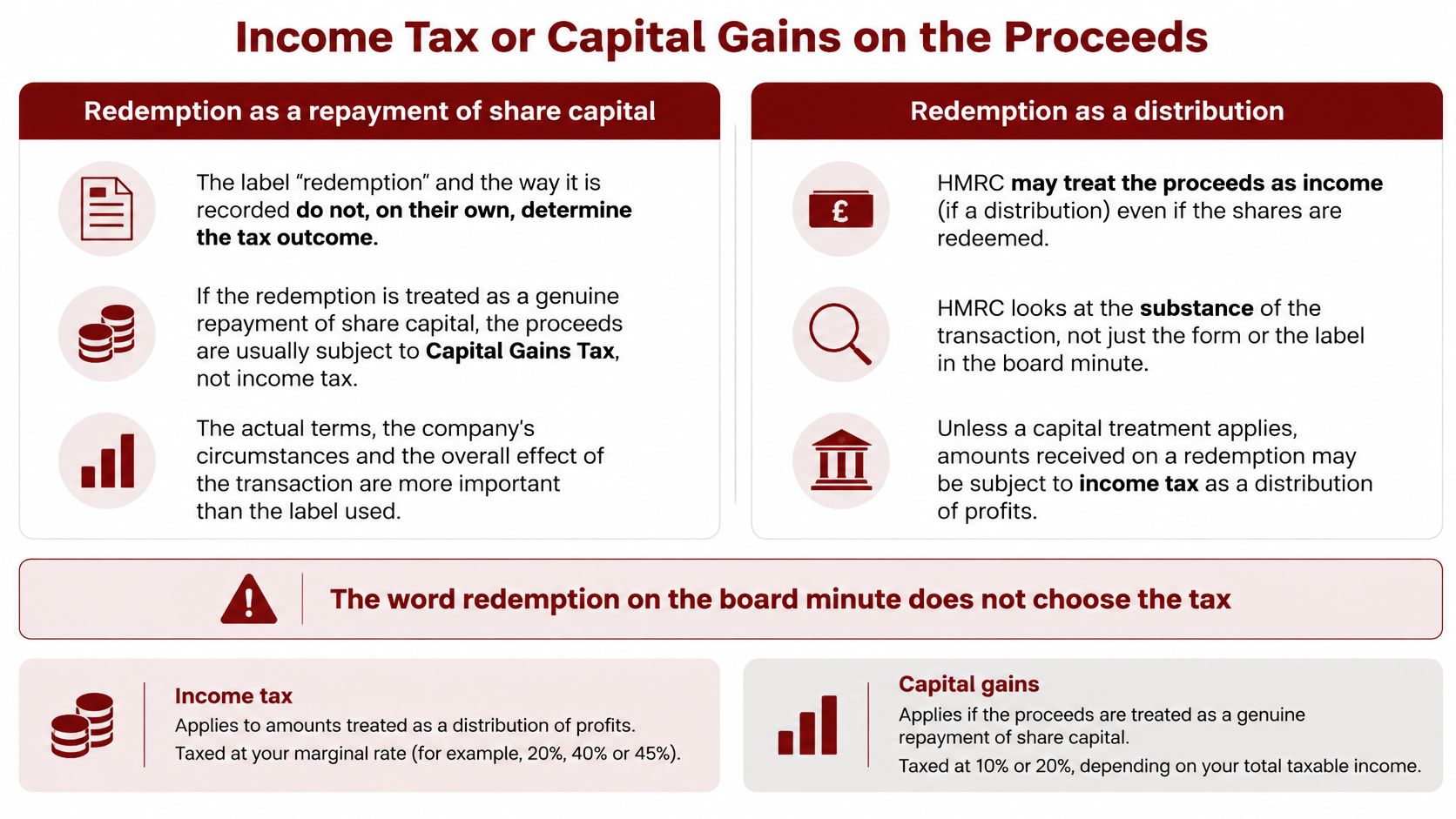
A company can have enough cash to redeem shares and still leave the shareholder with an income-tax bill. Redemption is not a transfer, and the label in the board minute does not decide the tax. HMRC treats redemption as a repayment of share capital, distinct from a purchase of the company's own shares. The payment is normally a distribution. Only limited cases avoid that treatment, so test the capital and income split with an adviser before payment.
What actually decides the bill
Price the redemption on the assumption that the payment may be taxed as income. Business Asset Disposal Relief is not automatic just because a shareholder exits. A premium may fall within the distribution rules, while a return of capital may receive capital treatment in limited cases.
The facts to examine are specific:
- Company status: Is the company an unquoted trading company, or has its trading status changed?
- The holder: Is the shareholder leaving, or will they remain connected to the company?
- The price: How much is a return of capital, and how much is premium?
- The funding: Is the payment funded from profits, a fresh issue or a capital procedure? The source affects the analysis, not just the accounting entry.
The unquoted trading company conditions relate to the off-market purchase of a company's own shares. They are not a general exception for redemptions. An off-market purchase may qualify for capital treatment if its conditions are met, including the shareholder leaving and not remaining connected. Test the treatment of a proposed redemption with HMRC or a tax adviser before agreeing the payment.
Three routes, three usual results
| Route | Usual tax result | What can change it |
|---|---|---|
| Redemption of redeemable shares | Normally a distribution, which may be taxed as income | Limited cases where the payment is treated as a capital distribution |
| Off-market purchase of own shares | Income unless the purchase-of-own-shares conditions are met | The unquoted trading company conditions and the shareholder's departure and connection status |
| Dividend while shares stay in issue | Income, with no disposal of the shares | It does not provide capital gains treatment |
If the shareholder is pricing the cheque as a capital gain, show them the possible income-tax result before agreeing the amount.
Model both outcomes in the business tax planning papers alongside the board minute. Where the split between capital and income is unclear, get advice on the tax treatment before payment. Tax support from Wisely can help assess that question.
Accounting Entries for a Redemption
Take a private company redeeming 30 shares of £1. The nominal capital cancelled is £30. Keep the capital and profit entries separate.
- Called-up share capital: Debit £30, the nominal value of the redeemed shares, to reduce issued share capital. Remove the shares from the register. The company does not show them as shares it holds.
- Capital redemption reserve: Where distributable profits fund the nominal value, transfer £30 to the capital redemption reserve. Keep this reserve as paid-up share capital for reduction purposes. Reduce it to the extent a fresh issue replaces the capital.
- The premium: Debit the premium to distributable reserves on the redemption date. Use the share premium account only where the limited rule for shares originally issued at a premium applies. A premium on shares issued at par does not belong in that account.
- Cash: Credit the bank account for the amount paid. The cash payment and the reserve movement are different figures when the redemption includes a premium.
- Consistent figures: The solvency statement, management accounts and ledger must use the same figures. Confirm the reserve movements before payment, not when preparing the year-end accounts.
Check the journal logic against the principles of double-entry bookkeeping before authorising payment. A journal posted to the wrong reserve leaves the accounting records wrong even after the shareholder has been paid.
A Founder Exit That Fails on the Numbers
A private trading company has 100 ordinary £1 shares. The founder holds 70, and an investor holds 30 redeemable £1 shares issued at par. The agreed redemption price is £50,000: £30 for nominal capital and £49,970 as a premium. The company has £20,000 in distributable profits and £55,000 in the bank.
The bank balance is not enough to make the payment lawful. Distributable profits fall £29,970 short of the premium. Because the investor's shares were issued at par, a fresh issue cannot fund that premium. The company must wait until distributable profits cover £49,970 or use the private-company payment out of capital procedure, including a solvency statement, auditor's report, special resolution and Gazette notice.
Tax can change the investor's expected return. Redemption is not a transfer and is not automatically a capital gain. HMRC usually treats the payment as a distribution, so the investor may face dividend tax rates rather than capital gains tax and Business Asset Disposal Relief.
The same deal, other ways it breaks
- Articles: If they do not authorise redeemable shares, the investor's shares may be ordinary shares in substance.
- Paperwork: Recording the holding as transferred instead of cancelled misstates what happened.
- Solvency: A statement copied from last year's statutory accounts may not reflect the company's position when it is made.
- Filing: Miss the one-month statement-of-capital deadline, and the issued capital remains recorded at £100.
Once the redemption is completed lawfully and the shares are cancelled, the cap table changes as follows:
| Item | Before | After |
|---|---|---|
| Issued shares | 100 | 70 |
| Issued share capital at nominal value | £100 | £70 |
| Founder ordinary shares | 70 | 70 |
| Investor redeemable shares | 30 | 0 |
| Distributable profits | £20,000 | £20,000 where the premium is met from capital, not reserves |
Update the register when the 30 shares are cancelled. Issued capital falls by £30, the shares' nominal value, not by the £50,000 payment.
When to Redeem and When to Choose Another Route
A redemption fits when the shares were issued as redeemable, the articles permit it, the shares are fully paid and non-redeemable capital will remain. The funding must also be lawful: distributable profits can cover the nominal amount and any premium. A fresh issue can cover the nominal amount, and a premium only if the redeemable shares were originally issued at a premium. Any remaining shortfall needs the statutory capital procedure.
Do not redeem ordinary shares that have no redemption right. Use the purchase-of-own-shares route instead, with its own approvals and a separate tax analysis if capital treatment is sought.
Choose a capital reduction when the company needs to reduce its capital and has no redeemable class to cancel. A dividend suits a holder who is staying and accepts income treatment, because the shares remain in issue. If the proposed payment has no lawful funding route, stop. A healthy bank balance does not make the payment lawful, and paperwork cannot fix an improper payment afterwards.
If the founder is considering a whole-company sale instead of cancelling a share class, compare post-acquisition exit strategies before agreeing a redemption price. A business exit plan should test the articles, cap table and latest accounts before any payment is promised.
Verdict: redeem a genuine redeemable class only when the company can fund it lawfully. Use the purchase-of-own-shares route for ordinary shares. Reduce capital when there is no redeemable class, and pay a dividend only if the holder is staying and accepts the income-tax treatment.
Action Accountants Limited, based in Colindale, can assess distributable profits, model whether the holder is likely to face income tax or capital gains tax, and prepare the company-secretarial filings for a redemption. If you are an owner-manager in North West London or elsewhere in the UK, bring the articles, cap table and latest accounts before promising a payment. Visit Action Accountants Limited to discuss the funding route and tax outcome before money leaves the company.