Tax for Freelancers: What You Owe in 2026
Clear tax for freelancers guide for 2026: rates, Class 4 NIC, allowable expenses, VAT, MTD from April 2026 and payment dates.

HM Revenue & Customs estimated that 7.02 million UK individuals with self-employed sole-trader businesses or landlord businesses were in Income Tax Self Assessment in the 2023-2024 tax year, according to HMRC's Making Tax Digital for Income Tax business population statistics. That scale is exactly why tax for freelancers can't be reduced to one rate. Your bill turns on profit, your entry into Making Tax Digital turns on gross qualifying income, and your January cash shock turns on last year's liability. Treat those as three different numbers, ring-fence cash as you earn it, and you'll avoid the trap that catches lumpy and side-hustle earners every year.
Table of Contents
- Freelance Profit and Allowable Expenses
- Income Tax and National Insurance Rates for 2026
- How to Register and File Self Assessment
- VAT MTD and the Dates You Must Pay
- Contractors Side Hustles and CIS in Practice
- File Yourself or Hand the Return Over
Freelance Profit and Allowable Expenses
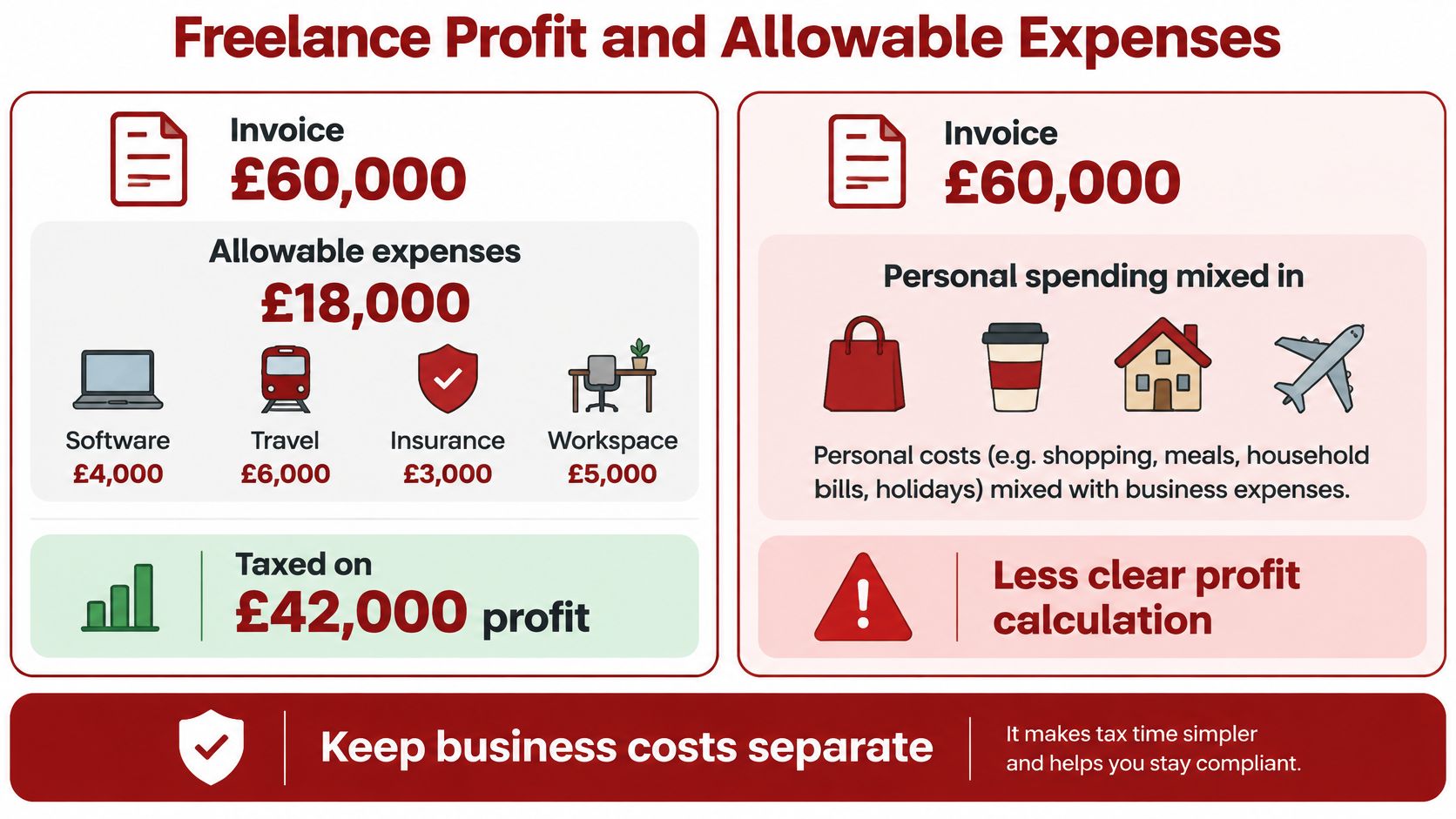
Two illustrators each invoice £60,000 in a year. The first records £18,000 of software, client travel, insurance and workspace costs, so she pays tax on £42,000 of profit. The second mixes everything through one personal account, cannot evidence what is business and what is private, and pays tax on almost the full £60,000. Same turnover, very different bills. HMRC taxes what is left, not what you invoice.
That leftover figure is business income minus allowable expenses. Sole trader freelancers calculate taxable trading profit through Self Assessment on that basis. Cut the profit figure correctly and you cut everything that follows from it. Inflate profit through weak records and you overpay every year.
The visual below shows why separating business costs from personal spending matters before any rate is applied.
Start With the £1,000 Trading Allowance or Actual Costs
Compare the £1,000 trading allowance against real costs and claim whichever is larger. Never stack both. The allowance wins for low cost work, perhaps writing from home on a laptop already owned. Actual costs win fast once software, insurance, travel or workspace enter the picture. Run both numbers once a year. Pick the better one.
Weak records hit twice. HMRC's self-employed National Insurance guidance confirms taxable trading profit drives both Income Tax and self-employed National Insurance. Every valid £1 of deductible cost lowers the profit exposed to both charges. A shoebox of receipts is not admin. It is cash kept.
What Counts as Wholly and Exclusively for the Trade
Claim costs that are wholly and exclusively for the work. For a typical freelance practice that means:
- Software and subscriptions: Accounting packages, design tools, project software and the business share of cloud storage.
- Insurance: Professional indemnity and public liability cover bought for the trade.
- Professional fees: Accountancy fees and relevant professional body subscriptions.
- Marketing: A dedicated website, hosting and advertising that promotes the business.
- People and supplies: Subcontractors paid to deliver client work, stationery and postage.
- Business bank charges: Fees on a business account used for trading.
- Training that updates a skill: A course that refreshes knowledge already sold, not one that qualifies for a new trade.
For a fuller walkthrough of category-by-category claims, the guide to tax deductible expenses for the self-employed sets out how those categories apply to sole traders. Keep it open for the quarterly tidy up. January guessing is where claims die.
Travel, Mileage and Working From Home
Client travel is allowable. An ordinary commute to a regular base stays private, whatever label is put on it. For cars and vans under simplified expenses, claim 45p a mile for the first 10,000 business miles and 25p after that. Log date, destination and business reason for each trip at the time. Contemporaneous notes beat reconstructed spreadsheets.
Home working follows the same logic. Use flat rates of £10 a month at 25 to 50 hours, £18 at 51 to 100 hours and £26 at 101 hours or more, or claim a fair share of actual heat, light and broadband. Choose one method. Document the basis. Apply it consistently. HMRC rewards a reasonable claim, not a creative one.
Tools that capture receipts and categorise spending through the year cut this to minutes a week, and first time buyers can compare options among AI2Fin tools for freelancers. Whatever is chosen, keep business and personal spending on separate feeds from day one.
What Stays Private
Some costs never qualify. Client entertaining, fines and penalties, personal drawings, and ordinary clothing stay private. Mixed use items need apportionment. A phone used half for clients is a 50 percent claim. Mark that percentage on the record before the quarter ends.
Under the cash basis, most equipment other than cars is deducted when paid for, which suits smaller trades. Keep invoice, receipt and a one line reason for every claim. If a cost cannot be explained in one line, it cannot be defended.
Income Tax and National Insurance Rates for 2026
Use this table first. These 2026-27 figures are for England, Wales and Northern Ireland. Scotland sets its own Income Tax rates on non-savings income, while Class 4 National Insurance stays UK-wide, so a Scottish freelancer reads the Income Tax rows differently and the National Insurance rows exactly the same.
| Charge | Band or trigger | Rate or treatment | Practical effect |
|---|---|---|---|
| Personal allowance | Taxable income up to £12,570 | 0% | No Income Tax if the allowance is not tapered |
| Allowance taper | Income above £100,000 | £1 of allowance lost per £2 | Allowance fully gone at £125,140 |
| Basic rate | Next £37,700, up to £50,270 total income | 20% | Usual rate on freelance profit after the allowance |
| Higher rate | Income above £50,270 up to £125,140 | 40% | Starts once total income passes £50,270 |
| Additional rate | Income above £125,140 | 45% | Personal allowance fully withdrawn |
| Class 4 National Insurance | Profits £12,570 to £50,270 | 6% | Charged as well as Income Tax |
| Class 4 upper rate | Profits above £50,270 | 2% | Still due after higher-rate tax begins |
| Class 2 National Insurance | Profits of £7,105 or more | Treated as paid | Protects the National Insurance record at no extra bill |
| Voluntary Class 2 | Profits below £7,105 | £3.65 a week | Optional if the reader wants pension credits |
| Small profits | Profits below £7,105 | No Class 4 | No compulsory National Insurance on that profit |
HM Revenue & Customs states that, for the 2026-27 tax year, self-employed people with profits above £12,570 pay Class 4 National Insurance at 6% on profits from £12,570 to £50,270 and 2% on profits above £50,270, in HMRC's National Insurance guidance on how much you pay. The same guidance lists optional Class 2 contributions at £3.65 per week. National Insurance isn't included inside Income Tax. It's a second calculation on the same profit, collected through Self Assessment.
The £40,000 Profit Test
Run one worked example and the layering becomes obvious. On £40,000 of taxable profit, Class 4 is about £1,645.80, because (£40,000 minus £12,570) times 6 percent equals £1,645.80. Income Tax on the same slice above the allowance, at 20 percent, is roughly £5,486. Add them together before you decide what you can afford to draw, because HMRC certainly will.
Every valid pound of expense cuts both Income Tax and Class 4. A £1,000 cost you've evidenced properly is worth more than £1,000 of turnover you haven't.
Below the main bands, profits under £7,105 don't require Class 4, and Class 2 is treated as paid once profits reach £7,105, which protects your National Insurance record without a separate bill. If your profits fall below that line, voluntary Class 2 at £3.65 a week is cheap insurance for your state pension record. Don't skip it by accident. Check your record and decide deliberately.
Read the Combined Marginal Rate, Not the Headline
Find the row your profit lands in and add the two charges together. A basic-rate freelancer between £12,570 and £50,270 of profit faces 20 percent Income Tax plus 6 percent Class 4, a combined 26 percent on the next pound of profit. Above £50,270 it becomes 40 percent plus 2 percent. That's the number to use when you price work and set cash aside.
One last trap sits outside the table. Once your bill is large enough, HMRC asks for advance instalments towards next year, and the mechanics of payments on account explain why your second January can feel far heavier than your first. Match your profit to a row, note the combined marginal hit, and reserve accordingly.
How to Register and File Self Assessment
Registration isn't complicated, but it's unforgiving about order and timing. Follow the path in sequence and you'll never pay a penalty for a step you didn't know existed.
The flow below summarises the route from first trade to paid bill.
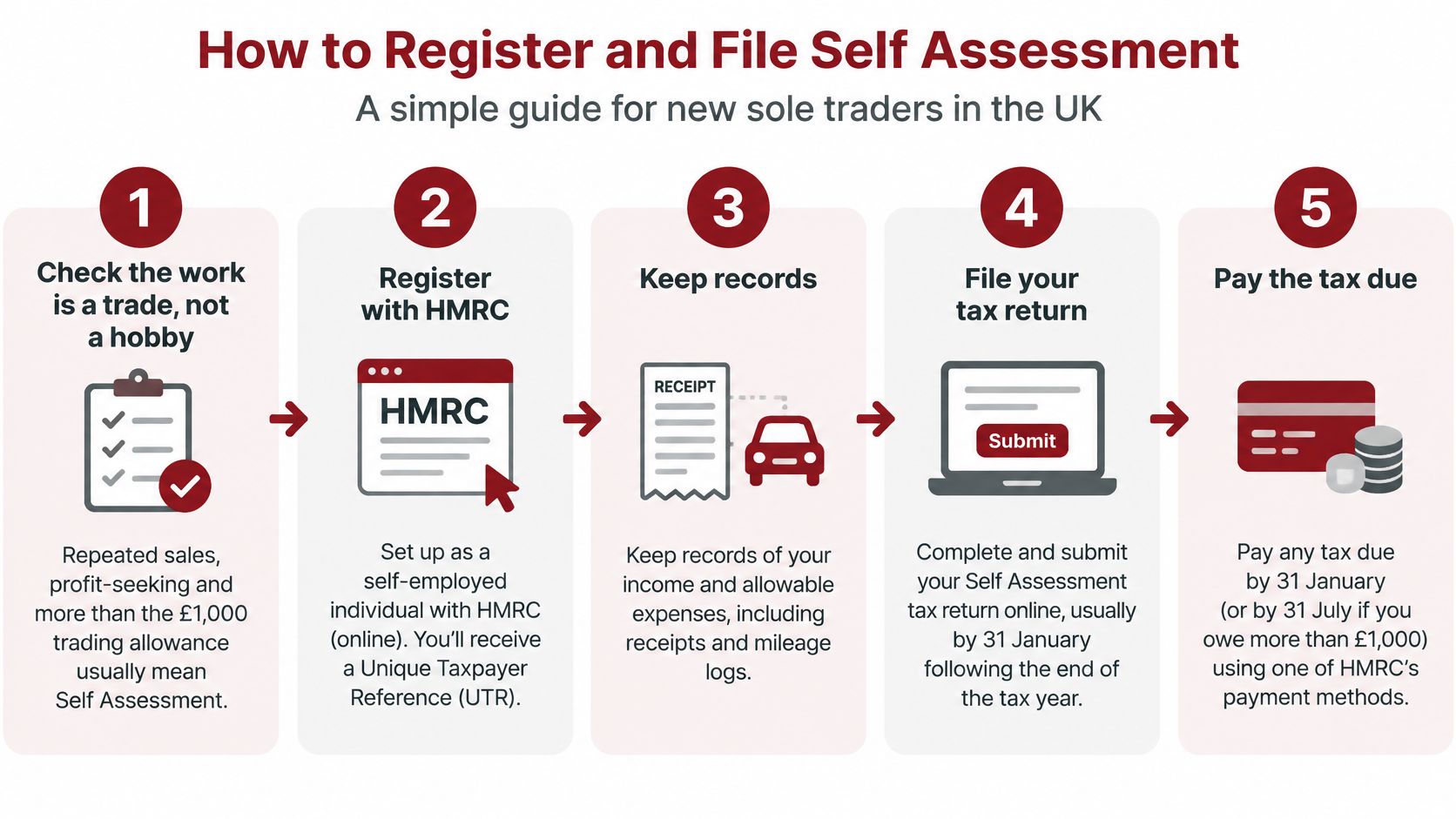
- Check you're trading, not hobbying. Repeated sales, a profit-seeking motive and income above the £1,000 trading allowance usually mean Self Assessment. Occasional clear-outs of your own possessions don't.
- Register for Self Assessment and National Insurance. Register as self-employed for Class 2 and Class 4 by 5 October after the end of the tax year you started. Miss it and you risk a failure-to-notify penalty even if your eventual profit is modest.
- Get your Unique Taxpayer Reference. HMRC posts your UTR and an activation code for your online account. Register early, because you can't file until the account is active, and post doesn't care about your deadlines.
- Choose your accounting basis. The cash basis is now the default for many sole traders and suits simple trades. Opt into traditional accounting if you carry stock, want to use losses more flexibly, or expect to incorporate soon.
- Keep digital records through the year. Log income, expenses and private-use splits as they happen. Rebuilding twelve months from bank statements in January is how allowable costs get lost.
- Complete the right pages of the return. Add employment pages for a PAYE job, self-employment pages for your freelance profit, and property or dividend pages where they apply. One return carries everything, so nothing hides from the personal allowance calculation.
- File online by 31 January after the tax year ends. A paper return is due earlier, by 31 October, which is one more reason to file online.
- Pay the balancing payment by the same 31 January. Filing and paying are separate duties with separate consequences, and the second-year bill can include advance instalments on top of what you owe for the year just filed.
If you'd rather watch the filing sequence than read it, the walkthrough below runs through the online process step by step.
Diarise two dates and guard them. 5 October in your first year gets you registered, and 31 January every year after that gets you filed and paid. Set both reminders today, while you're thinking about it, not when a penalty letter lands.
VAT MTD and the Dates You Must Pay
Profit decides your bill. Gross income decides your MTD duties. Taxable turnover decides VAT. Confuse those three and you will either register late or face a January payment you never ring-fenced.
| Obligation | What triggers it | When it bites | What is due |
|---|---|---|---|
| Self Assessment registration | Trading in a tax year | 5 October after that tax year | Register for Self Assessment and National Insurance |
| Online tax return | A Self Assessment record | 31 January after the tax year | File the return |
| Balancing payment | Income Tax and Class 4 still owed | 31 January after the tax year | Pay the balance |
| First payment on account | Last year's bill over £1,000 and under 80% collected at source | 31 January with the balancing payment | Half of last year's bill |
| Second payment on account | Same payment-on-account test | 31 July | The other half of last year's bill |
| MTD for Income Tax phase 1 | Qualifying income over £50,000 | From 6 April 2026 | Software, digital records and quarterly updates |
| MTD later phases | Lower qualifying income bands | Later phases for lower income levels | Same digital duties |
| VAT registration | Taxable turnover over £90,000 in a rolling 12 months | Within 30 days after the month the threshold is crossed | Register and then charge VAT |
The calendar view below puts those VAT milestones in the order you'll meet them.
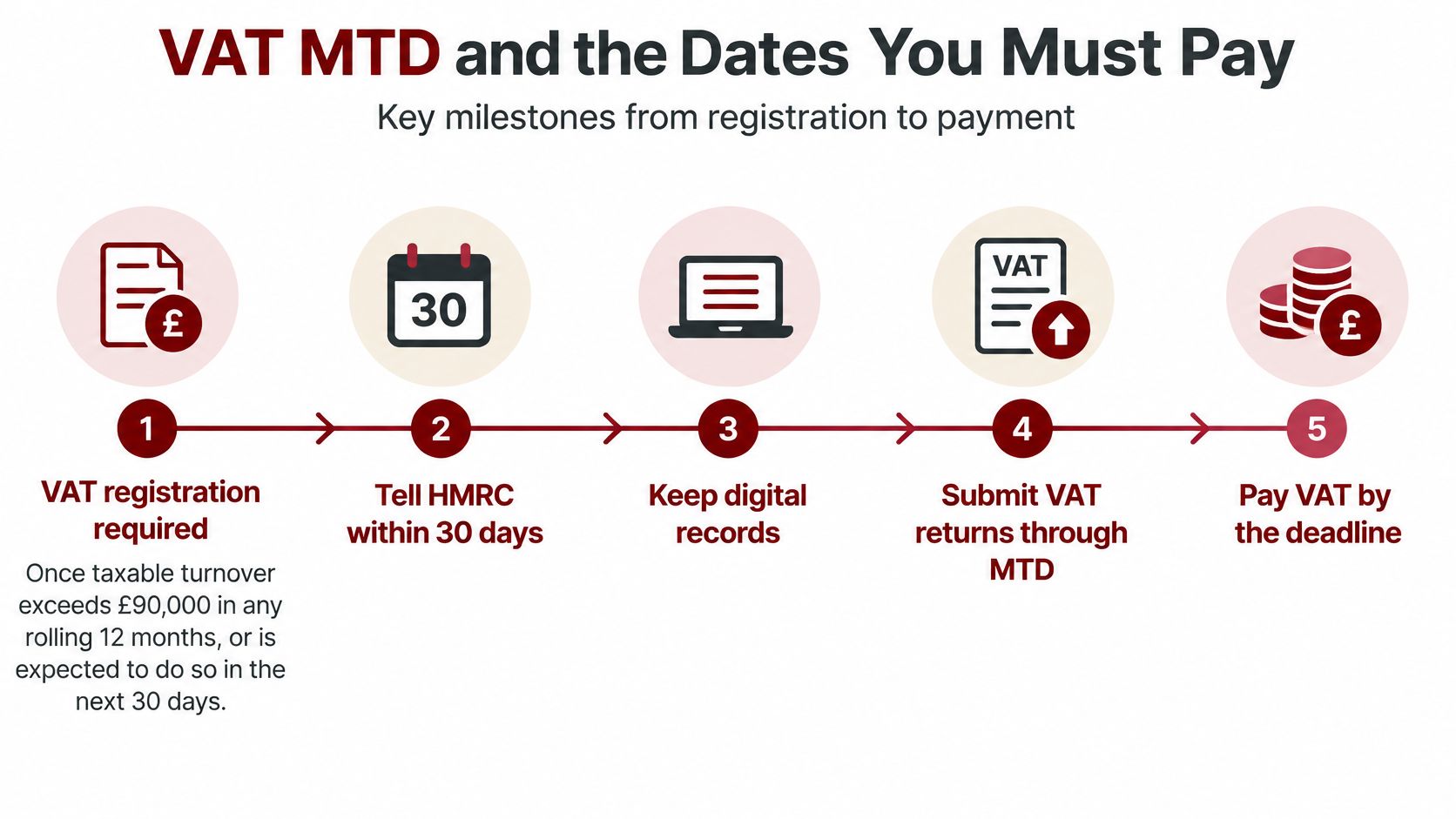
VAT Runs on Rolling Turnover, Not the Tax Year
You must register for VAT once taxable turnover exceeds £90,000 in any rolling 12 months, or when you expect it to do so in the next 30 days, and tell HMRC within 30 days of the end of the month you cross the line. Standard-rated work is usually charged at 20 percent. Check your rolling total monthly, because the test never resets in April. Flat-rate and cash-accounting schemes can smooth the admin, but they change when you pay and what you reclaim, so choose deliberately.
MTD Runs on Gross Income, Not Profit
HMRC confirms that taxpayers with qualifying income above £50,000 must use Making Tax Digital for Income Tax from 6 April 2026, with lower income bands brought in through later phases, in HMRC's guidance on using Making Tax Digital for Income Tax for the first time. A freelancer with £55,000 of gross takings and £35,000 of profit falls in the first wave despite the modest profit.
That distinction matters for cash. Compatible software, digital records, quarterly updates and a year-end declaration replace the once-a-year file, but the payment deadline stays 31 January. Side-hustle earners and lumpy billers should treat MTD as an admin trigger and profit as the funding trigger. Put a fixed share of every invoice into a separate pot. Do not wait for a single rate to tell you what you owe.
Payments on Account Create the January Shock
When last year's Self Assessment bill was over £1,000 and less than 80 percent was collected at source, HMRC collects two advance instalments, each half of that prior bill, on 31 January and 31 July. Your second January therefore demands the balancing payment for the year just ended plus the first instalment for the new one.
That is where freelancers get hurt. One good year sets next January's instalment. A quieter year still leaves the instalment due unless you act. If profits have fallen, claim to reduce the instalments rather than overpaying and waiting for an offset. For a broader look at payment methods and deadlines, the FaxZen guide to paying taxes covers the practical routes for settling a bill. Match your turnover to the VAT test, match your gross income to MTD, then fund the profit tax monthly.
Contractors Side Hustles and CIS in Practice
Contractor income arrives in three different ways. Taxed at source, deducted in advance, or layered on top of a salary. Each route changes what you keep, what you file, and which single document proves the position if HMRC asks.

Inside IR35, the Client Taxes You First
A consultant takes a long contract with a large firm. The client decides the contract sits inside IR35 and operates PAYE on the deemed employment income. She does not also declare the same fee as sole trader profit.
The rule flips with a small private sector client. The status decision generally stays with the freelancer. Get the status determination statement before work starts and file it with the contract. That one page settles the argument.
Contractors juggling status decisions alongside ordinary sole trader work often benefit from specialist support, and a contractor accountant in London can review determinations before a wrong call hardens into a year of wrong tax treatment. Challenge a determination you dispute at the time. Year end is too late.
Under CIS, Deductions Are a Prepayment, Not the Bill
A joiner subcontracts on site under the Construction Industry Scheme. Registered, he suffers 20 percent deducted at source. Unregistered, the deduction is 30 percent. With gross payment status, nothing is deducted.
None of those deductions is the final tax. CIS deductions sit as a credit on the Self Assessment calculation against the actual liability on profit. That is why missing monthly CIS statements hurt. Without them, the return understates the credit, and he looks overtaxed and penalised at once. Chase every CIS deduction statement from every contractor, every month, while the contractor still answers the phone. Gross income may trigger Making Tax Digital; profit sets the bill.
A Side Hustle Beside a Salary Is Taxed on the Total
HMRC's creator guidance confirms that side hustle income may be taxable when total income, including employment income, exceeds the £12,570 personal allowance, as set out in HMRC's tax rules for content creators. Once salary has used the personal allowance, freelance profit above the £1,000 trading allowance is taxable from the first pound. A small freelance slice is still taxable.
PAYE already taken on the salary gets credited on the return. It does not automatically cover the freelance profit. Overseas platform payouts count as income when the work is taxable here, wherever the platform sits.
Cash received is not the tax bill. Profit sets the bill, last year's liability sets the advance instalments, and your bank balance has to satisfy both.
Use a blunt reserve rule for volatile months. After expenses, set aside the marginal Income Tax and Class 4 the rate table implies for your band. Then add a buffer in year two for payments on account, because the January demand will combine the balancing payment with half of last year's bill again. Her one document is a simple monthly profit estimate, updated as invoices land. Ring fence the money in a separate account. Never borrow from it in a quiet month.
File Yourself or Hand the Return Over
Filing alone is reasonable when your affairs are simple. One trade, a handful of expense categories, no VAT registration, no CIS deductions to offset, and no advance instalments to forecast, and the online return is a manageable evening's work. If that description fits, file it yourself and spend the fee elsewhere.
Hand it over when the picture mixes. A salary alongside freelance profit, a limited company, construction deductions, rental income, or quarterly Making Tax Digital updates from April 2026 each add a place to get it wrong, and they compound. If you're weighing up help, the criteria for how to choose an accountant will sharpen the questions worth asking. The cost of a wrong status call or a year of missed expenses is usually larger than a straightforward return fee.
We price that choice plainly. A basic Self Assessment tax return is £250 plus VAT a year, and our sole trader, partnership and MTD starter package is from £42 plus VAT a month, covering quarterly MTD updates, year-end accounts, the Self Assessment return, an annual meeting and ad-hoc advice. Fees are quoted for your circumstances rather than landed as a surprise, and we complete the return, calculate the liability, file it and deal with HM Revenue and Customs on your behalf.
Gather last year's return, a current profit estimate and any CIS or PAYE statements, then make the call. Book before 5 October if you're registering for the first time, or well before 31 January if you're already in the system. Tax for freelancers rewards the organised and punishes the last-minute, and the fix is almost always starting earlier than feels necessary.
If your freelance profit, VAT position or Making Tax Digital duties have outgrown a spreadsheet, Action Accountants Limited prepares and files sole-trader and personal tax returns, handles VAT and CIS offsets, and liaises with HMRC so deadlines stop running your cash flow. Bring us last year's return and a current profit estimate, and we'll quote plainly for the work before your next 31 January arrives.