Annual Company Reports: A UK Filing Guide for SMEs
Annual company reports explained for North West London SMEs: filing deadlines, a preparation checklist and the mistakes that trigger late penalties.
Most UK limited companies must file annual accounts with Companies House within nine months of their accounting reference date, and a Corporation Tax return with HMRC within 12 months of the period end. The table below puts each date beside the mistake that most often causes a miss.
A tidy internal pack is not the same thing as a filing that has been accepted. Annual company reports sit on a public register that credit teams, suppliers and investors open without asking you first. I would lock the dates this week, then test whether the numbers tell one story, before anyone signs.
Table of Contents
- Which Annual Filings Are Due and When
- What an Annual Company Report Contains and Who Reads It
- How to Prepare Your Annual Accounts Step by Step
- Testing Whether Your Numbers Tell a Consistent Story
- Late Filing Penalties and What They Cost
- Preparing for the 2028 Software Filing Rule
- Confirm Your Filing Plan Before the Deadline
Which Annual Filings Are Due and When
A UK limited company usually makes two annual filings: annual accounts to Companies House and a Corporation Tax return to HMRC. The first accounts period has its own longer deadline. Later years follow the nine-month rule. Annual accounts are prepared and filed to Companies House, and corporation tax is filed to HMRC, so finishing one does not finish the other.
| Document | Filed with | Deadline | Common mistake |
|---|---|---|---|
| Annual accounts after the first period | Companies House | Nine months after the accounting reference date | Assuming the date is when the accounts were posted |
| First annual accounts | Companies House | 21 months from incorporation or 3 months after the accounting reference date, whichever is longer | Treating the first period like a standard year |
| Confirmation statement | Companies House | At least once every 12 months | Forgetting it because it is separate from accounts |
| Corporation Tax return (CT600) | HMRC | 12 months after the end of the accounting period | Filing accounts and assuming the return is covered |
| Corporation Tax payment | HMRC | Nine months and one day after the end of the accounting period | Confusing the payment date with the return date |
| Dormant company accounts | Companies House | Nine months after the accounting reference date, or the longer first-accounts deadline | Believing inactivity removes the obligation |
For private limited companies, the Companies House late filing penalties guidance states that annual accounts for later periods must be delivered within nine months of the accounting reference date. The clock stops when Companies House receives acceptable accounts, not when you post them or press send on a draft that gets rejected.
The traps that move the date
First accounts that cover more than 12 months generally have a longer opening deadline: 21 months from incorporation, or three months from the accounting reference date, whichever is longer. Treating that first period like a standard year is how new companies file too late, or file a 12-month set that does not match the period on the register.
The same duty applies if the company is dormant or non-trading. No sales does not mean no filing. A dormant set is shorter, but it still needs director approval and an acceptance receipt.
The confirmation statement is a separate Companies House filing, due at least once every 12 months. It confirms officers, the registered office, people with significant control and share capital. It carries no profit figure. Our guide to what a confirmation statement is sets out what you are confirming, and why skipping it still creates a compliance problem.
Corporation Tax splits into two dates. The CT600 is due 12 months after the end of the accounting period. The tax itself is due nine months and one day after that period end. Paying on the return date is late. Filing the return on the payment date can also be late if you have waited for the longer window and then missed it.
Practical rule: Write the accounting reference date at the top of a shared calendar, then derive the accounts deadline, the CT600 deadline, the tax payment date and the confirmation statement date from that one date.
Do that this week. A wrong period end moves every filing with it.
What an Annual Company Report Contains and Who Reads It
Name the document before you chase the dates. For a UK private limited company, the annual company report is the set of statements filed for the year.
What goes in the set depends on size.
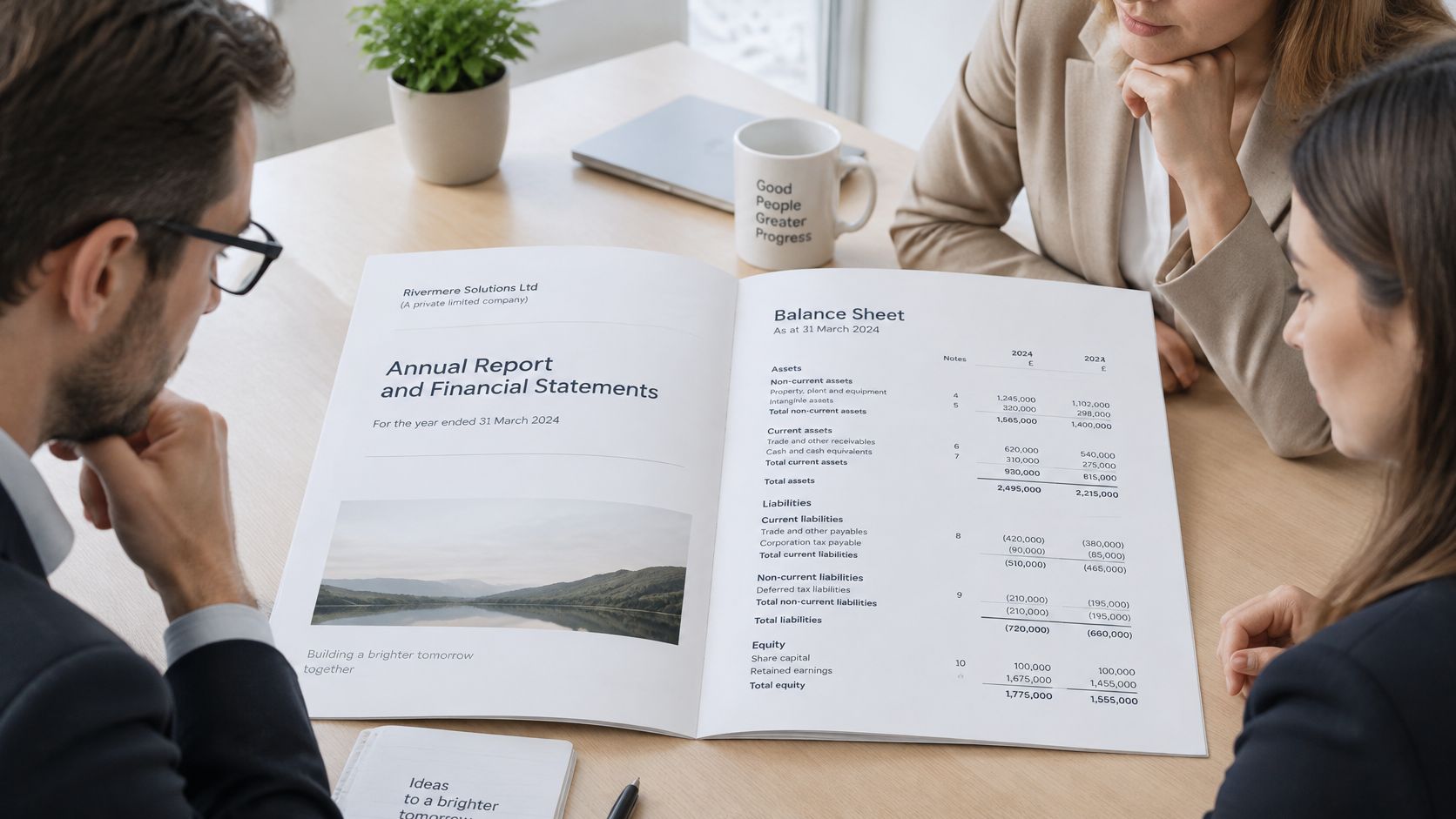
- Balance sheet: Assets, liabilities and equity at the period end. This is the page Companies House always expects.
- Profit and loss account: Income, costs and the result for the period. Micro-entities can choose a route that omits this from the filed copy.
- Notes: Accounting policies and the balances that need an explanation, including related-party items where the format requires them.
- Directors' report, and sometimes a strategic report: Smaller companies often stop at the accounts and notes. Larger companies add narrative on performance and risks.
Micro-entity accounts are a simplified balance sheet plus notes. Small companies file a fuller set. Filing the micro format when the company has outgrown the thresholds is a rejection risk, and it can also understate what a lender expected to see. Every accepted set ends with the director approval statement and its date. Companies House checks that statement before it accepts the filing. A missing date is a technical fail, not a style point.
The confirmation statement is a different document. It confirms company details. It does not report profit, cash or tax.
Who actually opens the file
The Companies House annual report and accounts 2023 to 2024 records that Companies House accepted 14.3 million filings in 2023 to 2024, up from 13.9 million the year before, and that the register was accessed approximately 16 billion times. Of those filings, 13.1 million were digital, a 92% digital take-up. That is not an internal archive. It is the record a supplier uses before extending credit, and the record a lender compares with your management pack.
Founders read the figures to see whether the year matched the plan. Directors sign to show they stand behind the governance and the numbers. External readers judge credit risk from one published set, not from the spreadsheet you kept back. If those versions disagree, the filed version is the one that counts.
Some groups also publish wider performance, including environmental data. Where that narrative has to line up with the accounts, carbon reporting with ESG Consulting is a useful check so the story outside the statutory pages does not contradict the numbers inside them.
How to Prepare Your Annual Accounts Step by Step
Start with the period, not the software. A wrong accounting reference date moves the Companies House deadline, the CT600 and the tax payment together.
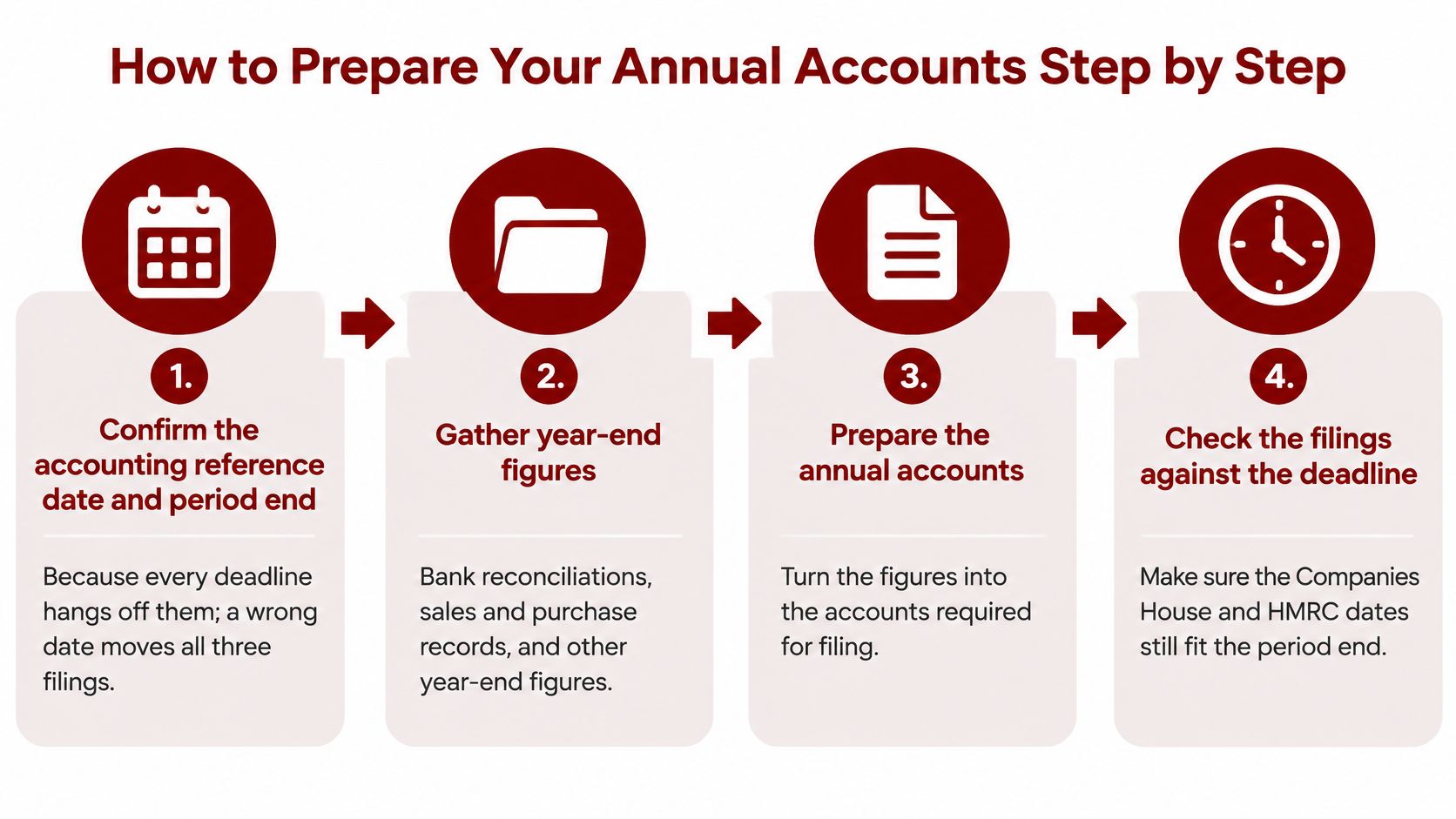
Work through the close in this order. Each step has a reason, and a slip we see when the file comes in late.
Confirm the accounting reference date and the period end. Check the date on the public record, not the date someone remembers from incorporation. If you shortened or extended the period, the deadlines move with it. Fix the date before you export a trial balance.
Gather the year-end figures. You need bank reconciliations, sales and purchase ledgers, payroll totals, VAT returns, stock or work in progress, and lists of debtors and creditors. The usual gap is an unreconciled bank account. If the bank does not agree, every other total is a guess. Our year-end accounts checklist is the practical list to work down before you call the numbers final.
Review expenses and claims before you close the books. Allowable costs that never hit the ledger cannot be deducted later without reopening the file. Look at director expenses, use of home, and costs sitting in a personal account that belong to the company.
Prepare the accounts in the format the company qualifies for. Micro-entity, small or full. Add a directors' report where that format needs one. The common slip is picking micro-entity accounts because they look shorter, then discovering the company fails the size tests. For limited company accounts, we take the end-of-year figures you provide, complete the accounts in the required format, and deliver them to Companies House on your behalf.
Reconcile profit to cash, VAT and the management accounts. A profit that cannot be traced to the VAT returns, or to the monthly pack the directors have been using, is not ready to sign. That check is the consistency test in the next part of this guide. Do it while you can still change a journal.
Get director approval and put the approval date on the balance sheet. The date is part of the filing, not a covering email. A missing or future date is a common reason a submission is rejected, and a rejection does not pause the statutory clock.
File, then keep the receipts. Submit the accounts to Companies House electronically. File the CT600 with HMRC. Save both acceptance messages. If a deadline is ever disputed, the receipt is the evidence, not a sent-items folder.
What to hand over, and what to keep
Do not send a folder of unsorted PDFs on the last Friday. A clean handover is the trial balance, the bank reconciliation, VAT workings and a note of any judgement (stock value, a bad debt, a retention). Keep the working papers for the same period as the filed set. If HMRC opens an enquiry, "the accountant has it" is not a file.
Leave a buffer between approval and the deadline. Electronic filing fails for dull reasons: an authentication code, a balance sheet that does not cast, an iXBRL tag that the software will not validate. Fixing that on the due date is how acceptable accounts arrive the day after the law required them.
Testing Whether Your Numbers Tell a Consistent Story
A report can be accepted by Companies House and still tell a weak story. Technical filing is not the same as a set of figures a lender can trust.
The Financial Reporting Council's 2024/25 review of corporate reporting found that cash flow statements, and inconsistencies between the financial statements and other parts of annual reports, continued to cause problems. Impairment was the issue raised most often for the third year running. The FRC urged companies to explain significant judgements, estimates, key inputs and assumptions more clearly. Listed companies feel that review first. The same gaps show up, in plainer clothes, in owner-managed accounts.
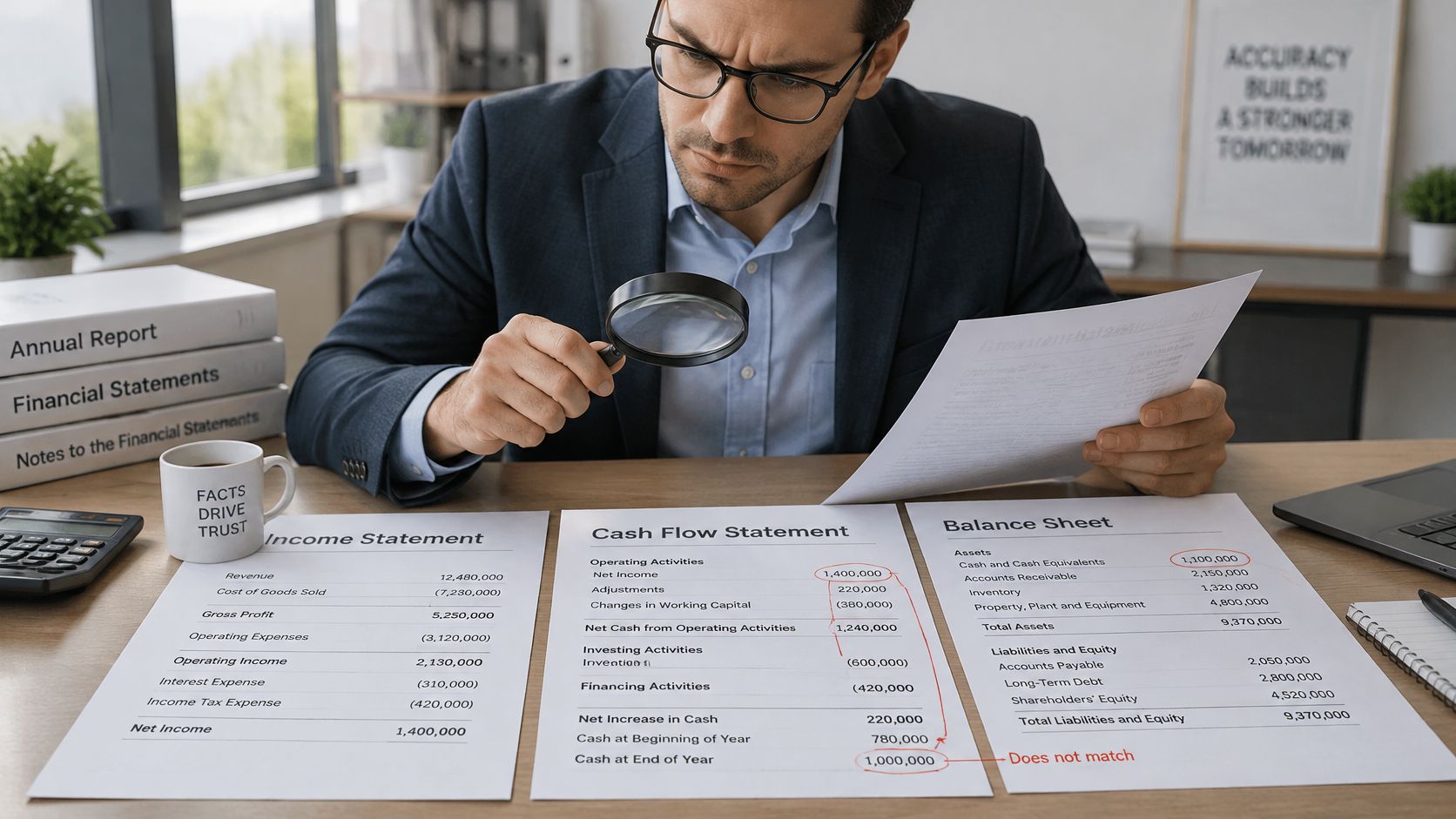
Questions to ask before anyone signs
Ask them in this order, out loud, with the draft in front of you.
- Why did profit rise while cash fell? If you cannot point to debtors, stock, a loan repayment or a fixed-asset purchase, the profit is not explained.
- Do the revenue claims match the VAT returns and the management records? A narrative that says "record sales" while the VAT control account does not agree is a problem, not a rounding difference.
- Does the directors' story match borrowing and the going-concern note? A confident outlook next to a maxed overdraft and no mention of how the company pays its bills next quarter will not survive a credit review.
- Which estimates could move the result? Stock, work in progress, bad debts, property values and contract margins are the usual ones. If a small change in one of them wipes out the profit, that estimate needs a note and a working paper.
Say a construction subcontractor shows a healthy profit on work that has not yet been invoiced, while the bank balance is thin, because the main contractor is holding a £60,000 retention. The accounts have to show that retention as an asset with a recovery story, not as cash the business can spend. Incomplete project costs and timing differences do the same damage. Profit looks strong. Cash and the CIS record tell a harder tale.
Our notes on financial ratio analysis are a practical way to test debtor days, margins and borrowing against what the directors have written.
A five-point test before approval
- Bank reconciliation agrees to the balance sheet, to the penny, on the period-end date.
- VAT returns for the year tie to turnover and to the VAT control account.
- Profit bridges to the movement in cash, debtors, creditors, stock and loans.
- Every material estimate has a working paper and a sentence in the notes.
- The words on the front match the ratios. If debtor days have stretched, do not describe collections as tight.
The Corporation Tax return is part of the same test. The limited company accounts service includes preparing and submitting that return, with a review of company expenses so that appropriate costs are deducted. We also look at claims and elections that can reduce the corporation tax payable. A deduction you forget is not a conservative filing. It is tax paid on a profit the company did not make.
If profit, cash, VAT and the director's note cannot sit in one paragraph without a contradiction, do not sign yet.
Late Filing Penalties and What They Cost
Private companies pay on a rising scale. The longer the accounts are late, the higher the penalty, and public companies sit on a higher scale again. These are the private-company bands.
| Length of delay | Private company |
|---|---|
| Up to 1 month late | £150 |
| 1 to 3 months late | £375 |
| 3 to 6 months late | £750 |
| More than 6 months late | £1,500 |
A private company that is three weeks late is in the £150 band. Stretch that to four months and the same company is in the £750 band. The jump is the point. A short delay is irritating. A delay that crosses three months costs five times the first band, before you count the time spent explaining the filing to a lender who has already seen the late marker.
Why "nearly on time" still fails
Penalties are issued automatically once the deadline passes. A rejected filing does not stop that clock. If Companies House receives accounts that are not acceptable, you have not filed. The next submission has to be acceptable, and it has to arrive inside the original date.
Lateness is unusual, which is why it stands out. The Companies House annual report and accounts 2024 to 2025 reports that 98.5% of UK companies had filed their annual accounts on time as of 31 March 2025, up from 98.3% in 2024. Being in the other slice is a visible exception, not a normal backlog.
The Independent Adjudicators' annual report records that Companies House issued 317,985 late-filing penalties for accounts in the 2024 to 2025 reporting year. Appeals exist, and they need specific grounds. "We were busy", "the accountant had the file", or "we posted it" rarely qualify, because the law looks at when acceptable accounts were received.
Double penalties can apply if accounts were also late in the previous year. One late year is an admin failure. Two late years look like a habit, and the bill reflects that.
The habits that keep you out of that list are ordinary: a shared calendar, a close that finishes with time to spare, a check that the filing was accepted, and separate diary entries for the CT600, the tax payment and the confirmation statement. The checklist at the end of this guide is the version to pin up this week, not after the penalty letter arrives.
Preparing for the 2028 Software Filing Rule
From 1 April 2028, the filing route itself changes. Treat that date as confirmed, and treat everything around the detail as something you should not rebuild your process for until the Government gives notice.
| Change | Status | What to do now |
|---|---|---|
| Accounts filed with commercial software from 1 April 2028 | Confirmed by the Government | Check that your bookkeeping can produce compliant iXBRL or software-generated accounts |
| Paper filing and Companies House's own digital service end | Confirmed for 1 April 2028 | Move to a software route before the cut-off |
| No change introduced in April 2027 | Confirmed, with at least 21 months' notice | Keep your current process until notice is given |
| Detailed reform for micro-entities and small companies | Under review | Track official updates before changing your process |
The Government's account filing update confirms that, from 1 April 2028, companies will have to file accounts using commercial software. That ends paper filing and Companies House's own digital filing service. The same update says the reforms remain under review, that changes will not be introduced in April 2027, and that companies will get at least 21 months' notice before implementation.
Decisions you can make before the notice
Three questions are worth answering now, while nothing is on fire.
Can the books produce a compliant file? If you keep records in a spreadsheet, or in software that cannot export iXBRL or a software-generated accounts file, the 2028 route will reject you even if the numbers are right. Test an export on this year's figures. Do not wait for the cut-off year. Our note on accounting software integration covers how the bookkeeping file and the statutory file need to talk to each other.
Who owns a rejection? When software refuses a filing, someone has to fix the tag, the company authentication code or the balance sheet total, and resubmit before the statutory date. Agree that person now. "The software company will sort it" is not a control.
How early should you test? I would run one full filing through commercial software at least one accounting period before you are forced to. A failed test in a quiet month is cheap. A failed test in the final week is a penalty.
Micro-entities and small companies do not face the same reporting load, or the same privacy worries, as a listed group. Use a short path. If you are micro-entity and audit-exempt, keep the shorter format, confirm you still meet the size tests each year, and only change software, not the content of the accounts, until official guidance says the content must change. If you are small but not micro, check whether your current package already files the fuller set. If you are close to an audit threshold, or you have shortened your accounting period, do not assume last year's route still fits.
Until the notice arrives, keep the process that already gets acceptable accounts in on time. We can take on the accounting work around that, from annual accounts through to corporation tax, outsourcing and company formation, so the software change does not become a reason to miss a year. Changing bookkeeping package in the same month as a deadline is the change that usually goes wrong.
Confirm Your Filing Plan Before the Deadline
Decide the plan while the deadline is still months away. A shared calendar beats a memory of "sometime in December".
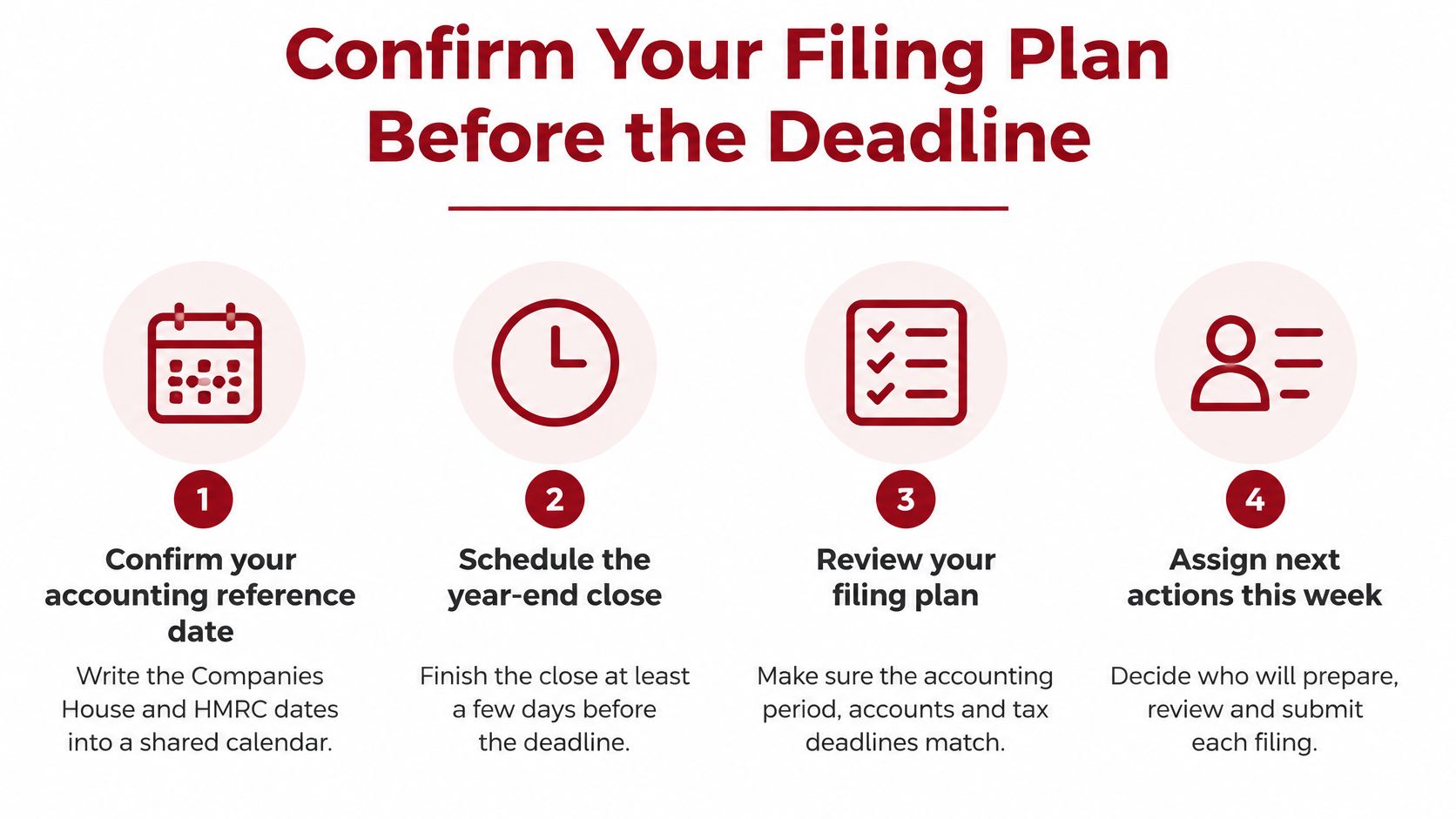
Do these seven things this week.
- Confirm the accounting reference date and write the Companies House date, the CT600 date and the tax payment date into a calendar more than one person can see.
- Finish the year-end close at least a month before the accounts deadline, so a rejected submission can be corrected and sent again.
- Set reminders at six months and three months before each date, not only the week before.
- Run the consistency test on profit, cash, VAT and the narrative before anyone approves the accounts.
- Book director approval and record that date on the balance sheet.
- Check the CT600 and the Corporation Tax payment date separately. They are not the same day.
- Put the confirmation statement on the same calendar, with its own owner.
If you want the finance function to carry more of this, we offer a confidential consultation for businesses that want to take the business to the next level. The limited company accounts service is a fully inclusive fixed price: we take the year-end figures, deliver the accounts to Companies House and file the CT600 with HMRC. Action Accountants is based in Colindale and works with clients in North West London and across the UK. Book the review before the next deadline, not after a penalty has already been raised.
Action Accountants Limited prepares and files annual accounts to Companies House and the Corporation Tax return to HMRC, so the public record and the tax return match the year you had. If your next deadline is already on the calendar, bring the period end and the draft figures to a confidential consultation and we will map the filings, the payment date and the gaps before you sign. Visit Action Accountants Limited to book that review.