Managing Business Expenses: A Practical UK Guide for 2026
Managing business expenses well protects cash flow, HMRC claims and margins. Practical UK steps, tables and fixes for SMEs and contractors.
In 2026 research, 60% of UK SMEs said customers were taking longer to pay than a year earlier. That changes the way founders should think about managing business expenses: recording what has been spent matters, but deciding what the business can safely pay, when, and with which checks matters just as much. The UK SME Finance Monitor highlights why a tidy ledger alone won't protect cash when receipts from customers arrive late.
A useful expense process connects tax records to decisions about cash, suppliers and fraud risk. The practical aim isn't to spend as little as possible. It's to protect necessary work, catch avoidable costs and prevent money leaving the business without the right evidence and approval.
Table of Contents
- Expense Types, Tax Treatment and Records to Keep
- How to Capture, Code and Approve Spending Each Month
- Cost Pressures Worth Tracking Separately
- Approval Tiers and Fraud Checks That Protect Cash
- Protecting Cash Flow When Customers Pay Late
- Expense Records for Construction and CIS Work
- Pick Your First Expense Fix This Week
Expense Types, Tax Treatment and Records to Keep
| Expense type | Typical tax treatment | Evidence to keep | Common mistake |
|---|---|---|---|
| Business mileage in your own car | Claim using the applicable HMRC mileage rules | Journey log with date, purpose and miles | Claiming commuting miles |
| Office rent and utilities | Allowable when wholly for business | Lease and utility invoices | Claiming the private-use share |
| Software subscriptions | Allowable as a revenue cost | Invoice and card statement | Missing the personal-use share |
| Equipment and computers | Consider capital allowances, including the Annual Investment Allowance | Invoice and asset register | Expensing items that should be capitalised |
| Staff training | Generally allowable | Course invoice and attendance record | Paying for the owner's personal course |
| Subsistence on business travel | Allowable when away from base | Receipt and note of travel purpose | Claiming personal meals |
| Client entertainment | Not allowable for tax | Receipt kept for internal records | Claiming it as a business expense |
The tax treatment depends on what the cost was for and how it was used. For equipment, don't assume that a purchase should be treated like an ordinary day-to-day cost. HM Revenue & Customs reported that UK companies claimed £157.2 billion in capital allowances net of balancing charges in 2023–24, a reminder that getting the distinction between capital and revenue expenditure right can have a substantial effect. The HMRC Corporation Tax Statistics 2025 provides that figure.
For home working, identify the business share of relevant costs and keep a clear record of how you worked it out. For mileage, record the journey while it's fresh, including its business purpose; a bank statement showing a fuel purchase doesn't establish which journeys were for work. For software, remove any personal-use portion rather than claiming the full subscription automatically.
Practical rule: Keep the evidence close to the transaction. A receipt saved with the project or business purpose is more useful than a pile of documents you have to interpret at year-end.
If you're VAT-registered, keep the VAT evidence and treatment distinct from the expense claim itself. This guide to claiming VAT back can help you check the records to keep for a reclaim. Could you show an invoice, a stated business purpose and the business link if HMRC asked tomorrow?
How to Capture, Code and Approve Spending Each Month
Use a repeatable routine rather than relying on someone to reconstruct a month from bank statements. A receipt app and a connected accounting system can reduce manual chasing, but the process still needs an owner and clear approval rules.
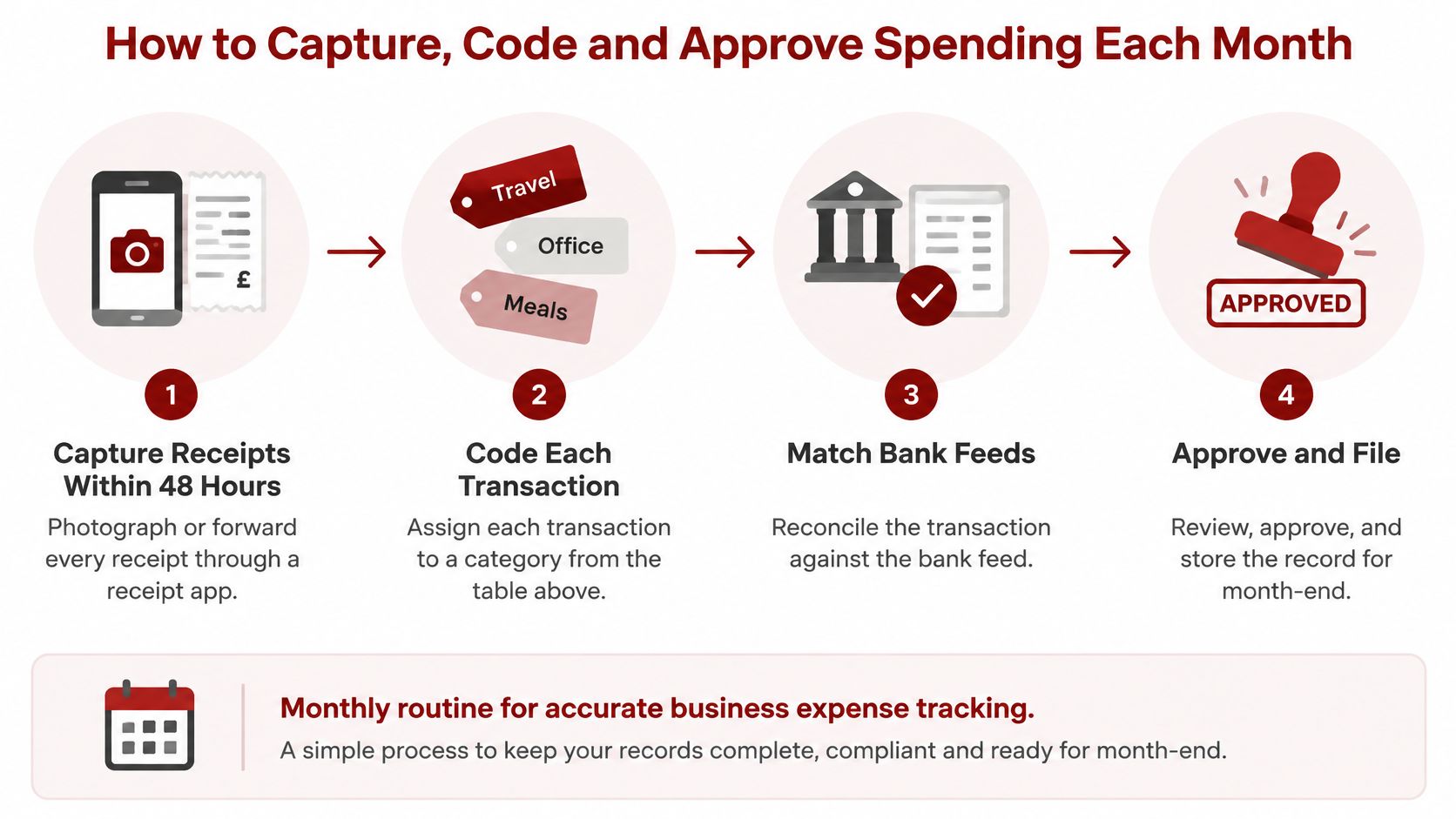
Capture each receipt promptly. Photograph it or forward the email to your receipt app within 48 hours, while the supplier and purpose are still easy to identify. Receipts chased weeks later are often missing, and a card transaction alone may not show what the business bought.
Code the transaction. Assign each expense to a category, such as software, mileage, equipment or travel subsistence. Uncoded transactions conceal deductions and make it harder to see which costs are driving a margin change.
Match the bank feed every week. Reconcile each payment against its receipt and accounting entry, then investigate duplicates or missing documents while details are accessible. A bank feed makes matching quicker, but it doesn't prove that a transaction was a valid business cost.
Get approval before payment. Route each bill through the approval tier that applies to its amount and purpose. Don't treat an urgent request or familiar supplier name as a substitute for checking the invoice.
Compare budget with actual at month-end. Flag any cost line more than 10% over budget and write down why it moved. Without an explanation, the next month's budget will repeat the same guess rather than reflect what happened.
Review recurring subscriptions quarterly. Confirm that each service still has a user and a business purpose, then cancel what nobody uses. A low monthly charge can be easy to overlook precisely because it doesn't attract attention on its own.
Lock the month and file mileage logs. Once transactions are matched and outstanding queries resolved, save the records with that month's accounts. Don't leave the mileage log separate from the expense records it supports.
A sole trader can usually protect around 30 minutes a week for this routine; a team of ten should set a fixed weekly slot and name who handles each task. If you're choosing or connecting accounting tools, review how accounting software integration will move transactions and records between systems. Some teams also use prebuilt workflow routines to keep recurring capture and review tasks from slipping.
A clean month means every transaction is matched, no balances are unexplained and each budget variance has a one-sentence explanation.
Cost Pressures Worth Tracking Separately
| Cost category | Typical share of businesses citing it as a reason to consider price increases | What to track monthly | Early warning sign |
|---|---|---|---|
| Labour and payroll | 26.4% | Gross pay, employer costs and overtime | Overtime above budget for two months running |
| Energy | 20.0% | Unit price and standing charges per contract | Tariff renewal date passes without a quote |
| Raw materials | 18.0% | Cost per job, by supplier | Price rise on the same supplier invoice |
| Finance costs | 14.0% | Interest, facility fees and card charges | Borrowing cost rising without new spend |
| Transport and haulage | 11.7% | Fuel, delivery and vehicle cost per job | Mileage per job rising over several weeks |
Keep these categories separate from general overheads. Labour moves with hours and staffing; energy follows contract terms; materials can vary by supplier or job; finance costs may rise without a change in activity; and transport depends on deliveries and site demands. Separate lines make it easier to identify what is squeezing margin and decide where to act.
Cost pressure can also affect growth plans. In 2024, 57% of UK SME employers with plans for growth reported that rising costs had affected those plans, according to the Department for Business and Trade's Longitudinal Small Business Survey.
For each category, set a budget, name an owner and choose a monthly review date. Record expected payments in the rolling 13-week cash-flow forecast, then compare actual spending with budget. If energy is 10% over budget, for example, check the contract and obtain fresh quotes before deciding whether to renegotiate, switch supplier or review prices. When customers pay late, use the forecast to rank which costs can wait and which payments are needed to keep work moving.
Approval Tiers and Fraud Checks That Protect Cash
A payment process that lets one person create and release a supplier payment can turn an administrative shortcut into a direct cash loss. UK Finance reported that banks prevented £1.68 billion of unauthorised payment fraud in 2025, while £1.28 billion was still stolen; 68% of invoice and mandate scam losses went through non-personal or business accounts. The figures are from the UK Finance Fraud Report 2026.
Set approval tiers around the point where a second person should review a payment. The £250 split below is a starting point. Adjust it to match available cash, staffing and buying arrangements.
| Spend band | Approver | Evidence required | Extra check |
|---|---|---|---|
| Under £250 | Budget holder | Itemised receipt | Code to an expense category |
| £250 and over | Budget holder plus a second approver | Supplier invoice and purchase purpose | Confirm the supplier and payment details |
Apply a callback rule to every request to change supplier bank details. Call a number already held on file, not one supplied in the change request or email signature. Confirm the new details with a known contact before editing the supplier record. An authentic-looking message is not independent verification.
Separate payment access where possible. The person who raises a payment should not be the only person able to release it. If an urgent payment cannot wait for the usual process, require a second approver and record the reason. Reconcile supplier statements monthly to catch unexpected invoices, duplicate charges or payments sent to altered details.
A two-person business can keep controls simple: use two spend bands, arrange a second review for larger payments where possible, and apply the callback rule to every bank-detail change. New or amended regulation can also bring one-off compliance costs. Plan for that work as an operating cost, and check the risk before cutting it.
Protecting Cash Flow When Customers Pay Late
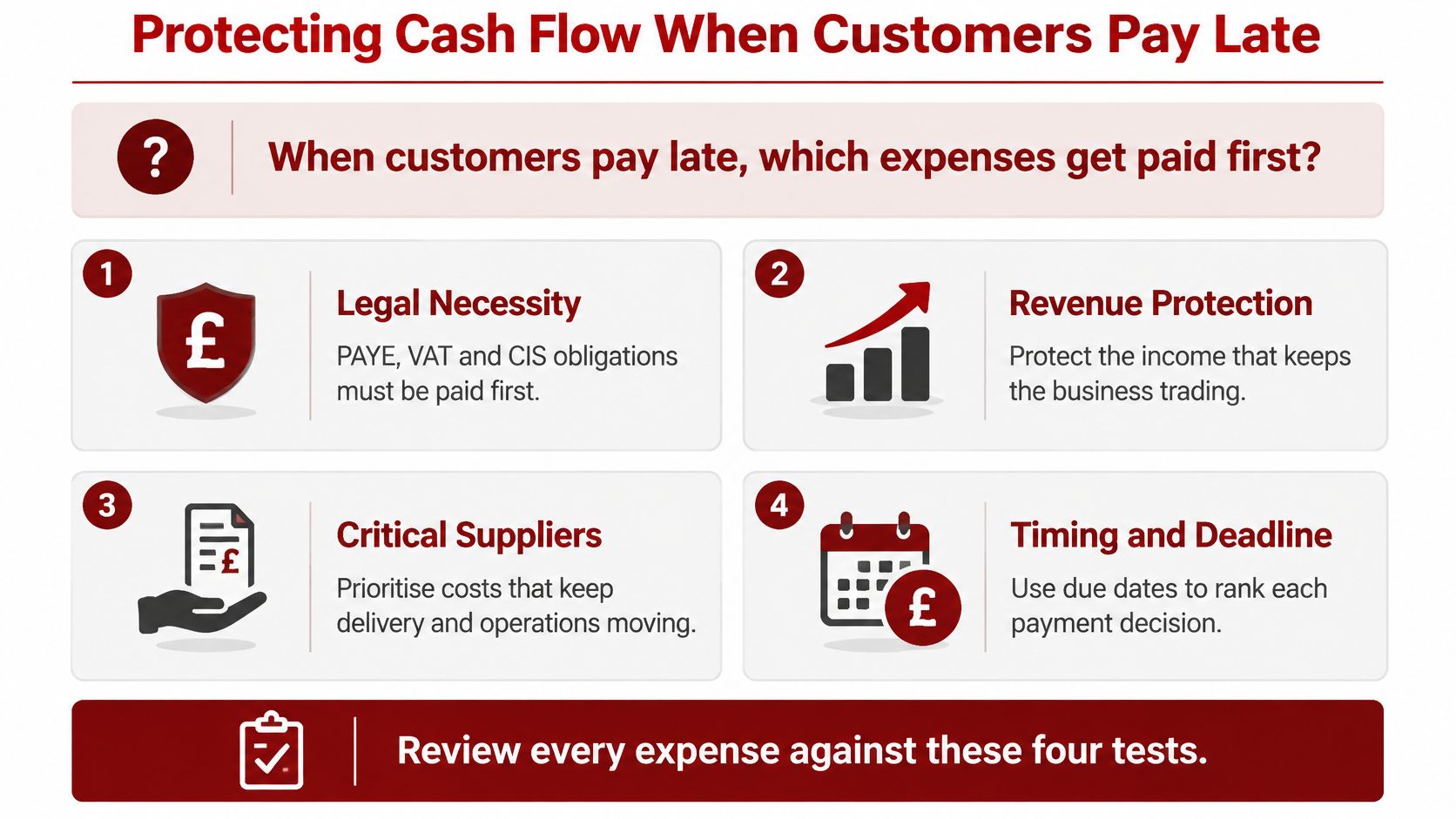
When customers pay late, ask four questions before deciding which expenses to pay first:
- Legal necessity: Which obligations, such as PAYE, VAT and CIS, must be met?
- Revenue protection: Which materials or labour keep paid work on track?
- Supplier consequences: What will happen if a critical supplier is paid late?
- Payment timing: When is each bill due, and when is the related customer payment realistically expected?
Then run a weekly cash-conversion cycle:
- Export aged receivables and payables. Start with a current view of what customers owe and what the business must pay.
- Classify invoices by due date, customer and job. For construction work, link invoices to the relevant site or CIS contract so a profitable project doesn't disguise a short-term cash gap.
- Resolve disputed or unlogged invoices within 48 hours. Check the paperwork, correct errors and contact the customer promptly. The UK Government found that 24% of businesses attributed late customer payments to administrative errors, including failing to log invoices or invoicing incorrectly, in its late-payments research.
- Forecast payroll, VAT, supplier payments and essential overheads over 13 weeks. Separate committed costs from discretionary purchases and ring-fence tax money rather than treating it as spare cash.
- Approve discretionary spending only if the forecast keeps your minimum cash buffer intact. A purchase can be useful and still be unaffordable this week if it puts payroll or a critical supplier at risk.
Set escalation triggers and follow them consistently. Contact the customer at seven days overdue, formally escalate at 14 days and review whether to place the account on credit hold at 30 days. Compare actual payment days with agreed terms monthly; repeated delays may justify a deposit, milestone billing or a change in credit terms.
Use the weekly forecast to model next quarter under 30-, 60- and 90-day customer-payment delays. For each scenario, shift the expected receipts, leave contractual and essential costs in place, and see when the cash buffer would be breached. That gives you a basis to collect earlier, renegotiate a supplier payment date or defer a discretionary purchase. This guide to improving cash flow offers further practical steps.
Expense Records for Construction and CIS Work
Tag every construction purchase with a job code. A supplier invoice for materials should sit alongside the site or contract reference, not just in a general materials account. That lets you see what each job consumed and whether the work is still delivering the margin you priced.

Keep vehicle and tool records clear about private and business use. Track mileage by site and retain the journey purpose; if a vehicle or tool is used privately as well, separate that use rather than putting the full cost against the business. CIS deduction records need their own reconciliation, because the amount received into the bank may be less than the gross payment while the business still has to meet its own costs in full.
Use this monthly routine:
- Tag purchases with a job code and keep the code on the invoice record.
- Store CIS deduction statements with the month's payment records.
- Reconcile gross payments to the bank and account for the difference between gross and net receipts.
- Check the allowable-costs list before year-end so eligible costs aren't missed or treated incorrectly.
Labour, materials, finance and transport deserve close attention because each can shift the profitability of a job. If you need construction-specific support, accounting for contractors and construction businesses should account for both the records and the CIS treatment.
A common error is booking a job-specific expense only as a company overhead. If a delivery of bricks for one site goes into a general materials account without a job reference, the company's overall expense total may still be right, but that contract's true margin is hidden.
The following video offers another perspective on keeping construction business records organised.
Pick Your First Expense Fix This Week
Choose the first fix according to what is currently putting the business at risk. If receipts and coding are unreliable, begin with the monthly capture routine. If cash is tight, build the 13-week forecast before approving discretionary spending. If payment fraud is the main concern, introduce callback checks for bank-detail changes first. Trying to install every control at once can leave the team with a complicated process that nobody follows.
Use a simple 30-day plan:
- Week one: Capture and code the last three months of transactions, and list any expenses without receipts.
- Week two: Set approval bands and name who can approve and release payments.
- Week three: Build the 13-week forecast and agree the customer-payment escalation triggers.
- Week four: Review subscriptions, mileage logs and CIS statements, then fix any gaps you find.
Before the year-end Corporation Tax Return, review the company's expenses so allowable costs aren't overlooked. Action Accountants' limited-company accounts service includes preparing and submitting the Corporation Tax Return, with a review of company expenses to ensure appropriate expenses are deducted. For a process review, ask for advice that considers your business's actual cash position, records and goals, rather than applying a generic checklist. Action Accountants Limited is based in Colindale, and its business phone number is 020 8378 0457.
Today's action: Export last month's transactions and mark every line that has no receipt.
Action Accountants Limited can review your expense records and approval process as part of an accounts review, including how the costs you claim are documented for your Corporation Tax Return. Visit Action Accountants Limited to discuss the right next step for your business.