Self Assessment Late Filing Penalties: How to Avoid Them
Self Assessment Late Filing Penalties start at £100 and can pass £1,600. See the timeline, interest rules, appeal steps and how to avoid them.
“Just make sure you pay your tax” is incomplete advice. You also need to submit the return, and treating those jobs as interchangeable is an expensive mistake. Self Assessment late filing penalties concern the paperwork, not just the money you owe.
My recommendation is straightforward: get the return submitted accurately, then deal with any payment shortfall separately. Don't leave an unfinished return sitting in your accounting software because you're worried about the bill. Keep a filing calendar and a payment calendar, even when their deadlines coincide.
Table of Contents
- Self Assessment Penalty Timeline From Deadline to Twelve Months
- Filing Late Versus Paying Late in Real Cases
- How Late Payment Interest Adds to Your Bill
- Reasonable Excuses HMRC Accepts and Rejects
- How to Appeal a Late Filing or Payment Penalty
- Checklist and Next Steps Before Your Deadline
Self Assessment Penalty Timeline From Deadline to Twelve Months
The first late-filing charge is £100, even if you owe no tax or have already paid, and the usual deadlines are 31 January for online returns and 31 October for paper returns, according to HMRC's Self Assessment deadline guidance. The same framework allows daily filing penalties of £10 after more than three months, capped at £900, followed at six and twelve months by further charges of £300 or 5% of the tax due, whichever is greater.
Start by checking the filing deadline that applies to your return. Don't assume the date in a reminder from last year settles the question, particularly if you're filing differently or HMRC has issued specific instructions.
Locate your position on the penalty ladder
The table separates the filing events from the payment events. Each row describes an additional charge at that stage, not a replacement for an earlier penalty; payment charges relate to the payment deadline, rather than the submission date.
Self Assessment penalty ladder by time overdue
| When | Filing penalty | Payment penalty | Interest |
|---|---|---|---|
| Missed filing deadline | £100 fixed penalty | None solely because filing is late | Starts on unpaid tax after the payment deadline |
| More than 3 months late | £10 a day, up to £900 | No new payment charge solely at this filing stage | Continues if tax remains unpaid |
| 30 days overdue on tax | None added solely by this payment milestone | Percentage charge on unpaid tax | Continues if tax remains unpaid |
| 6 months late | £300 or 5% of tax due, whichever is greater | Further percentage charge if tax remains unpaid | Continues if tax remains unpaid |
| 12 months late | £300 or 5% of tax due, whichever is greater | Further percentage charge if tax remains unpaid | Continues if tax remains unpaid |
The payment percentages are calculated in the worked cases below. Keeping them separate here matters: a taxpayer can occupy a late-filing row without having overdue tax, or a late-payment row without having an outstanding return.
Understand what the accumulated bill means
With the full daily charge and both minimum later charges applied, the filing penalties total £1,600, calculated as £100 plus £900 plus £300 plus £300. That's before any payment-related costs, and percentage-based filing charges can make the result higher.
Practical rule: Find the next filing milestone, then organise submission before you reach it. Waiting for a more convenient moment can expose you to another charge.
Partnerships need particular care because HMRC says all partners may receive a penalty for a late partnership return. Agree who prepares it, who approves it and who checks that HMRC has accepted it.
If you're new to the process, check the practical steps for registering for Self Assessment before access problems become a filing obstacle. Registration and submission are different jobs.
International guidance also needs separating. Omni Tax Help's explanation of IRS late filing penalty calculations is relevant to US obligations, not a substitute for HMRC's UK rules.
Open your HMRC correspondence now. Identify your own deadline and the filing stage you would reach if you submitted today.
Filing Late Versus Paying Late in Real Cases
A sole trader can finish the year without a tax liability and still receive a filing penalty. That surprises people who assume HMRC only charges penalties when it loses tax revenue. Submitting a required return and settling the resulting liability are separate obligations.
HMRC's Self Assessment penalties guidance distinguishes filing charges from payment penalties of 5% of unpaid tax at 30 days, six months and twelve months, with interest charged separately. The illustrative calculations below apply that framework and the filing ladder to a hypothetical £4,000 liability.
Compare the outcomes, not just the tax bills
For the four-month examples, assume HMRC charges exactly 30 daily penalties. Calendar dates affect the actual daily count, so £400 is an illustration, not a universal bill for every return described as four months late.
For the final example, assume all standard filing stages and all payment stages have been reached, the tax remains completely unpaid and no higher deliberate-withholding charge applies.
Penalty totals for four late-filing and late-payment cases
| Scenario | Filing penalty | Payment penalty | Total before interest |
|---|---|---|---|
| Return 4 months late, no tax due | £400 under the daily-charge assumption | £0 | £400 |
| On-time return, £4,000 unpaid 30 days overdue | £0 | £200 | £200 |
| Return 4 months late, £4,000 paid by deadline | £400 under the daily-charge assumption | £0 | £400 |
| Return 12 or more months late, £4,000 unpaid | £1,600 under the standard-charge assumptions | £600 | £2,200 |
The first calculation is the fixed filing charge plus the assumed daily charges. There's no payment penalty because there's no unpaid tax, but that doesn't cancel the filing obligation.
The on-time filer has the opposite problem. Their return is dealt with, but the unpaid liability creates a payment penalty, calculated by applying the relevant percentage to the outstanding balance.
Paying before the deadline protects the taxpayer in the third case from payment penalties. It doesn't excuse the late return.
The final case shows why leaving both jobs unresolved is the worst option. The filing charges accumulate independently of the payment charges, so a modest tax liability can produce a substantial additional bill.
Make the right decision when income is irregular
A landlord waiting for rent, a contractor awaiting an invoice payment and a founder reinvesting business income can all face a genuine cash shortage. None should use the bank balance as the trigger for starting their return.
Prepare the return from the records. Make the cash-flow decision using the calculated liability, rather than postponing the calculation until money arrives.
No tax to pay is not the same as no return to file.
Use separate task statuses in your diary or accounting checklist: return submitted, submission accepted, tax payment arranged and payment received by HMRC. Marking the whole job “done” when only one part is complete invites mistakes.
There's also a practical choice when you dispute a penalty. HMRC warns that interest can accrue on an unpaid penalty if an appeal fails; if the appeal succeeds, it repays the amount with interest. Paying while appealing can therefore be financially sensible when you have the funds, rather than treating withholding payment as part of your argument.
How Late Payment Interest Adds to Your Bill
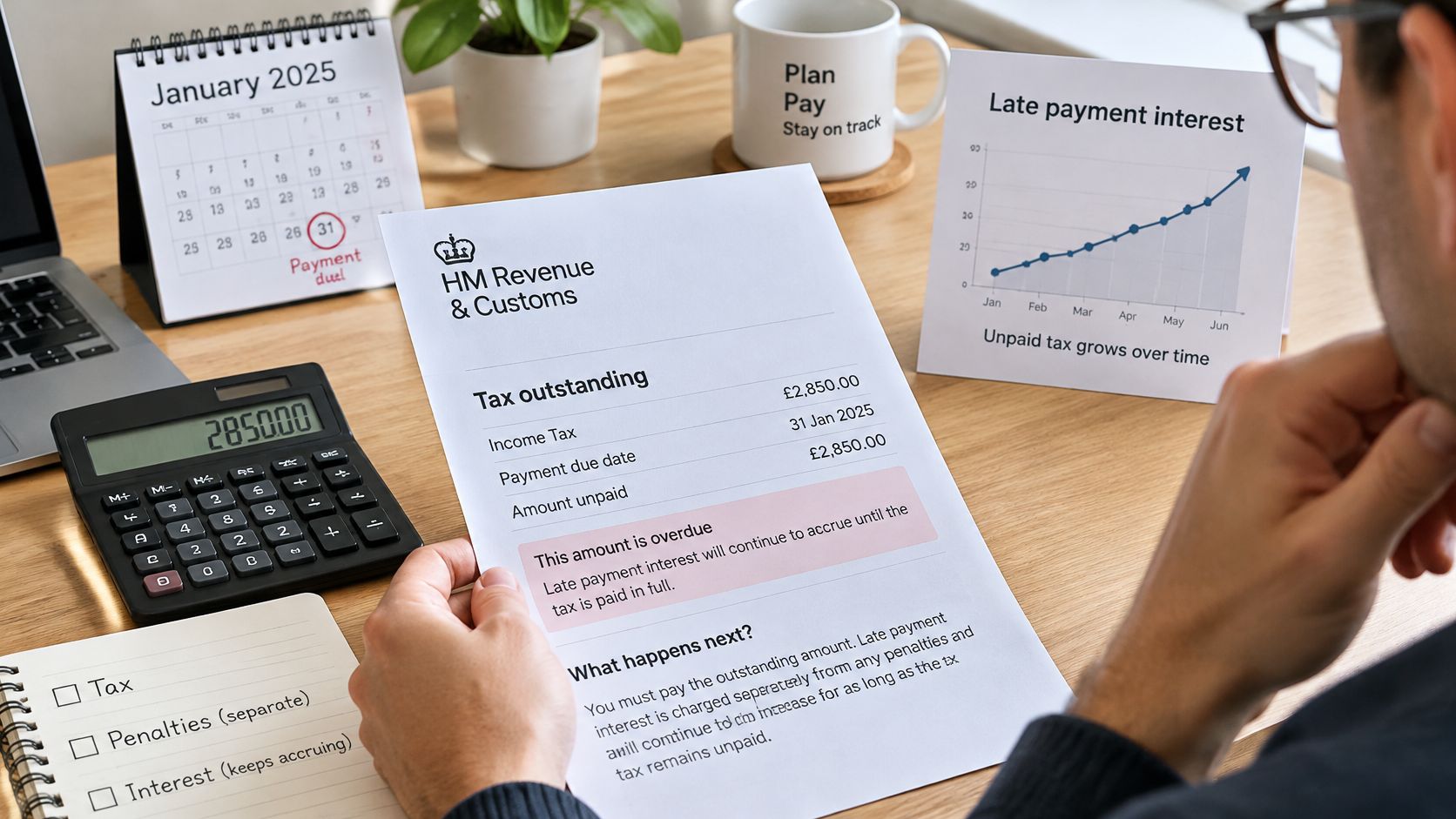
Interest is a separate cost of leaving tax unpaid. It isn't included in a filing penalty, and paying a penalty doesn't settle the underlying liability.
Keep the tax calculation, penalty notices and payment records together when reviewing the balance.
Budget for a variable rate
According to HMRC's Self Assessment manual, from 6 April 2025 the late-payment interest rate is the Bank of England base rate plus 4 percentage points, and penalty notices are generally payable within 30 days. Check HMRC's current published rate before estimating your own interest bill because the underlying base rate can change.
For a clearly hypothetical calculation, assume the base rate were 4%, giving an annual late-payment rate of 8% under that formula. Leaving £4,000 unpaid for a quarter of a year would then cost approximately £80, calculated as £4,000 × 8% × ¼, before any penalties.
That's a simplified planning illustration, not a statement of today's rate or an exact account calculation. The actual cost reflects the applicable rates and the period for which the tax remains unpaid.
Separate the tax reserve from the delay cost
Don't describe every added charge as compound interest. The practical problem is an accumulation of different liabilities: unpaid tax, interest and any applicable penalties.
For someone with irregular income, budgeting only for the original tax figure leaves a gap. When an overdue customer payment finally arrives, some of that money may now be needed for charges as well.
The accompanying video provides an additional format for reviewing the topic.
Build your cash forecast around the full payment position, including any payments on account, rather than assuming the balancing liability is the only amount to reserve. Keep tax money separate from the account used for suppliers and routine drawings.
The first useful action is to calculate the liability while you still have time to plan. Without that number, you can't judge whether incoming funds will cover the bill or whether you need to contact HMRC about payment difficulties.
Reasonable Excuses HMRC Accepts and Rejects
A reasonable excuse must explain the relevant period of delay, not merely identify something difficult that happened. HMRC's legal framework guidance requires attention to the period from the deadline to submission and says insufficient funds are generally not a reasonable excuse.
Build a timeline before deciding whether to appeal. Record when the obstacle began, how it prevented compliance, when it ended and what you did next.
Test the connection between the event and the delay
The situations below are assessment prompts, not promises of acceptance. Illness, bereavement, technical problems and missing records need a clear explanation of their actual effect on your ability to file.
Common reasons and whether they usually count
| Situation | Likely to count? | Key condition |
|---|---|---|
| Serious illness covering the whole delay | Potentially, where it prevented compliance | Explain the full delay and subsequent action |
| Bereavement or family crisis | Potentially, based on the circumstances | Show how it affected filing throughout the relevant period |
| Software or online service failure | Only for the period it prevented filing | Preserve fault evidence and act once resolved |
| Missing records | Not automatically | Show reconstruction efforts and why filing remained impossible |
| Agent delay | Only where reasonable care was taken | Demonstrate steps taken to prevent the failure |
| Insufficient funds | Generally no | A shortage of cash doesn't itself remove the penalty |
A hospital admission may explain why someone couldn't deal with their affairs. It doesn't automatically explain an extended period of inactivity after they recovered.
Likewise, a software error needs more than a statement that the system wasn't working. Save error messages, support correspondence and service-status information, then explain why the fault stopped submission.
Show reasonable action, not just a difficult situation
For missing records, request replacement bank statements, invoices or deduction statements promptly. Keep the requests and responses so there's evidence of what you tried, rather than an unsupported assertion that information was unavailable.
An agent's involvement also needs evidence. Approval emails, reminders and requests for submission confirmation help establish what you did to keep the return on track.
A convincing explanation connects the obstacle to the delay and the recovery to prompt action.
Readers dealing with both countries' tax systems may also find Tax Attorney Stephen A Weisberg's discussion of grounds for IRS penalty relief useful. Those are US considerations, however, and shouldn't be presented as HMRC's acceptance criteria.
Ask yourself whether your account explains the whole interval between the missed deadline and submission, including what happened after the original problem ended. If there's an unexplained gap, address it clearly rather than assuming a serious event excuses everything that followed.
How to Appeal a Late Filing or Payment Penalty
File first, then present the appeal clearly. HMRC's guidance on appealing Self Assessment penalties says a reasonable-excuse claim requires submission without unreasonable delay after the excuse ends, and reliance on an agent isn't automatically sufficient without reasonable care.
Check precisely which penalty notice you're challenging. A filing explanation may not address a payment failure, and a payment problem may say nothing about why the return wasn't submitted.
Put the evidence in a usable order
Use the process below to organise the case before sending it.
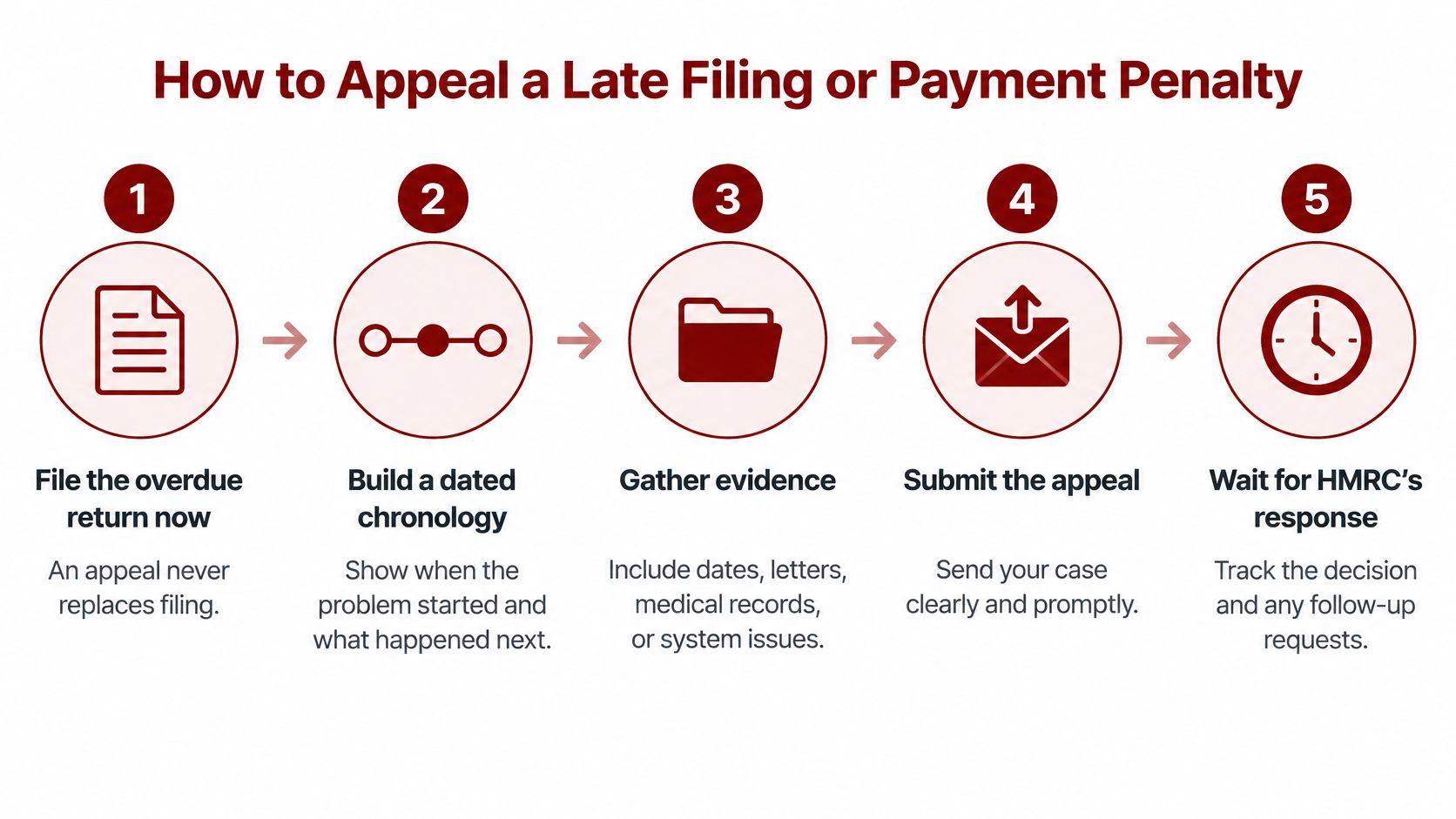
Submit the overdue return. Don't wait for HMRC to agree that your explanation is reasonable before completing the outstanding obligation. Save the submission acknowledgement so you can establish when the failure ended.
Build a dated chronology. List the deadline, the start and end of the obstacle, your attempts to resolve it and the submission date. Attach evidence to the relevant event instead of sending an unexplained bundle of documents.
Check the gaps. Read the chronology as someone unfamiliar with your circumstances would read it. Explain any interval between recovery, access being restored or records arriving and the eventual submission.
Submit the appeal through the appropriate channel. Use the online or postal route applicable to the notice, providing the filing or payment details and a plain explanation. Follow the notice's instructions and identify the decision you want HMRC to reconsider.
Make a separate payment decision. Decide whether to settle the disputed penalty while HMRC considers your case, taking account of the interest implications and available cash. Don't assume sending an appeal resolves everything shown on the account.
Keep a complete audit trail. Retain the appeal, supporting documents, delivery or submission evidence and every HMRC reply. Set a follow-up reminder and respond to requests for further information rather than assuming silence means acceptance.
Write a factual explanation
A short covering statement supported by a clear chronology is easier to assess than a lengthy account of how stressful the situation felt. Describe what prevented compliance, not why the deadline became inconvenient.
For example, identify the task you couldn't perform, the obstacle that stopped it and the action you took when that obstacle ended. Don't claim a system failure lasted longer than the evidence shows, or suggest an agent had information that you hadn't yet supplied.
Keep sensitive supporting material relevant. Medical evidence should establish the effect on your ability to comply, while technical evidence should establish the actual access or submission problem.
For help getting the outstanding obligation organised, use our Self Assessment tax return help. Keep preparation of the return and assessment of the appeal as distinct tasks so neither stalls the other.
Before submitting, check that your case meets these practical standards:
- Identifiable decision. The appeal clearly names the notice being challenged.
- Complete chronology. The dates explain the delay without unexplained intervals.
- Relevant evidence. Each attachment supports a specific statement.
- Prompt corrective action. The account shows what you did once compliance became possible.
- Clear request. HMRC can see why you believe the penalty should be removed.
Checklist and Next Steps Before Your Deadline
A reliable filing routine is better than an annual rescue operation. Give every task an owner, keep the records accessible and require evidence of completion.
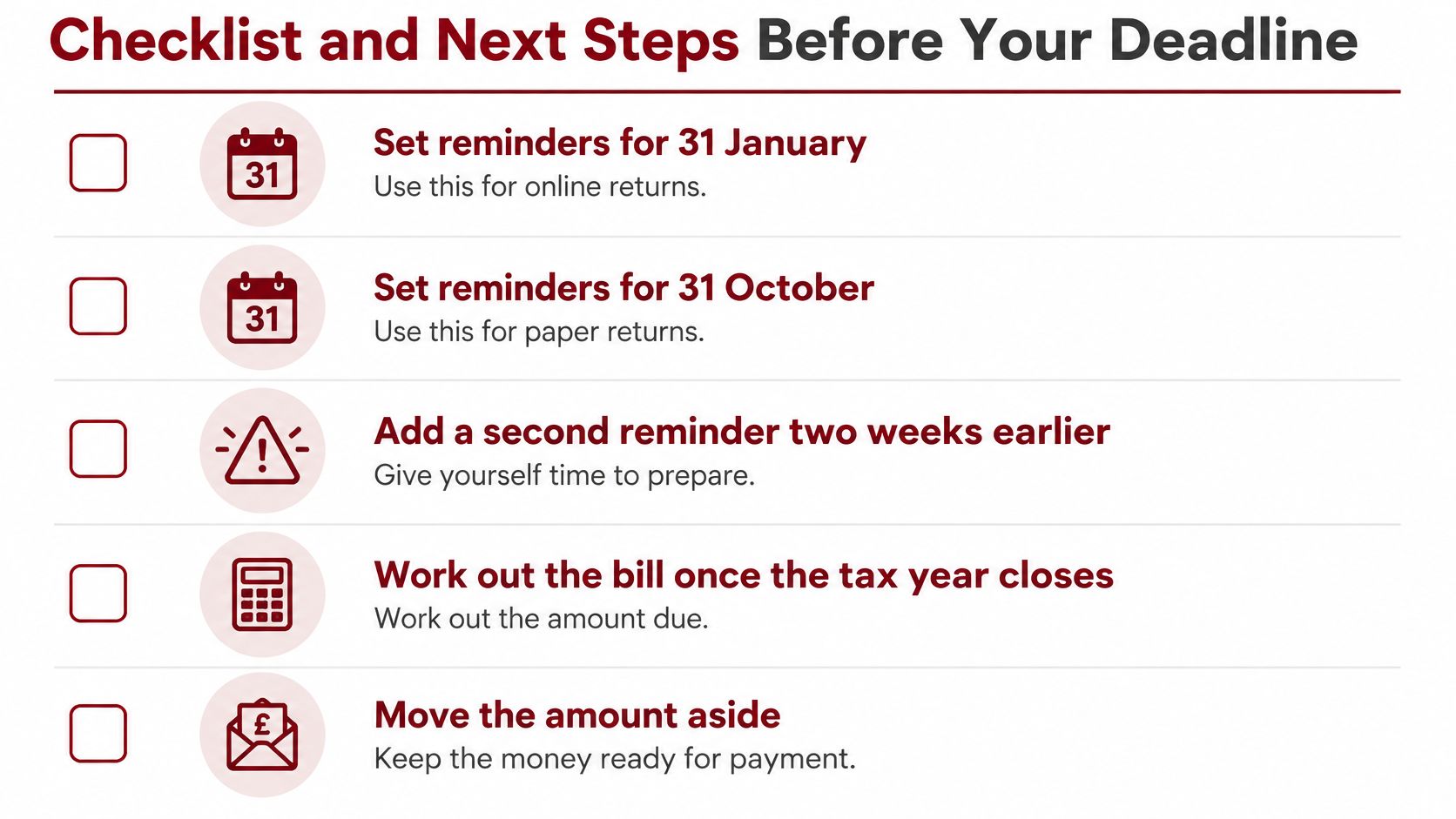
Use this checklist to organise preparation before the final rush.
Put preparation into the diary
- Confirm the applicable deadline. Use your HMRC account and correspondence, then add an earlier preparation reminder with enough time to resolve missing information.
- Calculate and reserve. Once the records are ready, work out the liability and move the required money away from everyday spending.
- Maintain the records. Store invoices, receipts, bank statements and tax documents consistently. A regular bookkeeping routine for sole traders makes preparation more manageable.
- Resolve incomplete information. Chase missing figures promptly and get advice on the correct treatment of anything still outstanding. Don't enter guesses to obtain a submission receipt.
Make completion verifiable
For a partnership, name the person responsible for coordinating preparation and approval. Where an agent prepares the return, agree the handover and approval process in writing, then request submission confirmation.
After filing, retain the acknowledgement and check the HMRC account for the payment position. If you can't pay in full, contact HMRC about the available payment options rather than leaving the balance unexplained.
Our Basic Self-Assessment Tax Return costs £250 + VAT per annum. The service includes a no obligation quote, completion of the return, calculation of the tax liability and filing, with liaison with HMRC on the client's behalf.
This week, create a return folder and populate it. Gather income records, allowable-expense evidence, property-income records if you're a landlord and CIS statements if you're a contractor. Then identify what's missing and assign each outstanding item a follow-up date.
Action Accountants Limited completes and files annual Self Assessment returns, calculates the tax liability and liaises with HMRC on your behalf. Visit Action Accountants Limited to request a no obligation quote and get your outstanding return or next filing deadline organised before avoidable penalties build.