Capital Gains Tax Explained: UK Rates, Reliefs and Dates
Capital Gains Tax Explained for UK sellers: how to work out CGT, current rates, reliefs and the 60-day property deadline.
HMRC now receives a large and growing volume of Capital Gains Tax on UK Property returns each year, and most of the decisions behind those bills were locked in months earlier. Your CGT position isn't decided when you complete a tax return. It's decided when you set the price, choose the completion date and work out which costs and losses you can prove.
Get capital gains tax explained properly before exchange and you'll usually have options. Leave it until after completion and you're mainly filling in forms about decisions you can't undo. For founders, landlords and investors, the bill turns on three things: the taxable gain, the rate your other income pushes you into, and the reporting deadline. On UK residential property you have 60 days from completion to report and pay, a clock that catches sellers who assume everything waits for Self Assessment. HMRC guidance on reporting other capital gains covers what to do when a gain falls outside the property return. Treat the 60-day deadline with the same seriousness as the rate. A correct calculation paid late is still a compliance failure.
Table of Contents
- What Capital Gains Tax Is and Who Pays It
- Current CGT Rates and Allowances for Your Sale
- How to Work Out Your CGT Bill Step by Step
- Worked Examples for Shares, Property and Business Sales
- Reliefs That Reduce or Defer Your Bill
- Reporting Deadlines and Pitfalls to Avoid
- Confirm Your CGT Position Before You Sell
What Capital Gains Tax Is and Who Pays It
Apply this test to any planned sale. Is there a disposal, of an in-scope asset, by a taxpayer who isn't exempt? If the answer to all three is yes, model the gain before you commit.
A disposal isn't only a sale for cash. It can also be a gift, an exchange, or another transfer where you give up ownership. That's where families get caught. Giving an asset to an adult child may feel like tidying up, but HMRC can still treat you as disposing of it, potentially by reference to its market value. You've received no cash, yet you may owe tax.
CGT is charged on profit, not sale proceeds. Think of a shopkeeper taxed on margin rather than takings. A flat sold for a high price doesn't automatically produce a large gain, and a modest-priced asset bought very cheaply can produce a surprisingly large one. Acquisition cost, qualifying improvement expenditure, disposal costs, losses and reliefs sit between the headline price and the taxable result.
Who Is in Chargeable Territory
- UK-resident individuals: You pay CGT personally on chargeable gains, subject to your available allowance, losses and reliefs.
- Trustees and personal representatives: You deal with gains in that capacity, with separate allowances and rates.
- Companies: A company doesn't pay CGT as an individual does. Its chargeable gains fall within Corporation Tax instead.
- Partners and joint owners: Each person's share matters. You don't get to choose one convenient taxpayer after the sale merely because one of you handled the paperwork.
In-scope assets commonly include shares held outside an ISA or pension, second homes, buy-to-let property, business assets, cryptoassets and certain personal possessions. Assets held inside an ISA or pension are usually sheltered, most private cars sit outside the charge, and your main home may be covered by private residence relief. Don't stretch those exceptions. A second property doesn't become your main home because you stay there occasionally, and shares held in a general investment account don't inherit ISA treatment because you'd intended to move them.
The context is getting harder to ignore. HM Revenue & Customs reported that UK taxpayers declared £127 billion in capital gains during the 2024-2025 tax year, an 82% increase from the previous year. More first-time sellers are meeting rules they previously assumed applied only to wealthy investors.

Start with ownership: The person, trust or company that owns the asset before disposal usually determines whose gain it is.
Current CGT Rates and Allowances for Your Sale
Start with the tax year of disposal. Yesterday's allowance won't rescue today's sale.
| Tax year | Individual exempt amount | Most trusts | Main individual rates (basic / higher) |
|---|---|---|---|
| 2021-22 | £12,300 | £6,150 | 10% / 20% (residential 18% / 28%) |
| 2022-23 | £12,300 | £6,150 | 10% / 20% (residential 18% / 28%) |
| 2023-24 | £6,000 | £3,000 | 10% / 20% (residential 18% / 28%) |
| 2024-25 to 29 October 2024 | £3,000 | £1,500 | 10% / 20% (residential 18% / 28%) |
| 2024-25 from 30 October 2024 | £3,000 | £1,500 | 18% / 24% |
| 2025-26 | £3,000 | £1,500 | 18% / 24% |
Check GOV.UK for the current year's figures before completion. Budgets move these numbers, and the only row that matters is the one covering your disposal date.
The HMRC Capital Gains Manual on the annual exempt amount records that the individual allowance was £12,300 in both 2021-22 and 2022-23, then fell to £6,000 in 2023-24 and £3,000 from 6 April 2024. Most trusts received half the individual amount. That collapse is why modest disposals now create tax or reporting issues that sellers once ignored. A £20,000 gain left £7,700 exposed in 2021-22. In 2025-26, £17,000 of the same gain is exposed.
The annual exempt amount is separate from your Income Tax personal allowance. Unused personal allowance doesn't shelter a capital gain. Sellers regularly overstate their tax-free capacity by adding the two together, then discover the gain is exposed much sooner than expected. Model them separately from the outset.
Rates changed just as sharply. The HMRC Capital Gains Manual on rates of tax states that from 30 October 2024, the main individual rates increased to 18% and 24%, while the rate for most trustees and personal representatives became 24%. Residential property moved into the same 18% or 24% structure. Before that change, the main individual rates were 10% and 20%, with residential property at 18% and 28%.
The Rule That Moves Your Rate
Your gain sits on top of your taxable income. If part of your basic-rate band remains unused, that part of the gain may take the lower CGT rate. Once your salary, dividends, rental profits or other income fill the band, the rest moves higher.
Two people selling identical assets for identical gains can pay different tax. A founder taking a large dividend in the sale year, or a landlord with substantial rental income, pushes the gain upwards. Someone between roles, or with lower taxable income that year, may keep part of the gain in the lower band. Timing is a decision, not an accident: shifting a completion into a quieter income year can hold more of the gain at 18%.
If the asset is UK residential property, the clock is tighter still. The gain must be reported and the tax paid within 60 days of completion, so your rate planning has to finish before you exchange contracts. There is no room to restructure after the sale.
Find your taxpayer type and disposal year first. Every other number in the estimate depends on those two rows.
Rates and allowances are inputs to a decision you make before exchange, not background trivia you look up afterwards.
How to Work Out Your CGT Bill Step by Step
Use this sequence before you accept an offer. The worked process in the visual below gives you the order, then the ten steps add the traps.
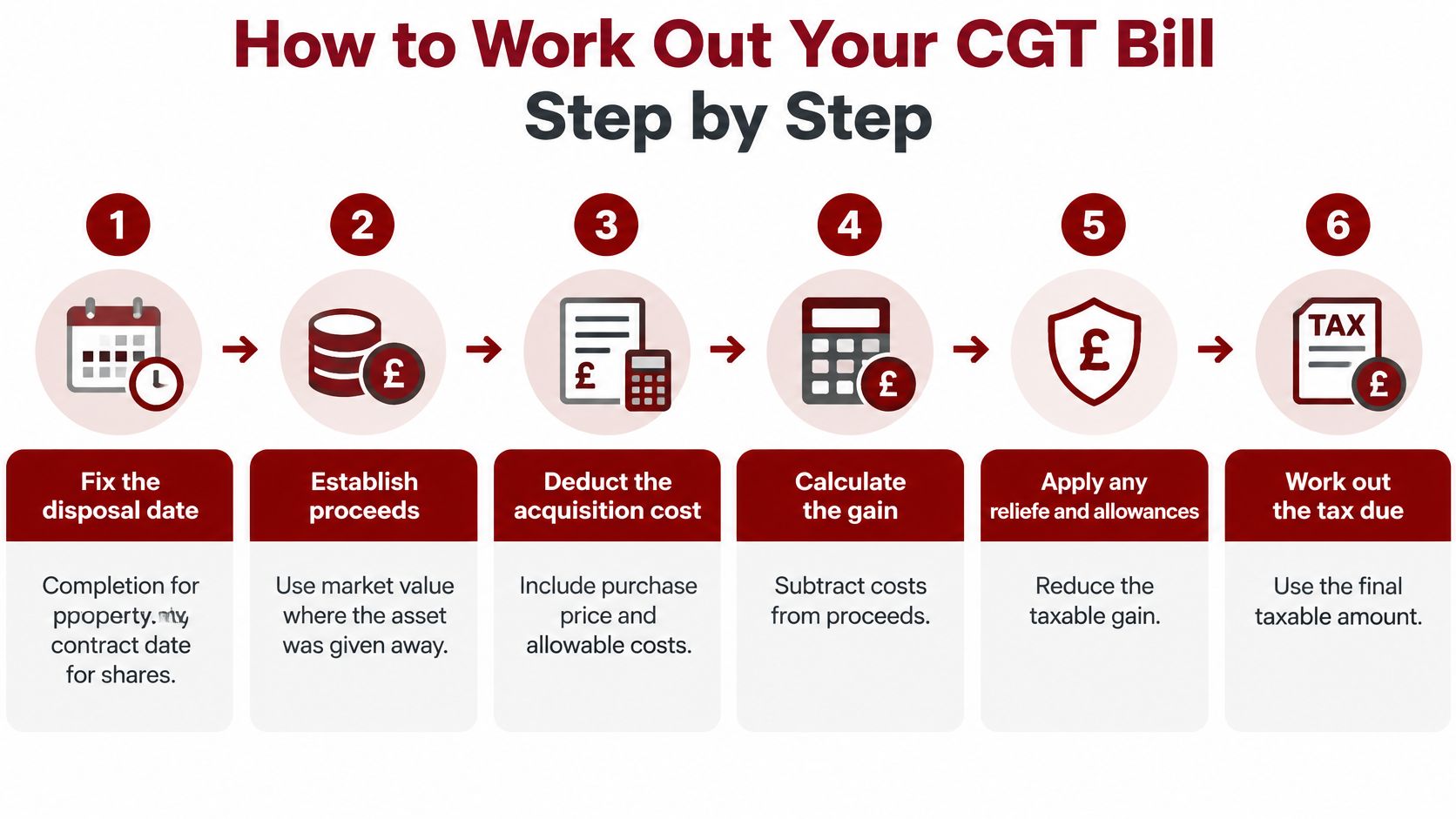
- Fix the disposal date: Use the legally relevant date for the asset, not the day cash reaches your bank. Getting this wrong can put the gain in the wrong tax year.
- Establish proceeds: Start with what you receive, and use market value where an asset is given away or transferred for less than it's worth. A nominal price between connected people won't necessarily control the calculation.
- Deduct acquisition cost: Include the purchase price and qualifying purchase costs. Weak records shrink your cost base and inflate the gain.
- Deduct capital improvements: Claim work that improves the asset, such as an extension. Don't dress up routine repairs as improvements.
- Deduct selling costs: Include qualifying agent, legal and other disposal costs. Keep invoices, not just bank entries.
- Use losses in the right order: Current-year losses come into the calculation, while brought-forward losses should be used efficiently rather than wastefully below the exempt amount. Undocumented losses are usually useless losses.
- Deduct the annual exempt amount: Apply the allowance for that year if it's still available. You can't roll an unused amount into next year.
- Apply the rate: Split the remaining gain according to your unused basic-rate band. Estimating without your expected income is guesswork.
- Apply any relief: Test eligibility before exchange, not after the asset has gone. One failed condition can change the rate or remove a deferral.
- Reserve the cash: Note the reporting and payment date immediately. Sale proceeds are not spendable proceeds until the tax reserve is separated.
The GOV.UK guide to CGT rates and allowances confirms that for 2025-26, the annual exempt amount is £3,000 for individuals and most personal representatives and £1,500 for most trustees. It also confirms that gains within the unused basic-rate band are generally taxed at 18%, with gains above it generally taxed at 24%.
For a business sale, the cost base and price need evidence. A disciplined approach to valuing a business before disposal helps you separate goodwill, assets and sale costs before negotiations harden.
This walkthrough shows why proceeds alone never answer the question:
Your mortgage does not reduce the gain. It reduces what you walk away with. Confusing those two figures causes some of the ugliest cash-flow surprises.
Worked Examples for Shares, Property and Business Sales
These are hypothetical illustrations. They assume no available losses, no other gains in the year, and that each seller has the full individual annual exempt amount available unless stated otherwise. Change one assumption and the result changes.
Shares Outside an ISA
Say a higher-rate taxpayer sells shares for £60,000. They originally cost £35,000, and selling costs are £500. The gain is £60,000 minus £35,000 minus £500, which equals £24,500. Deduct the £3,000 annual exempt amount, leaving £21,500. At 24%, the tax is £5,160.
The driver here is the seller's income position. The calculation doesn't begin at £60,000, but the rate is still unfavourable because the seller has no basic-rate band left. If you hold shares personally, don't look only at portfolio performance. Look at the tax year in which you crystallise it, whether losses are available, and whether spreading disposals would use another year's allowance. Investment timing and tax timing aren't the same exercise.
Buy-to-Let Flat
Say a landlord sells a flat for £320,000 after buying it for £240,000. There's a qualifying extension costing £15,000, plus £4,000 of qualifying purchase and sale costs. The gain is £61,000. After the £3,000 annual exempt amount, £58,000 remains. At 24%, the bill is £13,920.
The extension is doing real work in that calculation. Remove the evidence for it and the taxable gain rises. Treat a repair as an improvement and you risk the opposite error, understating the gain. Owners of holiday accommodation face their own fact patterns as well, so check the current treatment of furnished holiday let tax before assuming an ordinary buy-to-let answer fits.
The landlord also has a separate property reporting and payment problem. Even if the maths is right, the money must be available shortly after completion. If most proceeds repay a mortgage or fund the next purchase, reserve the tax first. Your lender doesn't care that HMRC is waiting.
Business Sale
Say a sole trader sells a business for £400,000, with a base cost of £150,000 and £10,000 of qualifying costs. The gain before the annual exempt amount is £240,000. After £3,000, £237,000 remains. If that gain qualifies for Business Asset Disposal Relief at 18%, the tax is £42,660.
Here, relief eligibility drives the answer more than the headline price. Founders should test it while the sale structure can still be changed. Owners who want broader transaction context can read specialist mergers and acquisitions advice for owners, then bring the proposed terms back into the tax calculation before signing.
Across all three examples, the sale price is the least informative number. Cost base, evidence, income and relief conditions decide what you keep.
Reliefs That Reduce or Defer Your Bill
Reliefs are conditional claims, decided by facts that exist before you exchange contracts. Meet every condition and document it, or budget for the tax at the full rate. The worst moment to learn a relief has failed is after completion, when the sale structure can no longer be changed.
| Relief | Who qualifies | What it does |
|---|---|---|
| Private residence relief | Owner-occupiers of their main home | Removes the gain for periods of occupation, with the last nine months treated as occupied |
| Business Asset Disposal Relief | Qualifying sole traders and qualifying shareholders in trading companies | Applies a reduced CGT rate to qualifying business gains |
| Investors' Relief | Qualifying individuals subscribing for shares in an unlisted trading company | Applies a reduced CGT rate where the investment conditions are met |
| Holdover relief | Donors giving business assets or unquoted shares | Defers the gain until the recipient disposes of the asset |
| Rollover relief | Businesses replacing qualifying assets from one year before to three years after disposal | Defers the gain by reducing the cost of the replacement asset |
Private Residence Relief
Your main home is sheltered for periods treated as occupation, including the final period set out in the table. Partial use gives partial answers. Letting part of the property, using a room exclusively for business, or living elsewhere for a stretch can each restrict the relief. The condition people miss is factual occupation: council tax bills and an address on a driving licence don't settle which property was your main residence. If you own two homes, the records decide, not the preference.
Business Asset Disposal Relief and Investors' Relief
Both reliefs apply a reduced CGT rate, and the rate and disposal-date rules change between tax years. Check the current rate on GOV.UK for your completion date before you price an exit, because a disposal either side of a rate change alters the bill. HM Revenue & Customs publishes what reliefs like these cost in its non-structural tax relief statistics.
Business Asset Disposal Relief, the relief that replaced entrepreneurs' relief, requires a qualifying business or shareholding and a qualifying ownership period. Being a founder isn't enough. Trading status, your role, your share rights and changes during the run-up to sale all need checking against the documents. Investors' Relief serves a different person entirely: outside investors in unlisted trading companies, where officers and employees of the company don't qualify. Confusing the two is an expensive category error.
A relief isn't secured because your buyer, broker or fellow shareholder says it should apply. Test your own conditions against the documents.
Holdover and Rollover Relief
Holdover relief can defer tax when qualifying business assets or unquoted shares are given away. The gain doesn't vanish. The recipient inherits a lower base cost, so the deferred gain resurfaces when they sell. Agree who carries that future cost before anyone calls the gift tax-free.
Rollover relief applies where sale proceeds are reinvested in qualifying replacement business assets within the permitted window. It defers the gain by cutting the replacement asset's base cost. The trap is spending first and checking later: the replacement must qualify, and reinvesting only part of the proceeds defers only part of the gain.
File the claim on time and keep the ownership history, company records, valuations and reinvestment evidence together. Relief value disappears quickly when the paperwork tells a different story from the claim.
Reporting Deadlines and Pitfalls to Avoid
The deadline most sellers miss isn't Self Assessment. It's the 60-day UK residential property deadline. The GOV.UK guidance on reporting and paying CGT states that where a UK residential property sale completes on or after 27 October 2021 and CGT is due, the seller must report and pay the estimated tax within 60 days of completion. It also states that ordinary repairs and routine maintenance generally don't create a capital deduction.
This timeline shows where that separate obligation sits:
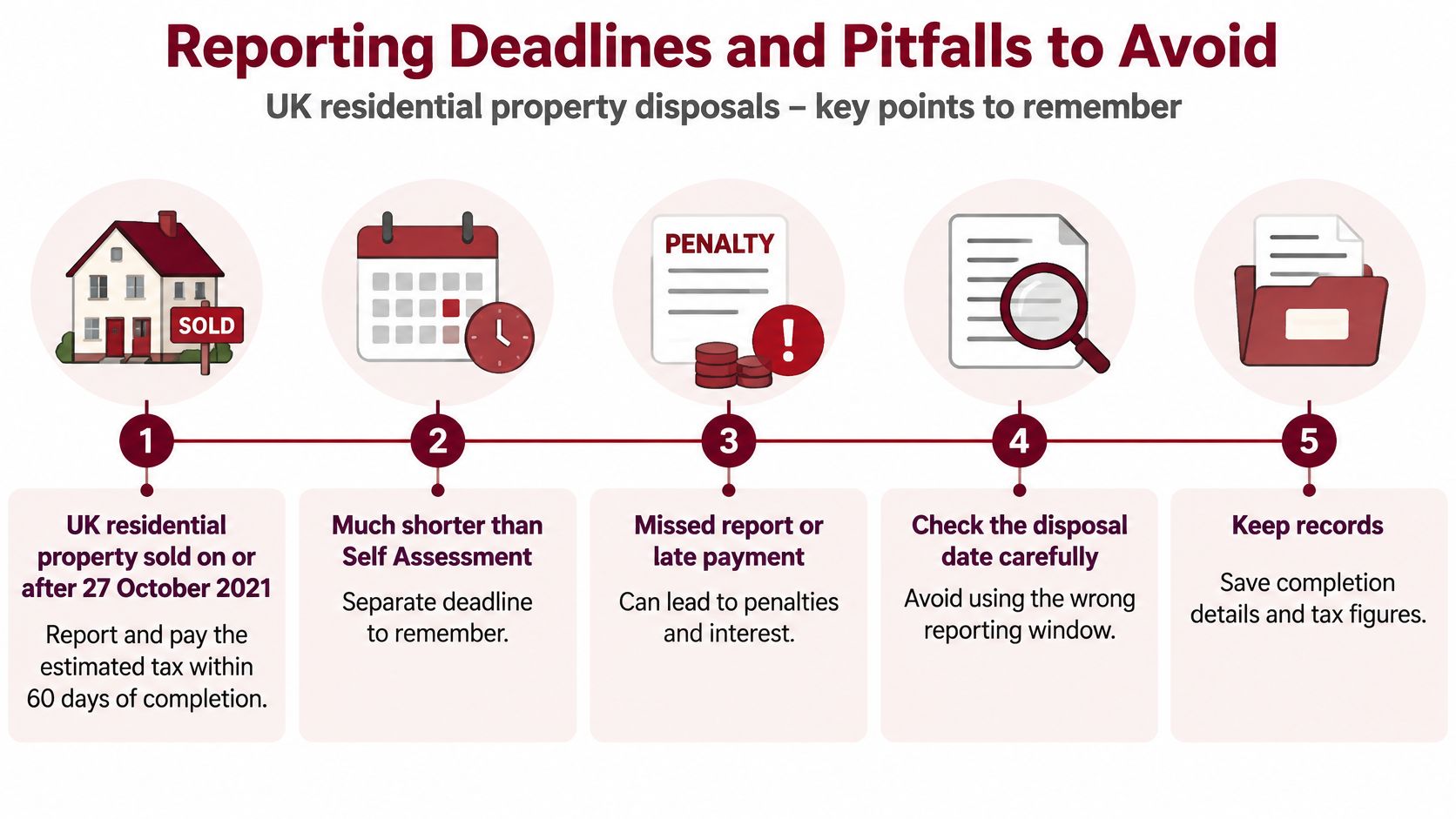
| Disposal | Report by | Pay by |
|---|---|---|
| UK residential property completed on or after 27 October 2021 | 60 days after completion | 60 days after completion, on the estimated tax |
| Other chargeable gains | Through the Self Assessment return for the relevant tax year | By the applicable Self Assessment payment date |
| Any gain where the estimate is wrong | Reconcile through the Self Assessment return | Balance due by the Self Assessment payment date, with interest where late |
Start at exchange, not completion. Model the gain, estimate your taxable income for the year, identify losses and reliefs, and decide how much cash stays untouched. At completion, the clock starts. Later, the Self Assessment return reconciles the estimate with the final position. If you underpaid because your income was higher than expected, expect a balance. If you overpaid, the reconciliation is where that gets corrected.
Where Sellers Trip Up
- No income estimate: A property calculation made before you know the year's salary, dividends or rent can use the wrong rate.
- Repairs labelled as improvements: Repainting and fixing what's broken don't automatically increase your capital cost base.
- Joint ownership ignored: Each owner's share, allowance and income position need separate attention.
- Inherited property mishandled: Your cost base may start from the value when you inherited it, not what the deceased originally paid. Don't guess from family memory.
- Deferred consideration overlooked: Business sale proceeds may include payments after completion. Tax timing and valuation need attention before you sign.
- Missing records: Completion statements and improvement invoices should be gathered before exchange, while solicitors and sellers can still retrieve them.
Contractors and sole traders create a second problem when business and personal records blur. Use a consistent system to track freelance income and expenses, so costs supporting a later asset sale aren't buried in unsorted bank transactions.
Check the wider tax return filing deadline as part of the same diary exercise. The property return doesn't replace your eventual Self Assessment responsibility where one is required.
A provisional figure is only as good as the records behind it. Build the file before completion and the deadline becomes administration. Build it afterwards and it becomes archaeology.
Confirm Your CGT Position Before You Sell
The cheapest CGT bill is usually shaped before exchange. After that, you're defending a position rather than designing one.
- Use more than one tax year where commercially sensible: Spreading disposals can use another annual exempt amount instead of wasting it.
- Review spousal ownership early: A transfer between spouses or civil partners before sale may allow both allowances and basic-rate bands to be considered, provided the ownership change is genuine and properly implemented.
- Bring losses into the open: Identify documented capital losses before the sale and use them efficiently against the gain.
- Watch the income year: Deferring a disposal may help if a salary, dividend or rental spike would push the gain into the higher rate.
- Model the exit, not just the asset: Founders should align the disposal with a documented business exit plan before relief conditions or sale terms are fixed.
Now gather the completion statement, acquisition records, improvement invoices, selling costs and loss history. Estimate your total income for the year. Then reserve the tax before you allocate the proceeds elsewhere.
Our compliance service includes completing tax returns, calculating the liability, and advising you on exactly when to make payments and how much to pay. It also includes practical advice on personal tax and available planning opportunities, and we deal with HMRC enquiries and represent clients in HMRC reviews. CGT rewards people who model early and keep evidence. It punishes people who treat the return as the start of the conversation.
If you're planning to sell shares, property or a business, Action Accountants Limited can model the gain before exchange, check reliefs and losses, and confirm what must be reported and when. Visit us to request a quote and settle your CGT position before contracts make the answer irreversible.