
Is Redundancy Pay Taxable? Your Complete UK Guide
Is redundancy pay taxable in the UK? Learn how the £30,000 rule works, what stays tax-free, and which payments attract Income Tax and National Insurance.

You've been handed a redundancy settlement and the headline figure looks reassuring. Then you notice separate amounts for statutory redundancy, enhanced compensation, notice, holiday pay and perhaps a bonus. The obvious question is simple: is redundancy pay taxable in the UK?
The answer is yes for some parts and no for others. The £30,000 rule applies to qualifying termination compensation, not automatically to every payment made when your employment ends. HMRC looks at what each amount is paying for, and the wording and legal basis in the settlement agreement can influence how payroll treats it.
Table of Contents
- What You Are About to Navigate with Your Redundancy Package
- The £30,000 Tax-Free Exemption Explained Simply
- Which Parts of a Redundancy Package Are Taxable
- Worked Examples for Mixed Redundancy Packages
- Employer Payroll and Reporting Obligations
- Common Pitfalls and Misconceptions to Avoid
- Practical Next Steps for Employees and Employers
What You Are About to Navigate with Your Redundancy Package
A long-serving employee may receive a letter after a restructure showing one large “redundancy package”. That label can hide several different payments. Statutory redundancy pay may sit beside pay in lieu of notice, accrued holiday, unpaid salary, commission, a bonus or an additional settlement amount. Those items don't all receive the same tax treatment.
The practical mistake is to look at the total and ask whether it falls below or above £30,000. You should first split the package into its legal components. The tax position follows the purpose of each payment, not the total shown in the offer letter.
This guide answers the questions that usually matter most:
- What does the £30,000 exemption cover?
- Which parts of a redundancy package are taxable?
- How do Income Tax and National Insurance apply in practice?
- What must the employer report through payroll and RTI?
- Which errors create avoidable tax problems?
- What should the employee and employer do next?
A settlement agreement should be read alongside the employment contract, especially where the contract contains notice, bonus, commission or benefit provisions. If you're reviewing the wider employment documentation, these samples of employment contracts can help illustrate how contractual entitlements are commonly recorded.
The central rule: classify the payment first, then apply the exemption. Never apply the exemption to the package as one undivided lump sum.
The worked examples later use the same method. They separate compensation from earnings, identify the amount that enters PAYE, and show why an employee's bank receipt may differ sharply from the headline settlement.
The £30,000 Tax-Free Exemption Explained Simply
The UK's central rule is that the first combined £30,000 of qualifying statutory redundancy pay and additional severance or enhanced redundancy compensation is usually free of Income Tax and National Insurance. This is not a general tax-free allowance for everything paid at termination.
The exemption is designed for compensation connected with the loss of employment. Amounts that represent salary, contractual benefits or payment for work already performed remain taxable as earnings. GOV.UK explains that unpaid wages, holiday pay, bonuses, restrictive covenant payments and pay in lieu of notice are treated separately from qualifying redundancy compensation. See the official HMRC guidance on redundancy pay, tax and National Insurance.
The conditions behind the exemption
For a payment to be treated as a relevant termination payment, HMRC's analysis focuses on the connection between the payment and the employment ending. The following conditions are useful when reviewing a package:
| Condition | What It Means in Practice |
|---|---|
| The contract ends | The payment must arise from the ending of the employment contract, rather than from ordinary work performed while employment continues. |
| At least two years' continuous service | The statutory redundancy context requires the employee to have at least two years' continuous service. |
| The payment connects to termination | The amount must compensate for the loss or ending of the office or employment. |
| The amount is not unreasonably above entitlement | A payment that is contractual, statutory or genuinely negotiated as compensation must be considered on its facts. An unreasonable excess may not receive the expected treatment. |
The £30,000 limit is cumulative. Statutory redundancy pay and an enhanced redundancy payment are not separate tax-free pots. They are combined with other qualifying termination compensation when deciding how much of the exemption remains.
Any qualifying compensation above £30,000 is subject to Income Tax, although qualifying redundancy compensation above the threshold isn't subject to employee National Insurance. That differs from notice pay, holiday pay, bonuses and unpaid wages, which are earnings and generally attract both Income Tax and National Insurance.
The strongest practical rule is this: the exemption applies to genuine compensation for termination, not to money the employee was already entitled to receive as part of normal employment.
Which Parts of a Redundancy Package Are Taxable
Start with the agreement's payment schedule. Don't rely on a single phrase such as “ex-gratia redundancy payment”. A package can contain tax-free compensation and fully taxable earnings-like items at the same time.
The statutory redundancy calculation is normally treated as qualifying redundancy compensation. An enhanced redundancy payment can also fall within the same treatment when it compensates the employee for losing employment. Together, those amounts use the same £30,000 exemption.
By contrast, holiday pay is payment for leave that has accrued during employment. It's earnings, not compensation for the loss of office. The same applies to unpaid salary, commission and a bonus that has been earned or triggered under the employment terms.
A component-by-component assessment
| Package Component | Tax Treatment |
|---|---|
| Statutory redundancy pay | Usually qualifying termination compensation. It uses the combined £30,000 exemption. |
| Enhanced or additional redundancy compensation | Usually included within the same exemption when it genuinely compensates for termination. |
| Compensation above the combined £30,000 threshold | Subject to Income Tax. Qualifying redundancy compensation above the threshold isn't subject to employee National Insurance. |
| Pay in lieu of untaken holiday | Treated as earnings under the accrual principle, so it's taxable and subject to National Insurance. |
| Death-in-service style payment | Treatment depends on the legal basis and facts of the payment. It shouldn't be assumed to be ordinary redundancy compensation. |
| Pay in lieu of notice, or PILON | Taxable earnings, with Income Tax and National Insurance applied through payroll. For a plain-English explanation, read Payment in Lieu of Notice explained. |
| Contractual bonus or commission | Taxable earnings where the employee has earned or become entitled to the amount. |
| Outstanding salary | Taxable earnings, reported through payroll. |
| Benefits continuing after termination | The tax position depends on the benefit and how it's provided. Non-cash benefits require separate review. |
| Settlement amount for giving up employment-related rights | Usually analysed as a termination payment, but the agreement must accurately identify what the amount settles and whether another rule makes it taxable. |
The table contains an important distinction. A payment described as “compensation” may still be taxable if it really replaces notice pay, salary or another contractual entitlement. Conversely, an enhanced redundancy amount may receive termination-payment treatment even though it exceeds the statutory minimum.
The label matters because it records the parties' intended allocation and gives payroll a basis for processing the payment. It doesn't override the substance. HMRC can examine what the payment is for, so an employer shouldn't relabel PILON as compensation merely to reduce deductions.
The Low Incomes Tax Reform Group guidance on redundancy confirms the practical split: holiday pay, unpaid wages, bonuses and notice pay are earnings, while qualifying redundancy compensation is treated under the termination-payment rules.
Worked Examples for Mixed Redundancy Packages
The calculation becomes manageable once every amount has a category. The examples below show the classification, but they don't pretend to calculate an employee's exact bank receipt without a tax code, cumulative earnings, pension deductions and other payroll details. A precise take-home figure depends on those missing facts.
Example one, statutory redundancy plus PILON
An employee receives £12,000 statutory redundancy pay and four weeks' pay in lieu of notice. The statutory amount is qualifying compensation and falls within the available exemption. The PILON is earnings, so the employer processes it through PAYE and applies Income Tax and National Insurance.
The employee's tax code must be applied to the taxable payroll amount in the normal way. The tax-free redundancy element doesn't use up the employee's PAYE personal allowance because it isn't treated as ordinary earnings.
The employee won't have a P60 showing the tax-free redundancy amount as taxable pay. The taxable notice payment forms part of the employee's pay and tax records for the relevant tax year.
Example two, enhanced severance above the threshold
An employee earning £35,000 receives £45,000 of enhanced severance, with no separate notice, holiday or bonus amounts included. The first £30,000 is usually exempt. The remaining £15,000 is subject to Income Tax at the employee's marginal rate, but qualifying redundancy compensation above the threshold isn't subject to employee National Insurance.
The exact PAYE deduction depends on the employee's tax code and other income in the tax year. If the employee already has substantial taxable salary, the excess may be taxed at a higher marginal rate. The P60 records the taxable amount included in payroll, not the exempt portion as taxable earnings.
Example three, a negotiated mixed settlement
Consider a package containing:
- £20,000 redundancy compensation
- £10,000 ex-gratia bonus
- £3,000 unused holiday pay
- £5,000 PILON
The redundancy compensation and ex-gratia amount are considered together as qualifying termination compensation. Their combined total reaches the £30,000 exemption. The holiday pay and PILON are separate earnings items, so both go through PAYE and are subject to Income Tax and National Insurance.
| Package Component | Example 1, £22k total | Example 2, £45k total | Example 3, £38k total |
|---|---|---|---|
| Qualifying compensation | £12,000 exemption applies | £30,000 exemption, then £15,000 taxable | £30,000 combined exemption |
| PILON | Taxable earnings | None stated | £5,000 taxable earnings |
| Holiday pay | None stated | None stated | £3,000 taxable earnings |
| Employee National Insurance | Applies to PILON | Not to qualifying redundancy compensation | Applies to PILON and holiday pay |
| P60 treatment | Taxable PILON only | Taxable excess only | Taxable PILON and holiday pay |
These examples also expose why a headline total is inadequate. Two packages with similar totals can produce different net payments because one may contain mostly compensation while another contains notice and accrued employment earnings.
Employer Payroll and Reporting Obligations
The employer should classify the package before the final payroll is run. Waiting until payment day encourages a single gross figure to be processed incorrectly, particularly where the settlement agreement combines compensation with notice, holiday and bonus amounts.
Process the final payment correctly
The employer should:
- Read the payment schedule. Identify statutory redundancy pay, enhanced compensation, PILON, holiday pay, salary, bonus, commission and benefits separately.
- Apply the exemption only to qualifying compensation. The combined £30,000 threshold isn't a blanket exemption for the entire final payment.
- Run taxable items through PAYE. Notice pay, holiday pay, unpaid wages and taxable bonuses are earnings.
- Apply the employee's tax code to taxable elements. The exempt compensation shouldn't consume the PAYE personal allowance.
- Calculate National Insurance by category. Class 1 National Insurance applies to earnings. It doesn't apply to qualifying redundancy compensation, including the qualifying amount above the £30,000 threshold for employee NIC purposes.
The employer must also report the taxable payment through Real Time Information, normally using the Full Payment Submission for the relevant payroll run. The final payment should sit in the tax year in which it's paid, rather than being moved informally to a more convenient period.
P45, P60 and benefits
The P45 should be issued when employment ends, showing the employee's pay and tax details needed by a future employer or HMRC. A P60 is issued for the tax year where the employee remains employed at the year end, and it records taxable pay and tax deducted. The exempt redundancy compensation isn't shown as taxable earnings on the P60.
Non-cash benefits require separate treatment. A retained benefit, benefit continuing after termination or reimbursed item may need review for payroll or P11D reporting, depending on its nature and the conditions attached.
Employers should retain the agreement, calculation, payroll workings and correspondence for the applicable record-keeping period. They also need a clear audit trail showing why each amount was classified as compensation or earnings.
For businesses that need a more structured approach to final payroll processing, guidance on payroll for small business can help establish consistent controls around leavers, RTI and payroll records.
Payroll instruction: Don't ask the payslip label to do the legal work. Record the commercial and contractual reason for each payment before deciding its tax code.
Common Pitfalls and Misconceptions to Avoid
The most expensive mistakes happen when an employer or employee treats the £30,000 exemption as a packaging exercise. It isn't. HMRC distinguishes compensation for losing employment from earnings that arose during employment or from contractual notice obligations.
Mislabelling PILON as “ex-gratia” is a classic error. If the amount represents notice pay, calling it compensation won't change the obligation to deduct Income Tax and National Insurance. The same warning applies to bonus, commission, accrued holiday and unpaid salary. Putting those amounts under a broad “redundancy” heading doesn't turn them into tax-free compensation.
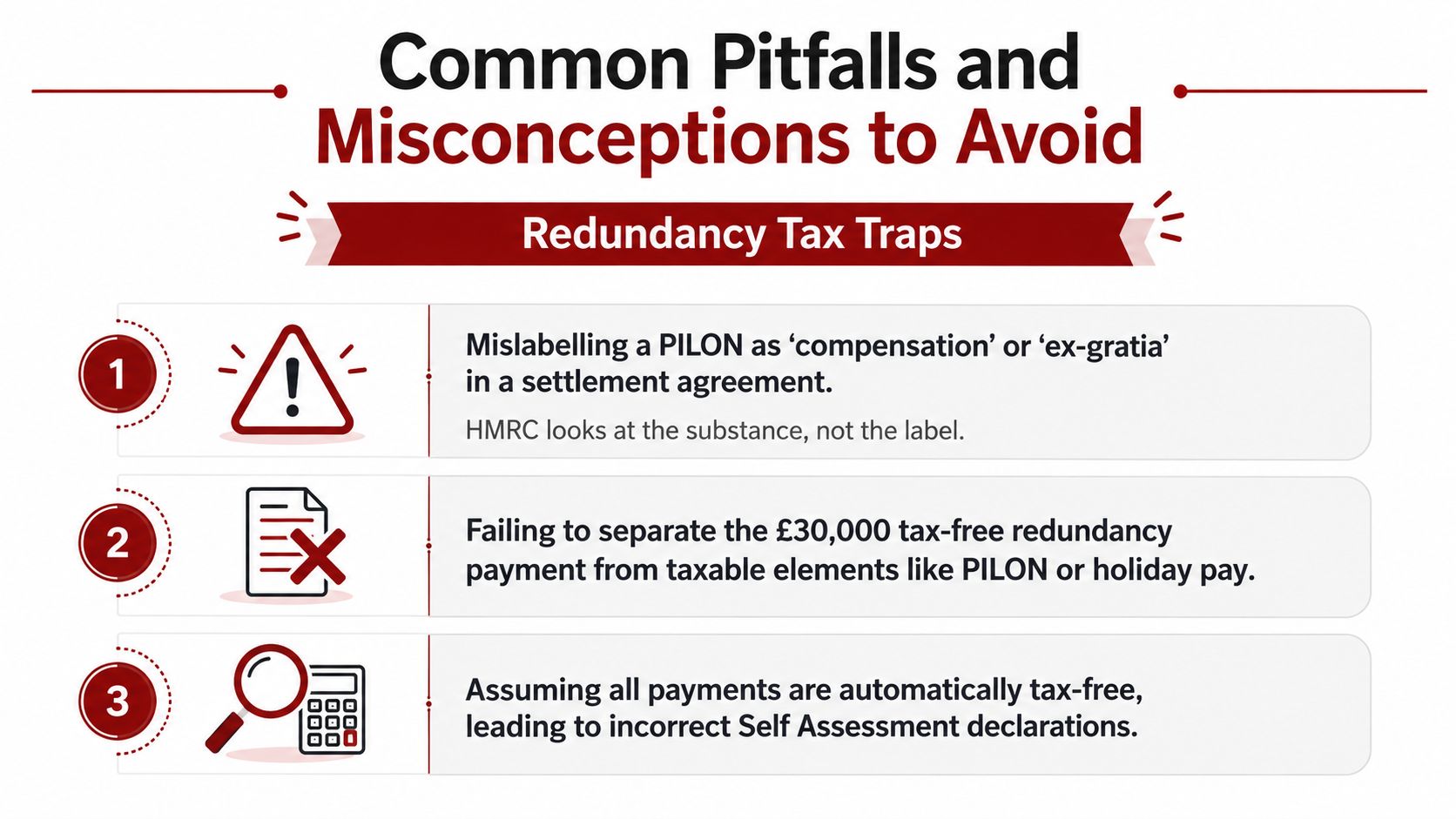
Five checks that prevent trouble
- Separate statutory and enhanced redundancy correctly. They aggregate for the combined exemption. They aren't separate allowances.
- Keep earnings outside the exemption. Holiday pay, unpaid wages, bonuses, commission and notice pay remain taxable as earnings.
- Check legal-fee arrangements. Employer-funded legal fees may require a benefit-in-kind analysis. Don't assume the payment is automatically tax-free because it relates to a settlement.
- Review unusual service history. Foreign service, overseas duties and other cross-border facts can change the analysis. Specialist advice is appropriate where the employment has an international element.
- Test the agreement against the facts. The payment's legal basis and purpose matter more than promotional wording in an offer letter.
An employee who believes too much tax has been deducted should compare the agreement, final payslip, P45 and tax code. The overpayment relief claim guidance may be relevant where the tax treatment needs to be corrected, but the first step is identifying whether the error concerns classification, payroll timing or the tax code.
Practical Next Steps for Employees and Employers
Employees should ask for a written schedule before signing anything. It should identify the qualifying redundancy compensation separately from PILON, holiday pay, salary, bonus, commission and benefits. Check the final payslip against that schedule, then review the tax code and the pay and tax figures on the P45.
Keep the settlement agreement, calculation and payslips with your tax records. If the PAYE deduction looks wrong, contact HMRC or a payroll-savvy accountant with the full breakdown rather than relying on the headline settlement figure.
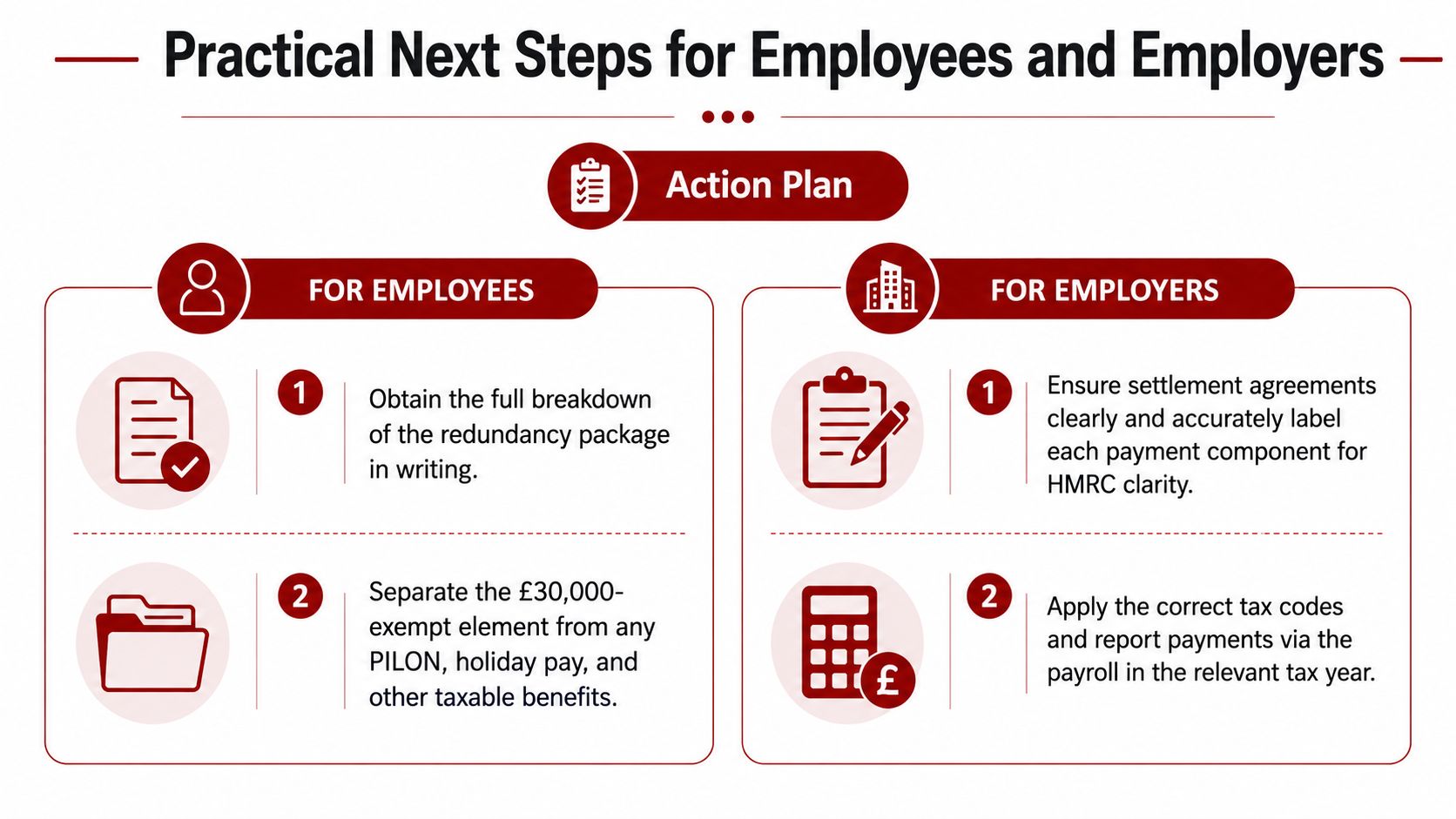
Employers should classify every component before payroll, document the reasoning, apply the exemption only to genuine compensation and report taxable amounts through RTI. They should also check whether any non-cash benefit requires P11D treatment and ensure the P45 and P60 reflect the taxable payroll correctly.
The employer should review its PAYE payment deadlines so deductions are paid and reported on time. Specialist advice is essential where the agreement includes foreign service, share arrangements, unusual benefits, pension contributions, disputed contractual rights or a substantial payment above the exemption.
If you're unsure whether your redundancy package has been split correctly, don't sign or process it on the basis of a single headline figure. Get the agreement, contract and proposed payroll breakdown reviewed together.
Action Accountants Limited can review redundancy packages, separate qualifying compensation from taxable earnings, and help employers process final payroll and reporting accurately. Visit Action Accountants Limited for practical UK tax, payroll and accounting support.