
Mileage Rates HMRC Company Car: Rates, Tax and Records
Mileage Rates HMRC Company Car explained: 2026-27 AMAP and AFR rates, tax, NIC, records and worked examples for UK firms.
The most repeated advice on mileage rates HMRC company car claims is incorrect. Many payroll templates still say "pay 55p a mile and you're fine." That rate is not a universal HMRC mileage rate. It is the approved amount for an employee using their own car or van. Put the same figure on a company car and you have overstated the tax-free payment, often by a wide margin.
Ownership decides the rate set. Everything else, the pence, the tax, and the records, follows that one choice.
Table of Contents
- HMRC Mileage Rates for 2026-27 at a Glance
- Which Mileage Rules Apply to Your Car
- Company Car Fuel Rates by Engine and Fuel Type
- How to Calculate a Company Car Mileage Claim
- Worked Examples for Directors and Employees
- Tax, National Insurance and P11D Reporting
- Recordkeeping Checklist for Mileage Claims
- Choose Your Mileage Policy Before the Next Claim
HMRC Mileage Rates for 2026-27 at a Glance
From 6 April 2026, the HMRC approved mileage allowance for an employee's own car or van is 55 pence per business mile for the first 10,000 miles in a tax year. Every business mile above that threshold falls to 25 pence.
Before 6 April 2026 the first-band rate was 45 pence, so the 2026 change lifted the headline rate by 10 pence, or approximately 22.2%. Update any policy, spreadsheet, or expense system that still carries the old first band for journeys on or after that date.
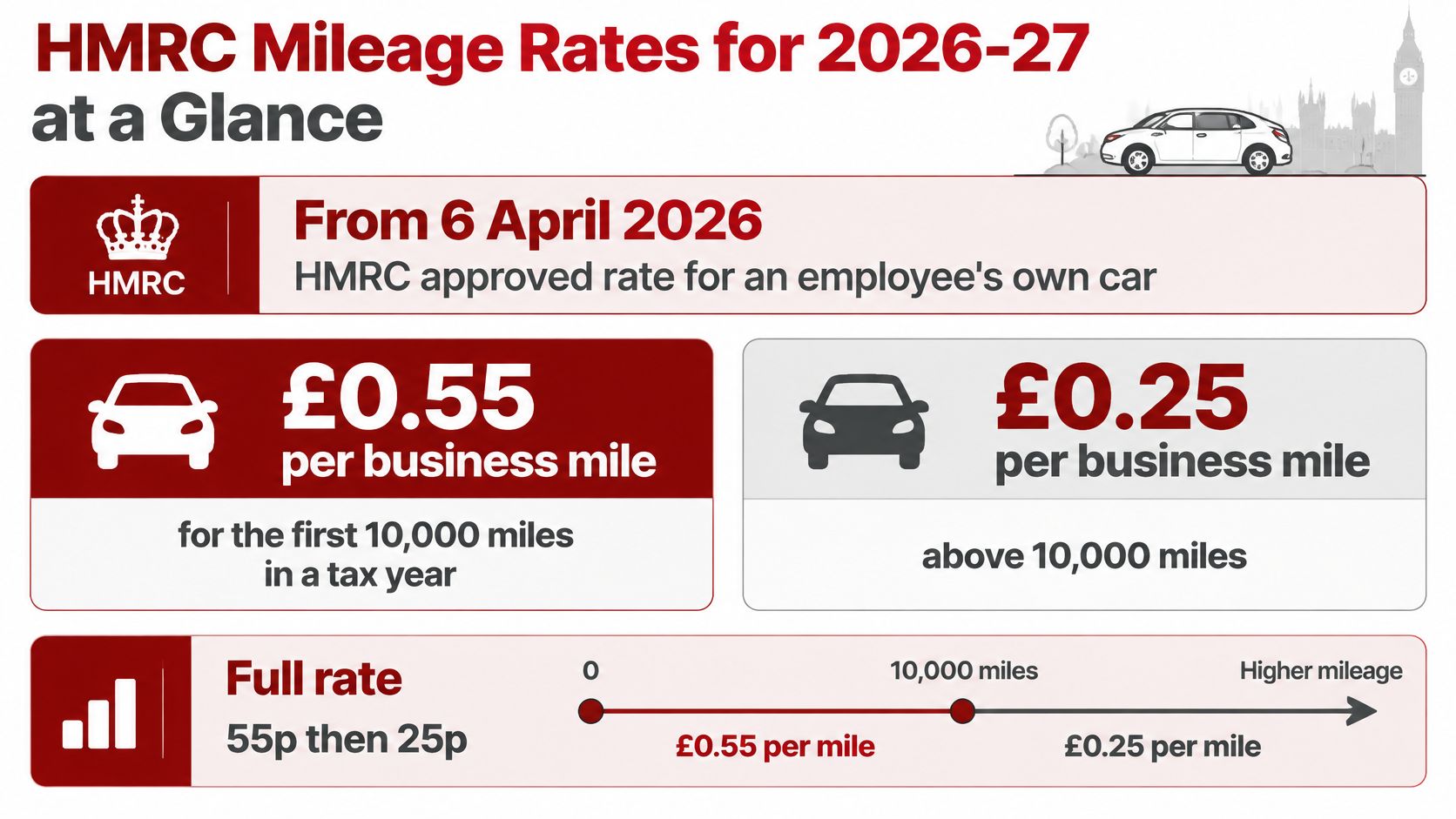
These Approved Mileage Allowance Payments (AMAPs) are a benchmark, not an order to pay that amount. You may pay more or less. Pay above the approved amount and the excess can create taxable reporting obligations. Pay below it and the employee may claim tax relief on the shortfall.
| Vehicle or journey | Rate per business mile | Applies to |
|---|---|---|
| Car or van, first 10,000 miles in tax year | 55p | Employee-owned vehicle |
| Car or van, above 10,000 miles in tax year | 25p | Employee-owned vehicle |
| Motorcycle | 24p | Employee-owned motorcycle |
| Bicycle | 20p | Employee-owned bicycle |
| Passenger carried on business journey | 5p per passenger | Fellow employees carried |
The same schedule sets motorcycle mileage at 24 pence per mile and bicycle mileage at 20 pence per mile, with a separate 5 pence passenger payment for carrying fellow employees on qualifying business journeys. The passenger amount is per passenger, and only where that colleague is also travelling for the business.
The 10,000-mile split applies to cars and vans, and it is cumulative across the tax year, not per month or per trip. Motorcycles and bicycles have no second band.
Practical rule: This table covers employee-owned vehicles only. A company car follows a different rate set.
Which Mileage Rules Apply to Your Car
Think of the own-car rate as a fixed fare for a taxi you bring yourself. It is meant to cover the running costs of that car. A company car is closer to a hire vehicle. The employer already funds the car, so the mileage payment should cover the fuel element, not insurance, servicing, and depreciation as well.
HMRC's employer rates and thresholds for 2026 to 2027 draw the line clearly. AMAPs are generally for employees using their own cars. Advisory Fuel Rates (AFRs) apply to employees using a company car. For 2026–27, AMAPs are 55p per mile for the first 10,000 business miles and 25p thereafter, while company-car AFRs vary by fuel type and engine size. Petrol cars over 2,000cc are listed at 27p per mile from 1 September 2026.
| Criterion | Own car (AMAP) | Company car (AFR) |
|---|---|---|
| Who owns the vehicle | Employee | Employer |
| Rate source | Approved Mileage Allowance Payments | Advisory Fuel Rates |
| What the rate covers | Full running costs of the car | Fuel element only |
| Rate structure | 55p then 25p per mile | Set by fuel type and engine size |
| Evidence needed | Business mileage log | Mileage log plus vehicle engine and fuel details |
There is no obligation to use AFRs. Pay above the applicable AFR, and the excess can be taxable where it is not a genuine expense reimbursement.
The switch founders actually make
A founder often starts in a personal car, then moves to a leased or salary-sacrifice company vehicle. That pattern is common in small London businesses. Record the change date. Price journeys before it on the own-car rates and journeys after it on the company-car rates. Do not wait for year end and apply one rate to the whole year.
Two errors cost real money.
- 55p on a company car: You overstate the tax-free reimbursement. The gap between 55p and a fuel-only rate is profit HMRC can treat as taxable pay.
- An AFR on a private car: You under-reimburse the employee and you are in the wrong framework. The shortfall may still be claimable, which pushes admin onto the driver. Our note on tax deductible expenses for the self-employed is the right place if the driver is not on payroll at all.
Payroll needs one field that never gets skipped: who owns the car on the date of the journey.
Company Car Fuel Rates by Engine and Fuel Type
Look up the car before you look up the rate. HMRC advisory fuel rates from 1 September 2026 are engine- and fuel-specific, because fuel consumption and energy cost vary by powertrain. One flat pence figure will misstate the reimbursement.
| Vehicle type | Engine size or charging | Advisory rate per mile |
|---|---|---|
| Petrol | Up to 1,400cc | 14p |
| Petrol | 1,401cc to 2,000cc | 17p |
| Petrol | Above 2,000cc | 27p |
| Diesel | Up to 1,600cc | 15p |
| Diesel | 1,601cc to 2,000cc | 16p |
| Diesel | Above 2,000cc | 22p |
| Hybrid | Treated as petrol or diesel | Use the matching petrol or diesel rate |
| Electric | Home charging | 7p |
| Electric | Public charging | 15p |
How to pick the band
Take the engine size and fuel type from the V5C, not from memory and not from a similar car in the fleet. Match the rate to the vehicle used on that journey.
Petrol and diesel bands are not the same. A diesel up to 1,600cc is not in the petrol "up to 1,400cc" box. Read the row that matches the fuel in the tank.
Hybrids are treated as petrol or diesel for this calculation. They do not use the electric rates. If the hybrid runs on petrol, use the petrol band for its engine size.
Electric company cars
Fully electric company cars use separate advisory electricity rates: 7p per mile for home charging and 15p for public charging. These rates let you reimburse business mileage without collecting every fuel receipt, but only if the rate matches the charging location.
Charge a home-charged journey at the 15p public rate and you overpay against HMRC's benchmark. Use the 7p home rate for a driver who mostly charges in public and you under-reimburse them.
Where a driver uses both, split the miles on a fair basis and keep the split with the claim. Electricity is not treated as a fuel for company-car fuel-benefit purposes, so the mileage payment and any private-use fuel benefit are separate questions. Do not net them off in one figure.
AFRs move with fuel prices, so diarise a check each quarter. A rate typed into a spreadsheet in the spring can be the wrong band by autumn.
How to Calculate a Company Car Mileage Claim
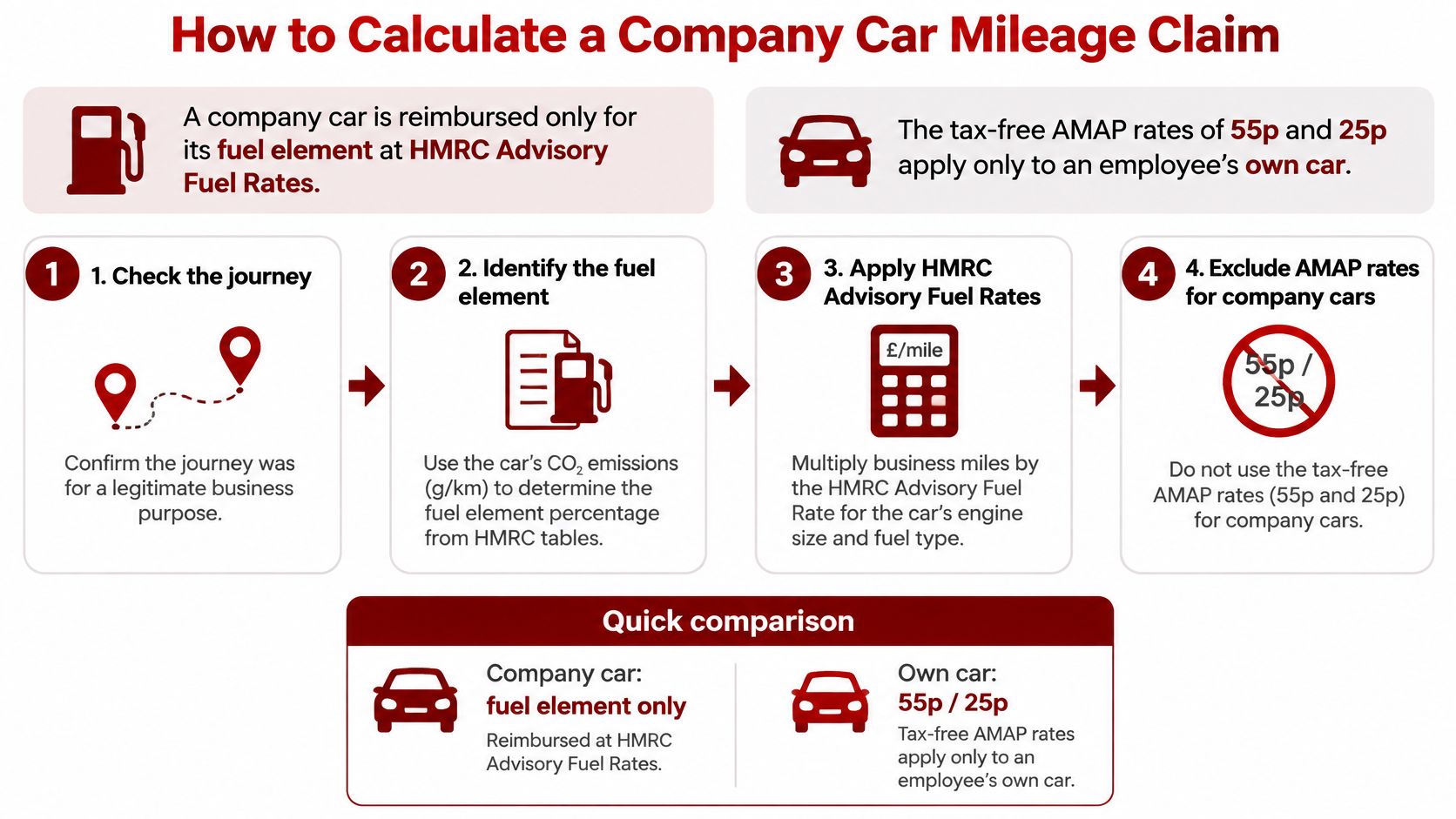
A company car is reimbursed only for its fuel element at HMRC advisory fuel rates. The tax-free AMAP rates of 55p and 25p apply only to an employee's own car. HMRC's mileage allowance guidance is blunt on this: employers cannot apply those tax-free approved rates to a company car, and treating the payment as an ordinary mileage allowance outside that exemption can create taxable excess and payroll reporting.
The travel, mileage and fuel rates also keep three calculations apart. The car's taxable benefit uses its tax price and an appropriate percentage linked mainly to CO2 and fuel type. Fuel reimbursement uses the advisory rates. For 2026–2027 the company-car fuel benefit multiplier is £29,200. Fully electric cars have a 4% appropriate percentage, cars emitting 1–50g/km can range from 4% to 16% depending on electric range, and a diesel supplement can add 4 percentage points where it applies. Say the appropriate percentage is 4% on a £30,000 list price. That is a £1,200 taxable benefit before you have paid a penny of fuel.
- Confirm ownership and purpose. The car must be a company car, and each journey must be genuine business travel. Commuting to a permanent workplace does not qualify.
- Log the journey. Date, start, end, and purpose. The log is what proves the miles were business.
- Read the V5C. Engine size and fuel type pick the AFR band. The band is what proves the rate.
- Electric cars: name the charger. Home rate or public rate, based on where that journey was charged.
- Multiply. Business miles in each band times the selected rate. Do not blend bands into an average.
- Pay it as fuel only. Run the total through payroll or expenses, and store the amount with the rate you applied.
- Reconcile. Match logs to payments at month end and again at year end, before P11D and payroll deadlines.
HMRC allows a lower mileage payment plus a separately calculated fuel amount, but only if you document that structure and apply it the same way every time.
A short walk-through of the same split is worth ten minutes before you change the payroll code.
Worked Examples for Directors and Employees
Say an employee drives 12,000 qualifying business miles in their own car. The approved amount is £6,000: 10,000 miles at £0.55 is £5,500, and 2,000 miles at £0.25 is £500. Miss the threshold and you either overpay the second band or short-change the driver.
| Scenario | Calculation | Result |
|---|---|---|
| Employee, own car, 12,000 business miles | 10,000 × £0.55 + 2,000 × £0.25 | £6,000 |
| Employee, own car, 8,000 business miles | 8,000 × £0.55 | £4,400 |
| Employer pays 60p on own car, 8,000 miles | 8,000 × £0.60 = £4,800 against an approved £4,400 | £400 taxable excess |
What actually moves the number
Staying inside the first band. At 8,000 business miles the whole claim sits at 55p, so the approved amount is £4,400. There is no second-band cut. The risk is the opposite: paying 60p. On those 8,000 miles the employer pays £4,800 against an approved £4,400, and £400 is taxable excess. That excess belongs in payroll, not in a "rounding" column. If you run payroll for a small business, build the excess into the pay run rather than discovering it at year end.
Changing car mid-year. A founder who moves from a personal car to a company petrol car must split the year at the change date. Miles before that date use the own-car bands. Miles after it use the AFR for that petrol engine. Add the two results. One blended rate for the year is the mistake.
Charging location on an electric company car. The same 3,000 business miles are £210 at 7p if they were charged at home, and £450 at 15p if they were charged in public. Location changes the claim by more than double. "Electric" is not a rate.
These figures are illustrative. Every payment must use the actual business miles and the actual vehicle.
Tax, National Insurance and P11D Reporting
Two bills get mixed up. They are not the same bill.
Excess mileage is pay
Any mileage payment above the approved amount for that vehicle is taxable earnings. It runs through PAYE and it attracts National Insurance. In the 60p example, that excess is added to pay. It is not a harmless round-up, and it does not disappear because the driver "uses the car for work."
Report it. Leaving it off the payroll record is how a tidy expense policy becomes an HMRC correction, with employer's National Insurance on top. Directors are not exempt from that treatment. Our guide to National Insurance for directors is the place to check how director pay interacts with benefits.
The car itself is a benefit
A company car is a benefit in kind. The taxable amount starts from the car's tax price, multiplied by an appropriate percentage tied mainly to CO2 and fuel type. That calculation stands whether or not you also reimburse fuel. A cheap fuel rate does not shrink the car benefit.
Employers report these benefits on the P11D and pay Class 1A National Insurance on them. We prepare a P11D at £95 + VAT per employee per annum. That fee is small next to a wrong benefit figure carried for a full tax year, but it is not optional admin if a car or an excess payment exists.
Check the car's current list price, CO2, and fuel type before you estimate the benefit. Keep the mileage reimbursement and the benefit-in-kind calculation in separate workings. One spreadsheet that "nets them off" will not survive a review.
Recordkeeping Checklist for Mileage Claims
A claim without a log is weak evidence. A log without the engine and fuel details cannot justify a company-car band. Build the record at the time of the journey, not from memory at month end.
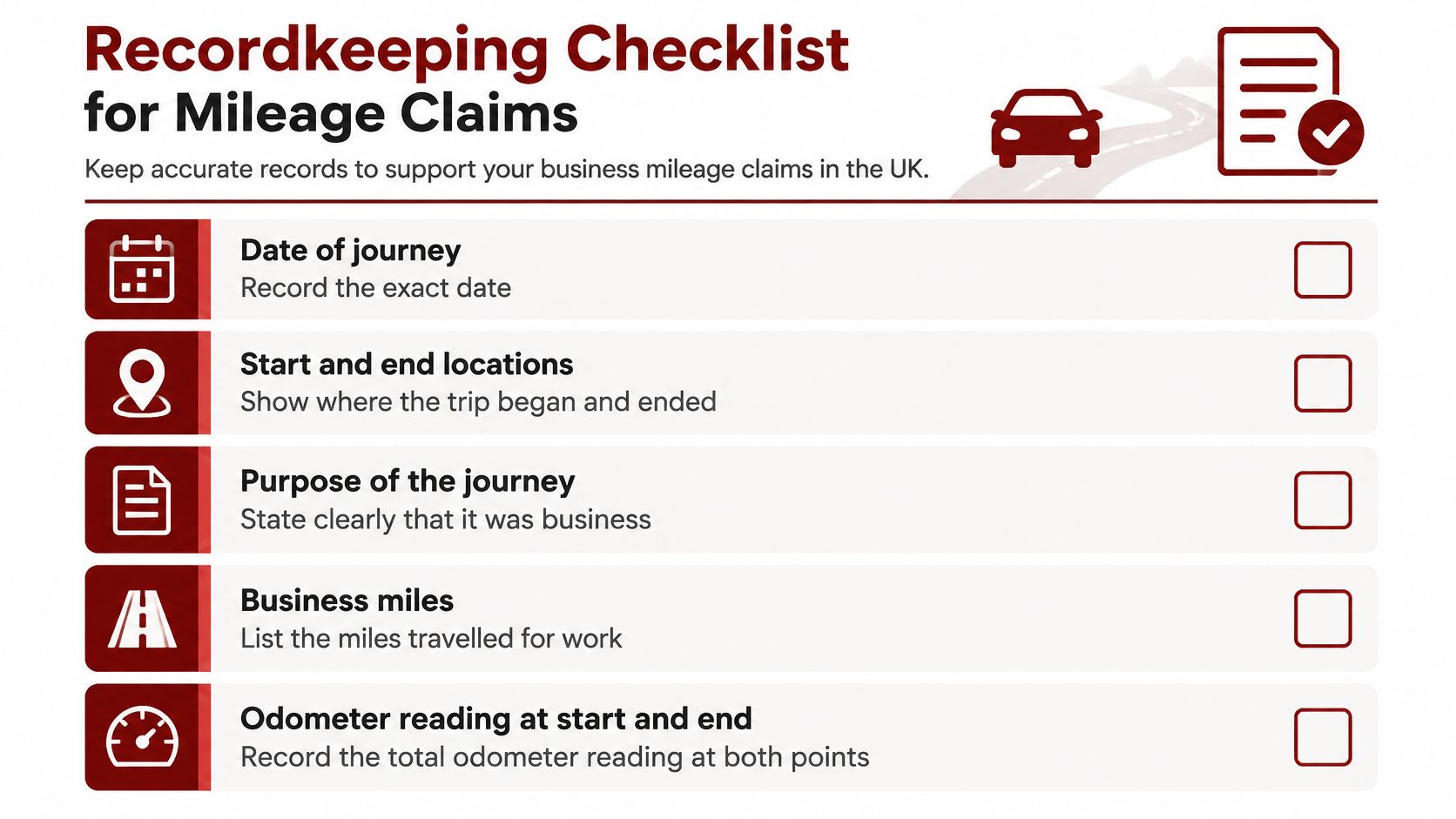
- Date of journey: Ties the miles to the rate in force that day, including a mid-year AFR change.
- Start and end locations: Shows the trip was not ordinary commuting dressed up as a client visit.
- Purpose, stated as business: "Meeting" is not a purpose. Name the client, site, or task.
- Business miles, plus odometer at start and end: Stops rounded totals that collapse under a check.
- Vehicle registration: Proves which car, so ownership and rate source are obvious.
- Engine size and fuel type: This is what justifies the AFR band. Take it from the V5C.
- Charging location for electric cars: Home or public. Without it, 7p and 15p are a guess.
- Rate applied and why: Write "own car, first band" or "diesel 1,601–2,000cc," not just a pence figure.
- Amount paid and payment date: Links the log to the bank or payroll entry.
- Approval by a director or budget holder: A second pair of eyes before the money moves.
If paper logs keep failing, UK mileage tracking advice from Snyp is a useful check on what a defendable record contains. The tool matters less than whether the fields above are filled in before the claim is approved.
Reconcile logs to payments every month. Year-end is too late to discover that three drivers crossed 10,000 miles in January and you kept paying the first-band rate. Sole traders who claim mileage rather than actual running costs should keep a fresh log for each tax year and strip out private miles. Our bookkeeping for sole traders work is built around that separation. Keep employer expense and payroll records for the full period HMRC can enquire, and keep a sole trader's log until well after that year's filing deadline.
Choose Your Mileage Policy Before the Next Claim
Pick the rule for the car you have, then write it down.
Employee, own car. Use 55p then 25p, and track the 10,000-mile threshold across the tax year. Do not reset it each month.
Company car. Pay the AFR for fuel only, on the band for that engine, fuel, or charging location. Never drop the own-car rate onto it.
Sole trader or contractor in a personal car. You are not on the employee route. Claim business miles under the self-employed mileage rules, confirm the simplified rate HMRC publishes for sole traders before you claim, and keep a separate log for each tax year that excludes private miles.
London SME. Write a one-page policy. Who owns each vehicle. Which rate source applies. The log format. The payment cycle. The review date.
- List every vehicle used for business.
- Confirm ownership for each one.
- Assign the rate source, AMAP or AFR.
- Set the log template and refuse claims that skip a field.
- Review the policy at each tax year end, and again whenever a car changes.
For a limited company that wants this policed with the rest of the compliance, the Limited Companies Premium package starts at £355 per month + VAT for annual turnover up to £500k, £455 per month + VAT for up to £1 million, and £960 per month + VAT for up to £3 million. Each fee is a general estimate, because every proposal is customised to individual circumstances and the complexity of the work involved.
Ask us in Colindale to review the mileage policy and the P11D position for any company car before the next claim run.
Action Accountants Limited prepares payroll, benefits, and expense reviews for London founders who need mileage rates HMRC company car claims to match the car that was driven. We separate own-car reimbursements from company-car fuel, and we file the P11D and payroll consequences that follow. Visit Action Accountants Limited and book a review before the next claim run.