
Management Consulting for Small Businesses: Key Strategies
Discover how management consulting for small businesses can drive growth, improve efficiency, and solve key challenges in 2026.

A Harrow electrical contractor opens the banking app and sees a balance that doesn't match the spreadsheet. Three invoices are overdue, a client is chasing an update on WhatsApp, and the next CIS payment deadline is approaching. Revenue looks healthy, but the owner is still working late to keep suppliers paid.
That isn't a branding problem. It's a management problem, usually involving cash conversion, pricing, workflow, controls, or all four. Management consulting for small businesses should fix those leaks in a focused, modular engagement, not bury an owner under a six-figure strategy retainer and a deck nobody uses.
Table of Contents
- When a Small Business Owner Knows It Is Time to Bring in Outside Help
- What Management Consulting for Small Businesses Covers
- Why Targeted Advice Pays Off in the UK Small-Business Economy
- How a Typical Engagement Works From First Call to Final Handover
- Pricing Models and How to Budget Without Bleeding Cash
- The Cash-Flow First Approach to Consulting for SMEs
- Choosing the Right Consultant in North West London
- Your First Two Weeks With a Management Consultant
When a Small Business Owner Knows It Is Time to Bring in Outside Help
The Harrow contractor doesn't necessarily need a grand transformation programme. They need someone to reconcile what has been sold, delivered, invoiced, collected, and spent. A good adviser can isolate the bottleneck, agree a measurable outcome, and help install a process the team can operate without constant owner intervention.
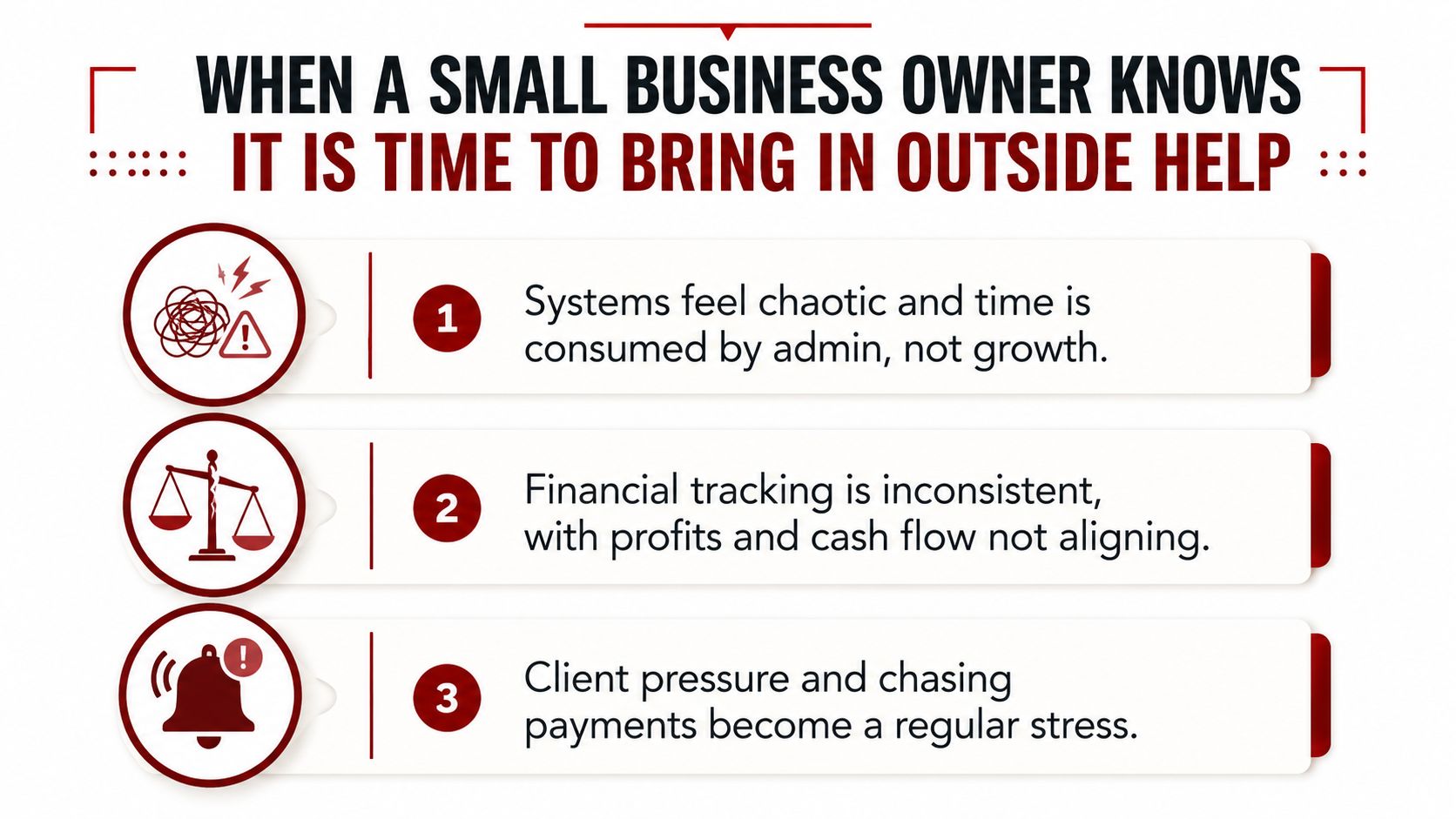
Revenue is rising while cash is tightening. More work can create more pressure when invoices go out late, deposits aren't collected, or customers pay outside agreed terms. Turnover can make the business look successful while unpaid work consumes the money needed for wages, materials, and tax.
The owner is spending most of the week on administration. If quoting, chasing debtors, approving purchases, correcting timesheets, and answering routine questions occupy the owner's evenings, the business has outgrown its informal systems. The owner's time should be spent on decisions and relationships, not reconstructing basic information.
Margins keep shrinking despite price increases. A price rise won't repair a job that was under-quoted, over-resourced, or burdened by untracked subcontractor and travel costs. A consultant should examine job-level profitability and identify whether the problem sits in pricing, scope control, purchasing, scheduling, or overhead.
CIS or VAT processes are drifting. Construction businesses need controls around subcontractor verification, deductions, records, and reconciliations. A growing firm can't rely on memory, scattered emails, and an end-of-month scramble to keep compliance work accurate.
Decisions are being delayed because nobody has the full picture. If the owner can't answer which customers are profitable, how much cash is committed, or which jobs are absorbing capacity, they're making expensive decisions with partial information. That's the point at which outside help becomes practical rather than indulgent.
The same discipline helps when a firm is ready to bid for larger customers. Owners preparing to win public sector contracts as an SME often need stronger financial records, documented processes, delivery controls, and evidence that the business can manage contract obligations.
What Management Consulting for Small Businesses Covers
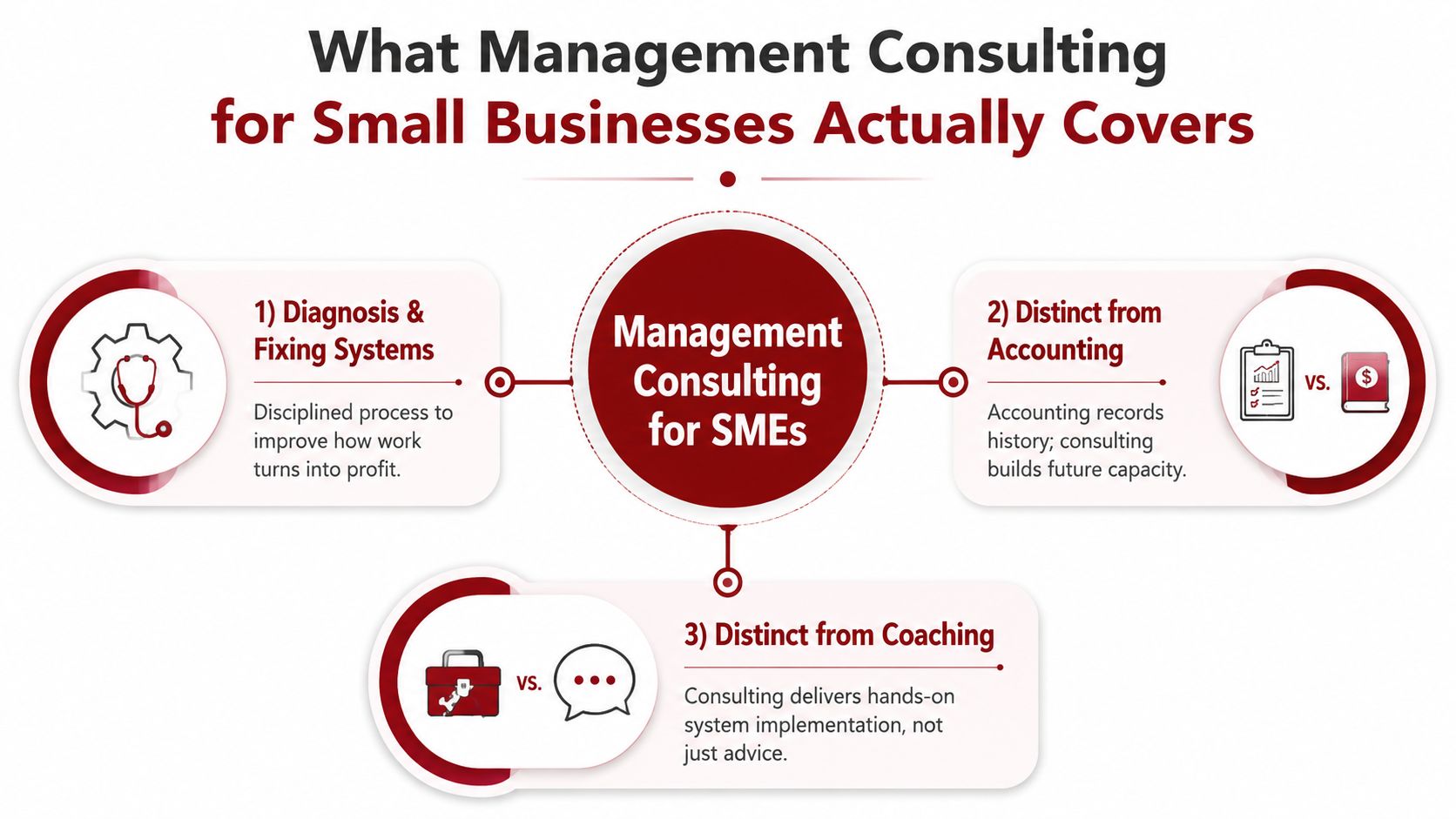
A plumbing firm can complete jobs on time and still lose money because invoicing lags, labour is poorly scheduled, or variations are missed. A consultant follows that chain from enquiry to payment, finds the constraint, and changes the operating process. An accountant records results and supports reporting and tax work. A coach develops confidence, accountability, and decision-making. Consulting changes how the business functions day to day.
The five workstreams owners buy
Operations covers the path from enquiry to completion and payment. For a plumbing firm, the work might include job costing, tighter engineer scheduling, and faster completion sign-off followed by invoicing. A trade contractor may need labour, materials, subcontractors, and variations matched clearly to each job.
Finance turns accounts into usable management information. A design studio could need monthly management accounts, a dashboard showing gross margin and overhead, and pricing that reflects senior staff time spent on client work. Statutory accounts rarely answer those questions quickly enough.
Profitability shows where money is made and lost. Emergency work may produce a healthy margin while fixed-price packages perform poorly and certain customers consume excessive administration. The consultant should give the owner evidence for changing prices, services, terms, or customer selection.
Cash flow deals with timing, not just accounting profit. A practical review may set up an aged-debtor routine, clearer payment terms, staged billing, supplier negotiations, and a rolling forecast. Late payment can leave a profitable business short of cash because it funds delivery before customers settle their invoices.
CIS-aware controls support construction contractors and subcontractors. They should cover verification, the correct treatment of subcontractors, deduction records, and monthly reconciliation between bookkeeping and payment records. Consulting does not replace specialist tax advice. It makes the controls used by the business dependable.
A consultant can connect operational improvements with visibility and customer acquisition, including integrating business consulting in SEO. Do this only when the offer, capacity, pricing, and fulfilment process can handle the demand that marketing generates.
Scope matters. Commission one workstream, such as a pricing review or debtor-control reset, instead of paying for a full transformation. Accounting support can sit alongside the engagement, including the practical services outlined in this guide to how an accountant can help a small business. A modular brief keeps the work tied to a measurable business problem and protects cash while changes are implemented.
Why Targeted Advice Pays Off in the UK Small-Business Economy
UK policy evidence gives owners a stronger reason to take focused advice seriously. The Enterprise Research Centre review found that formal business advice was associated with around a 10% productivity increase, and that the effect could persist for at least two years after businesses took up the advice. The same review cites broader evidence associating external advice with an average 22% increase in labour productivity, while trusted professional advice was associated with gains of 35% for exporting advice and 26% for tax and payments advice. The Enterprise Research Centre review explains why the subject matters beyond abstract strategy.
The UK government's evidence annex also reports that a 0.1-point increase in management-score quality in the ONS Management and Expectations Survey was associated with a 9.6% productivity increase. It reports the same 22% average labour-productivity association for SMEs using external advice, with trusted professional advice linked to 26% in tax and payments and 35% in exporting. The government's small-business evidence annex points towards targeted management improvement, not generic motivational support.
At the start of 2024, the UK had 5.5 million SMEs, representing 99.8% of the business population, according to the Enterprise Research Centre review. That scale means small improvements in controls and productivity matter to individual owners and to the wider economy.
| Pain Point | UK Data Snapshot | Typical Consulting Lever |
|---|---|---|
| Weak productivity and management controls | Formal advice associated with around 10% productivity improvement, with effects lasting at least two years | Management scorecard, workflow redesign, job costing, accountability |
| External advice not being used strategically | SMEs accessing external advice associated with a 22% average labour-productivity increase | Narrow diagnostic tied to a defined operational constraint |
| Tax and payment friction | Trusted professional advice associated with a 26% gain in tax and payments | VAT, CIS, payment controls, reconciliations, and process ownership |
| Export and market expansion barriers | Trusted professional exporting advice associated with a 35% gain | Readiness review, pricing, documentation, and delivery controls |
| Small firms dominate the economy | SMEs represented 99.8% of the UK business population at the start of 2024 | Practical, modular support designed for owner-managed capacity |
The commercial test: if the consultant can't identify the cash, margin, capacity, or compliance outcome being pursued, the brief isn't ready.
How a Typical Engagement Works From First Call to Final Handover
A small-business engagement should resemble building work. You agree what needs fixing, inspect the relevant parts, carry out the work, test it, and hand the process back. You shouldn't pay for an attractive research project that leaves the same problems sitting on your desk.
Five stages with visible deliverables
Discovery call. Use the first conversation to name the commercial problem. Is it overdue debt, weak job margins, an overloaded owner, unreliable forecasts, or CIS administration? The consultant should listen for the symptom behind the complaint and send a short written summary of the proposed focus.
Written scope. The proposal should state what's included, what isn't, the information required, the meetings involved, the success measures, and the fixed price or agreed fee method. Ask for deliverables in plain language, such as a debtor-control process, a pricing model, or a weekly cash-flow routine.
Diagnostic week. The consultant reviews management accounts, aged debtors, bank information, contracts, pricing records, and relevant CIS documentation. They should speak with the people who quote, schedule, deliver, invoice, and chase payment. The output should be a prioritised diagnosis, not a long list of observations.
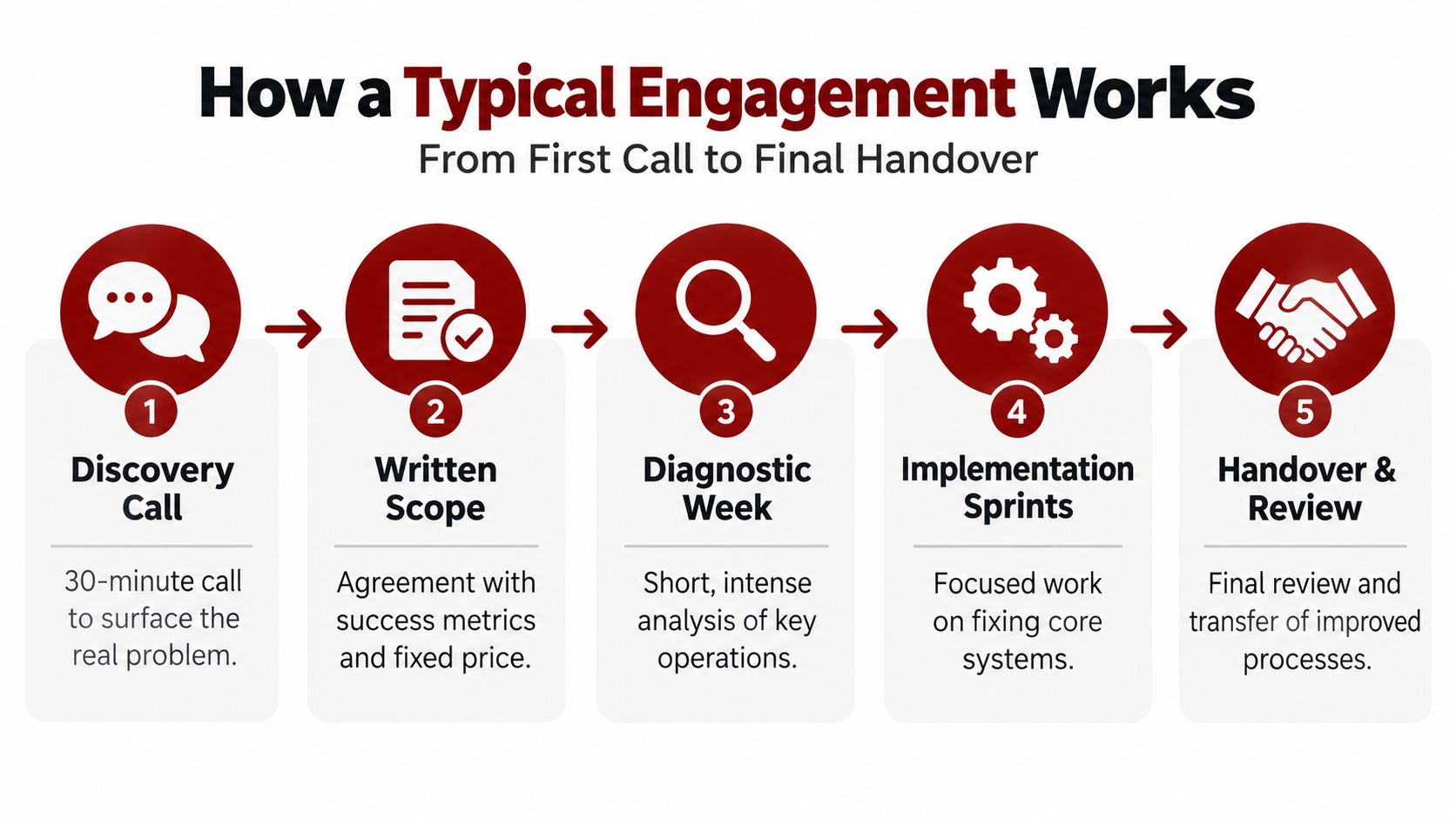
Implementation sprints. A defined delivery block should produce a one-page action plan, the required working templates, a written playbook, and a short weekly stand-up. The consultant should work with staff on the new process, rather than explaining it to the owner.
Handover and review. The final stage transfers ownership to the business. Include a 30-day handover period and a 90-day follow-up review, with outstanding actions, responsible people, and the measures to monitor. The owner should know exactly what happens next without the consultant.
The format below shows the level of specificity worth demanding.
| Stage | Owner should receive |
|---|---|
| Discovery | Problem statement and proposed focus |
| Scope | Success metrics, exclusions, timetable, and fee |
| Diagnosis | Findings, evidence, priorities, and risks |
| Implementation | New process, templates, training, and action tracker |
| Handover | Playbook, ownership map, review dates, and next actions |
This video can provide additional context on how advisory work should connect diagnosis with practical implementation.
Pricing Models and How to Budget Without Bleeding Cash
Price matters because a consultant can't improve cash flow while creating a new cash crisis. Compare the fee structure with the shape of the problem, the certainty of the deliverable, and the owner's ability to implement the recommendations.
| Pricing Model | Typical UK Range for SMEs | Best Fit | Main Risk |
|---|---|---|---|
| Hourly | £90 to £250 outside London, £150 to £400 or more in London | One-off clarity, review, or specialist question | Open-ended hours and scope creep |
| Fixed-fee project | Agreed per project | Defined work such as a pricing or cash-flow review | Weak brief creates disputes over exclusions |
| Monthly retainer | £800 to £3,500 for SMEs | Ongoing part-time finance and operations support | Paying for availability without clear outputs |
| Outcome-based fee | Tied to recovered cash or profit improvement | Aggressive cash recovery or compliance work | Disagreement over attribution and measurement |
The figures in this comparison are the planning ranges supplied for this brief. Treat them as budgeting guidance, not a quotation. London pricing can vary with experience, specialism, urgency, and the complexity of the records.
Hourly work suits a narrow question. Fixed fee is usually cleaner when you want a defined output, such as a pricing review, debtor process, or management dashboard. A retainer makes sense when the owner wants ongoing access to a part-time finance and operations director rather than a single intervention.
Outcome-based fees can align incentives when the work directly targets recovered cash or a defined profit improvement. They need careful drafting, including the baseline, measurement period, responsibilities, exclusions, and treatment of results that arise from unrelated trading changes.
The hidden cost of cheap hourly advice is unfinished implementation. Before accepting a low rate, ask how many hours the consultant expects, what you'll receive, who will build the templates, and what happens when the initial diagnosis reveals a second problem. For a wider view of accounting and advisory fee structures, review small-business accounting pricing guidance.
The Cash-Flow First Approach to Consulting for SMEs
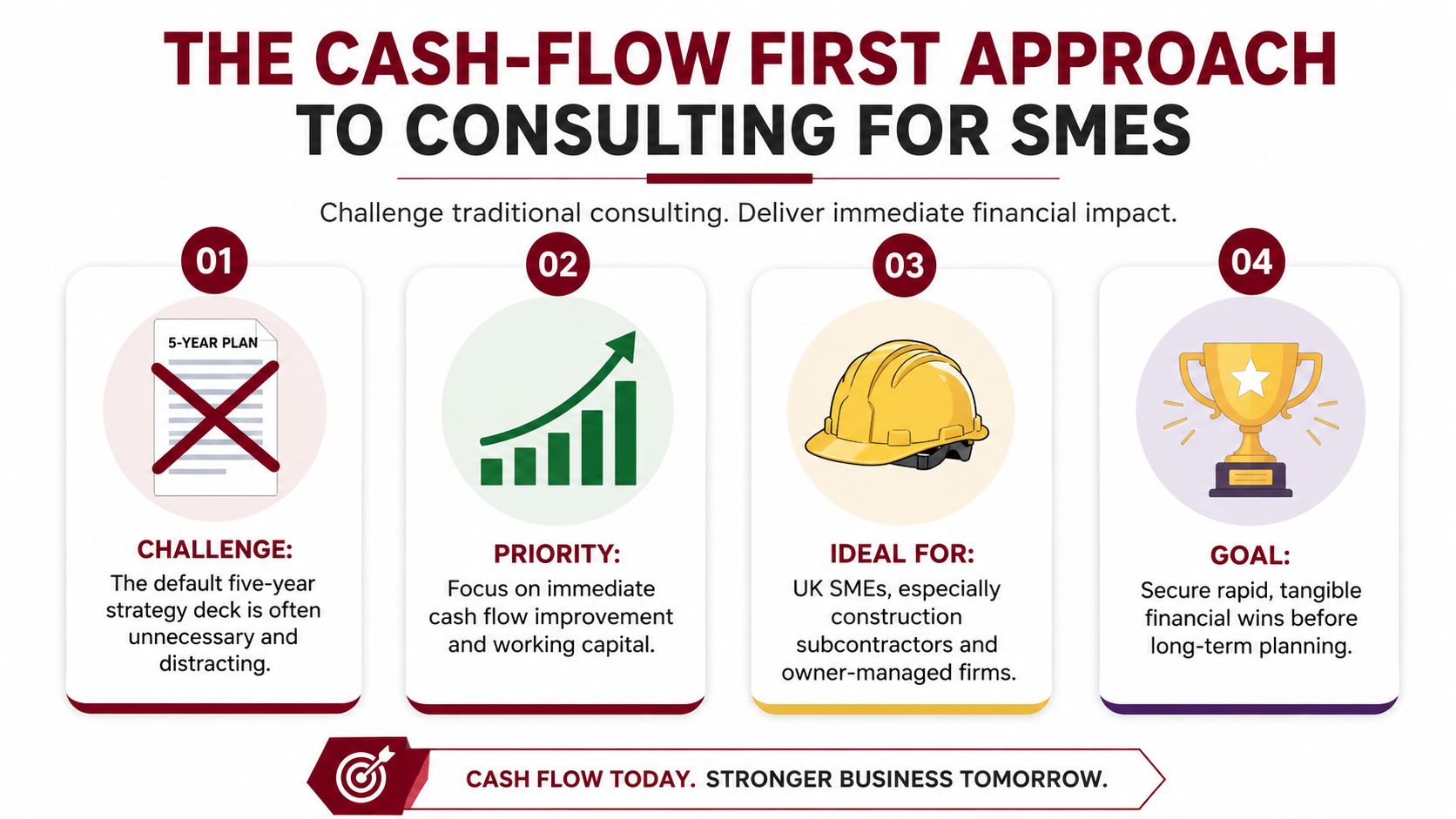
Most small firms don't need a five-year strategy deck first. They need to know which customers owe money, which jobs create margin, when tax and supplier payments fall due, and whether the next month can be funded without emergency borrowing.
The cash-flow-first approach is especially relevant to construction subcontractors and owner-managed service firms. External finance use among smaller businesses stood at 44% in Q1 2025 and 42% in Q2 2025, according to the British Business Bank's Nations and Regions Tracker. Separate market analysis cited in the brief says late-payment culture leaves SMEs with an average debt burden of £25,000, making cash preservation central to whether a firm can afford further support.
A consultant should start with the cash cycle, not the brand story.
The practical levers
- Payment terms: Use terms that match the work and funding burden, such as 14 or 21 days where commercially appropriate.
- Stage payments: Collect deposits, milestones, and agreed retention amounts instead of funding an entire project from internal cash.
- Thirteen-week forecasting: Build a weekly cash forecast that shows expected receipts, committed costs, payroll, tax, and supplier payments.
- Credit control: Assign invoice ownership, automate reminders where possible, and escalate overdue accounts according to a written process.
- CIS controls: Verify subcontractors, record deductions properly, and reconcile submissions with payment and bookkeeping records.
- Profit visibility: Keep profit reporting separate from cash reporting, because a profitable job can still create a short-term funding gap.
A North West London contractor with a £40,000 debtor mountain might not need a rebrand or a new strategic vision. The useful intervention is to identify disputed invoices, issue missing applications for payment, tighten approval steps, and move towards a 28-day average payment cycle. Those figures describe the supplied vignette, not a universal result, so the consultant should establish the contractor's baseline before promising an outcome.
For a practical checklist of cash controls, see ways to improve small-business cash flow. The principle is straightforward: fund long-term planning with a business that can collect what it has already earned.
Choosing the Right Consultant in North West London
A North West London owner shouldn't choose a consultant because the proposal contains polished language about transformation. Choose the person who understands the records, rules, customers, and decisions that create pressure in your business.
Apply a six-factor filter
Credentials come first. Look for relevant professional standing, such as CMC, ICAEW, or CIMA credentials, where the work requires formal financial, management, or advisory competence. Credentials don't guarantee a result, but a consultant should be able to explain the experience behind the recommendation.
Sector experience changes the quality of diagnosis. A Park Royal subcontractor dealing with a CIS deduction query needs someone who understands construction workflows, applications for payment, subcontractor records, and the relationship between compliance and cash. A generalist strategist may produce sensible growth language while missing the control failure causing the actual problem.
References should come from comparable businesses. Ask for written references from owners with a similar size, operating model, and problem. A large corporate transformation project won't prove that the consultant can improve a small contractor's invoicing routine.
Pricing must be transparent. Accept fixed fees, capped hours, or a clearly defined retainer. The proposal should separate discovery, implementation, travel, software, and any specialist work so you can see the full commitment.
Chemistry matters, but test it through work. A paid diagnostic session is more useful than an informal sales conversation. Watch how the consultant asks questions, handles incomplete information, and challenges your assumptions.
Proximity has practical value. A face-to-face meeting can help when staff need to demonstrate a process on site or when the consultant must understand how paperwork moves between an office, a workshop, and a job location. Remote work can be effective, but it shouldn't be the only option if the situation benefits from observation.
A Wembley hair-salon owner trying to move beyond a £1.2m revenue ceiling needs a different adviser from the Park Royal subcontractor, even though both need better decisions and controls. The salon may need service-level profitability, staff capacity analysis, pricing, and branch economics. The subcontractor may need job costing, CIS discipline, debtor recovery, and contract administration. A useful consulting service for Colindale and North West London businesses should make those distinctions clear.
Ask every shortlisted consultant:
- How have you recovered late payments or improved collection discipline for a comparable SME?
- What profit turnaround have you personally helped implement, and what did you do?
- Can I speak to a named reference who runs a similar-sized firm?
Red flags include a vague proposal, no draft contract, unclear ownership of deliverables, and reluctance to share a sample action plan. A consultant who won't show how the work will be managed probably hasn't defined it tightly enough.
Your First Two Weeks With a Management Consultant
The first fortnight should produce movement, not ceremony. Give the consultant access to the information that reveals how money enters and leaves the business, then insist that every finding becomes an owned action.
Days one and two
Start with a paid discovery session. Hand over three months of bank statements, aged debtor information, contracts, pricing records, supplier commitments, and the CIS submissions folder where relevant. The consultant should map the cash cycle from quote to collection and identify where work, paperwork, approval, or payment stalls.
Don't hide messy records. Inconsistent information is often the evidence. A credible adviser will distinguish between a bookkeeping issue, a process issue, a customer-term issue, and a management decision that has been avoided.
Days three to five
The consultant should produce a shared action plan with the top three profit leaks. Each leak needs an owner, a deadline, a baseline, and a success measure. Examples include cutting debtor days from 64 to 40 or lifting gross margin by two points, as specified in the engagement plan.
The measures must belong to the business, not the consultant's presentation. If the target concerns cash, agree whether it means invoices issued, receipts collected, debtor days, or available bank balance. If it concerns margin, define which costs and jobs are included.
Days six to ten
Use targeted working sessions to fix the process. The consultant might shadow credit control, rebuild the weekly cash-flow forecast, review job-costing entries, or test the subcontractor verification routine. The owner should be removed from as much day-to-day firefighting as possible, otherwise the business won't have the attention needed to adopt the changes.
Early wins should fund the remaining work. A recovered invoice, renegotiated supplier term, corrected variation, or tightened payment clause can provide practical evidence that the engagement is addressing the right constraint.
Days eleven to fourteen
End the first phase with a written handover pack. It should include a 90-day execution calendar, a CIS controls checklist where relevant, KPI dashboards, process owners, recurring meeting dates, and unresolved risks. Hold a recap meeting that confirms what the consultant will continue to do and what the owner's team now owns.
The standard to demand: every recommendation should become a decision, a process, a named owner, or a measurable target.
Management consulting pays when the brief stays narrow, the evidence is accessible, and the outcome connects to cash or profit. If your business is in North West London, start this week by exporting the aged-debtor report, gathering recent bank information, listing the three decisions you've postponed, and booking a diagnostic conversation with an adviser who understands your sector.
Action Accountants Limited provides practical management consulting alongside accounting, tax, bookkeeping, forecasting, KPI development, and CIS-aware support for contractors and growing businesses. If you need a focused review of cash flow, profitability, operations, or compliance controls, visit Action Accountants Limited to discuss a measurable engagement.