LTD Company Christmas Party Allowance UK Guide
Understand the ltd company christmas party allowance in the UK, including the £150 per head rule, eligibility, what counts, and how to stay compliant with HMRC.

By mid-December, the venue has sent your Ltd company a neat package price, the team is expecting a proper celebration, and someone in the office has asked whether payroll needs to know. The quote looks comfortably below the £150 per-head Christmas party limit, but the open bar, coach home and extra guests haven't been added yet.
That creates the questions directors need answered. Is £150 a hard ceiling or an allowance? Can partners attend? Does the rule cover directors? What happens if the final invoice creeps over the threshold? The answer depends on the event's structure and its complete VAT-inclusive cost, not the headline restaurant package.
Table of Contents
- Planning the Christmas Party Without a Tax Surprise
- How the Annual Events Exemption Actually Works
- What Costs Count Towards the £150 Per Head Limit
- Corporation Tax Treatment of Staff Entertainment
- Directors, Trivial Benefits and Festive Gifts
- When the £150 Limit Is Exceeded and What HMRC Reports
- Your Pre-Event Checklist and Year-End Records
Planning the Christmas Party Without a Tax Surprise
The office manager forwards three venue quotes. One is a £65-a-head meal, another includes a DJ, and the third offers a coach and late checkout. You want to approve the cheapest option, but HR wants to know whether the expense is tax-free and whether anyone must report it.
The short answer is yes, a qualifying annual staff event can be tax-free. But the ltd company Christmas party allowance isn't a pot of money that the company can spend however it likes. HMRC treats £150 per person as a threshold, inclusive of VAT, and the exemption can fail if the final cost goes above it. HMRC's annual events guidance confirms that the amount applies to annual functions and isn't a separate cash allowance.
Your event needs to meet three tests:
- It must be annual in nature.
- It must be open to all employees on a fair basis.
- Its total cost must be £150 or less per attendee, including VAT and relevant extras.
Partners can attend, but their attendance affects the calculation. Directors can attend, provided the event is a genuine staff function rather than a private directors' dinner. Transport, accommodation, entertainment and drinks can all change the final figure.
Practical rule: Don't approve the venue package until you've built an all-in budget based on the expected attendees.
You can still make the celebration distinctive without losing control of the numbers. For ideas covering formats, activities and team-friendly options, review these Christmas corporate party ideas for 2026, then price every proposed extra before booking. A modest buffer below the threshold is sensible because last-minute additions can turn an exempt event into a taxable benefit.
How the Annual Events Exemption Actually Works
The annual-events exemption works only when the function passes three tests. The same rules cover a Christmas party, summer barbecue or another recurring staff social event.
The three tests you must pass
| Condition | HMRC test | Practical check |
|---|---|---|
| Annual event | The function must be annual in nature | Describe it as a recurring company event and retain the invitation |
| Open to employees | It must be open to all employees generally | Invite the whole workforce, or all employees at the relevant location |
| Cost limit | The total cost must not exceed £150 per attendee, inclusive of VAT | Add the complete event cost and divide it by the relevant attendees |
“Open to all” does not require every employee to attend. Eligible employees must have a genuine opportunity to attend. If the company operates from several locations, it can hold an event for staff at one location, provided it does not selectively exclude employees working there.
For corporation tax purposes, staff entertaining is generally allowable where it serves the trade and is not mainly customer entertainment. The HMRC's business income manual covers this treatment, including employee Christmas parties.
The £150 limit applies across the tax year when the company holds more than one annual function. It is not £150 for the summer barbecue and another £150 for the Christmas party. Add the relevant cost per attendee for the events before deciding whether the exemption applies.
A combined-event example
Suppose the summer barbecue costs £90 per head and the Christmas lunch costs £75 per head. Together, they cost £165 per head, so both events cannot be covered in full by the annual-events exemption.
The £15 excess does not become the taxable amount. The exemption applies to qualifying events as a whole, so the company must decide which event, or combination of events, receives the exemption. The other event can become a taxable benefit for the relevant attendees.
Directors should check this before approving a second function. A private directors' dinner does not become an exempt annual staff event merely because the company pays for it. Keep the invitations, attendee lists and calculations for every annual function, then settle the treatment before payroll and year-end accounts work begins.
What Costs Count Towards the £150 Per Head Limit
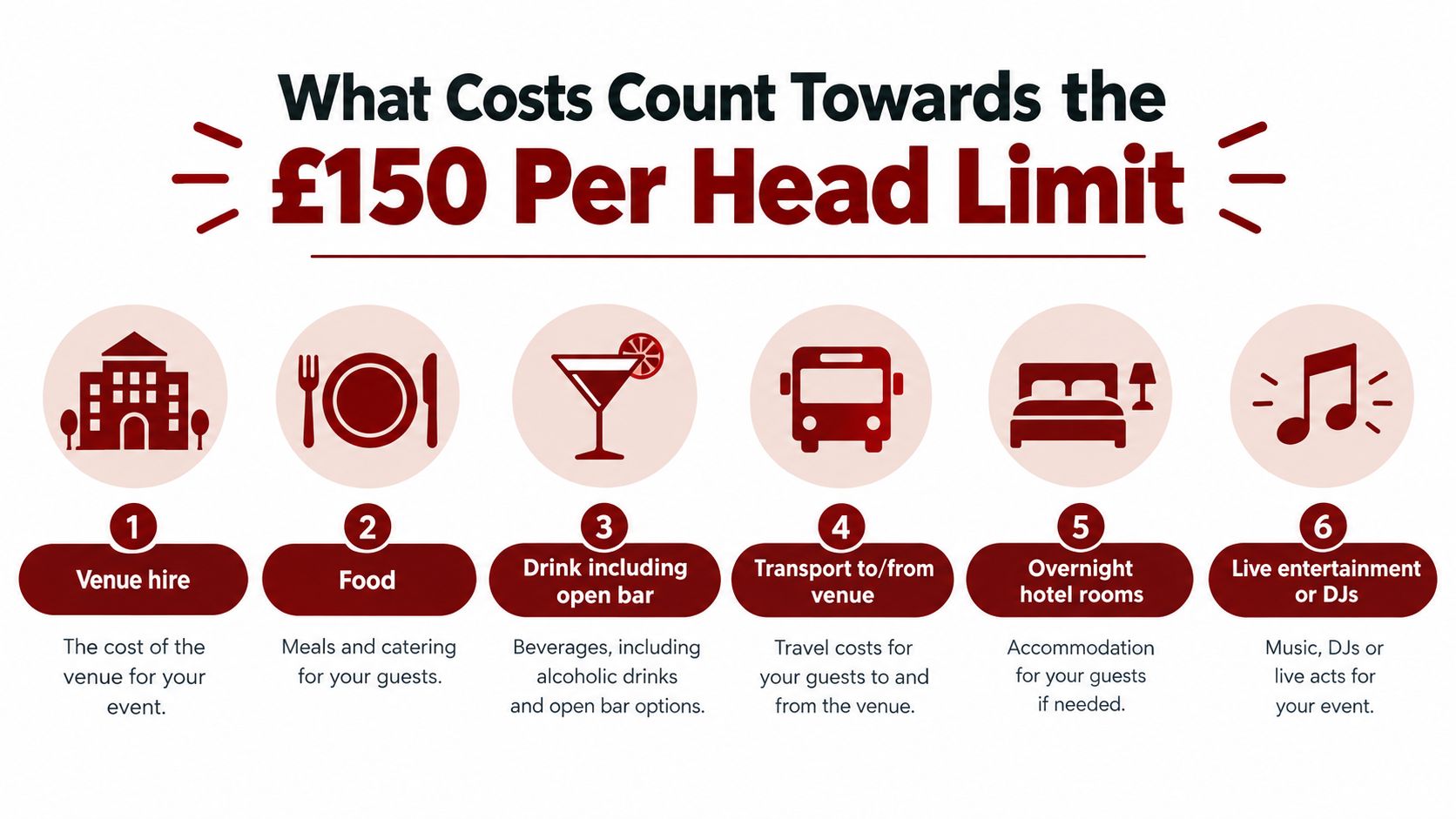
The venue's advertised price is only one part of the calculation. HMRC looks at the cost of providing the function, so you need to include the associated expenses that make the event possible or enhance the experience.
Build the all-in figure
Include the following where the company pays them for the event:
- Venue hire, including room hire or private dining charges.
- Food and drink, including reception drinks and an open bar tab.
- Transport, such as a coach, taxis or other organised travel to and from the venue.
- Overnight accommodation, where rooms are provided as part of the function.
- Entertainment, including a DJ, live music or another booked act.
- Event extras, such as party favours or goody bags connected with the celebration.
- VAT, because HMRC applies the threshold on an inclusive basis.
A package priced at £130 per head can therefore become £155 after a £12 coach, a reception drink and a £15 goody bag are added. That event is no longer safely within the exemption. The calculation should use the final cost and the actual attendance position, not an optimistic early estimate.
Budgeting advice: Treat the £150 figure as a ceiling, not a target. Leave room for agreed extras and invoice changes.
Guests require careful treatment. Their attendance may affect the overall cost-per-head calculation, while costs incurred for a guest shouldn't automatically be treated as an employee's personal benefit. Keep employee and guest details clear in the event file, especially where partners attend or where the company buys separate gifts.
Festive gifts are a separate issue rather than a way to disguise additional party spending. If you're considering bottles, hampers or accessories, this ROCKS Whiskey Chilling Stones tax guide can help you distinguish gift treatment from the annual event calculation.
The practical answer is to ask the venue for an itemised invoice. A single “Christmas package” line makes it harder to identify transport, entertainment, accommodation and gifts when you reconcile the final per-head figure.
Corporation Tax Treatment of Staff Entertainment
A Christmas party can reduce your company's taxable profit and still create a tax bill for employees. Treat the company deduction and the employee exemption as separate checks before approving the final booking.
For the company, staff entertaining is generally an allowable business expense where it is incurred wholly and exclusively for the trade and is not mainly entertainment for customers. A properly organised staff Christmas party can therefore qualify for corporation tax relief. The employee-side exemption has its own annual-event conditions and £150 per head limit. If that exemption fails, the company may still claim the entertainment cost, but it must deal with the resulting benefit reporting and employer NIC.
| Scenario | Corporation tax, Ltd company | Income tax and NIC, employees | Action required |
|---|---|---|---|
| Qualifying staff event | Generally allowable | No taxable benefit under the exemption | Keep invoices, invitation and calculation |
| Event above the threshold | Staff entertaining may remain allowable | Taxable benefit for relevant attendees | Report through the appropriate payroll or benefits process |
| Client-focused entertainment | Generally disallowable | Employee treatment depends on any separate staff benefit | Separate staff and client costs |
The cliff edge matters. An eight-employee party costing £160 per head produces company spending of approximately £1,280. The staff entertainment may remain deductible, but each employee has a taxable benefit of £160, not just the excess over £150. The company must also account for employer Class 1A NIC on that taxable benefit. Use the final invoice and attendance record to support both the corporation tax entry and the benefit calculation.
Payroll or benefits reporting becomes necessary when the employee exemption does not apply. Keep the decision clear in the records: event purpose, invitation, attendance, full cost per head, and the reason the event qualifies or fails. A tax deduction does not remove the duty to report a taxable benefit.
Client hospitality must stay outside the staff calculation. Customer entertainment follows a different corporation tax treatment, so code those invoices separately. For year-end planning, use this guide to how to reduce corporation tax, while checking that any saving does not create an unreported employee benefit.
A photographer, branded awards or entertainment can still fit the event plan if the final costing supports the intended treatment. You can find award ceremony photo booth packages, but price the feature before signing off the budget and retain the supplier invoice.
Directors, Trivial Benefits and Festive Gifts
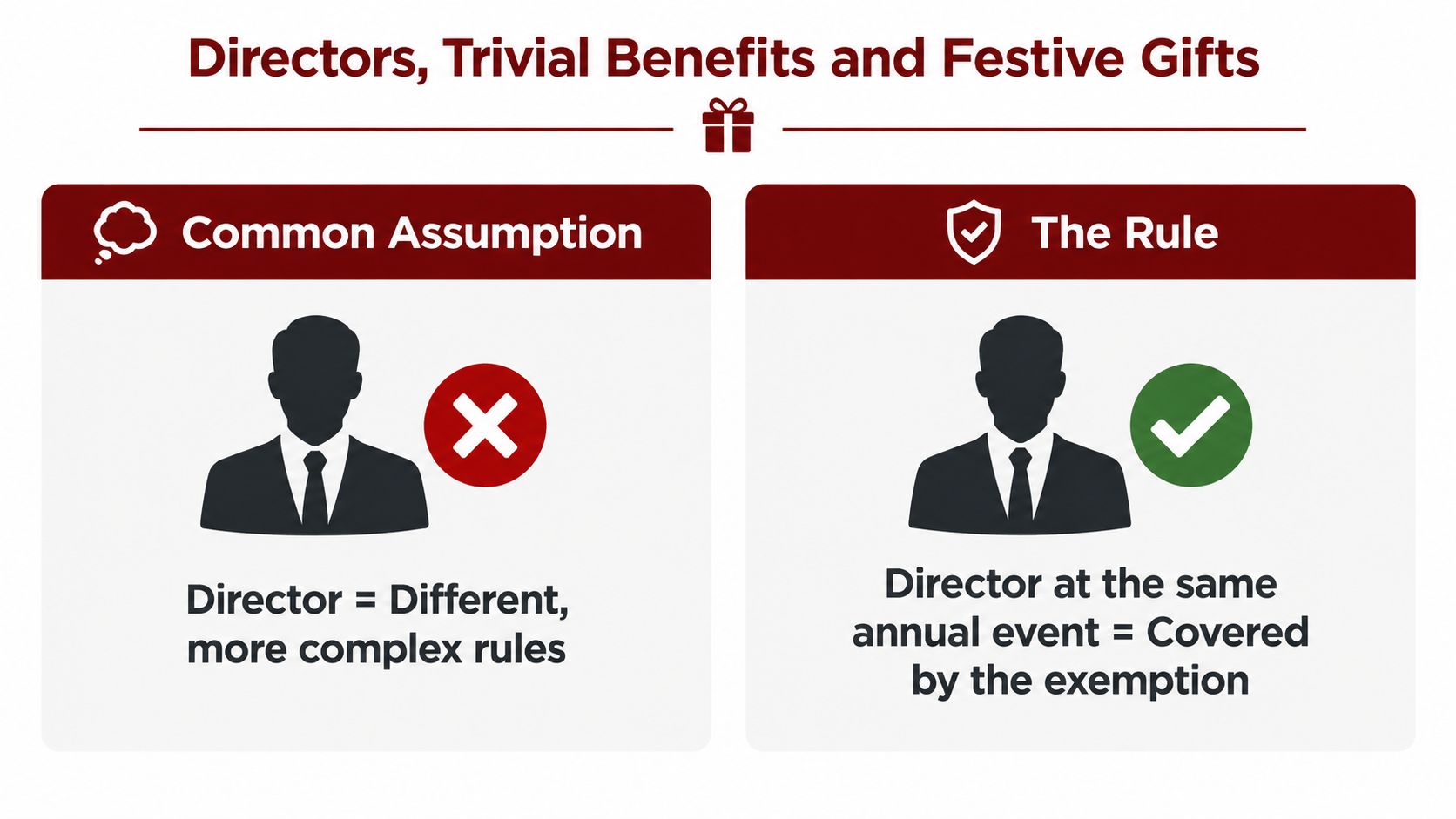
A director doesn't lose access to the annual-events exemption just because they own the company. A director attending the same genuine annual staff party as the workforce can be covered by the exemption, provided the event satisfies the normal conditions.
The problem arises when the event is really for directors only. A private directors' lunch, a partners' evening or a senior-management dinner isn't open to all employees, so it doesn't pass the inclusivity test. Calling it a “Christmas party” won't change the underlying facts.
Keep gifts separate from the party
The annual event exemption and trivial benefits rules are different. A trivial benefit can qualify where it is:
- Under £50 per person.
- Non-cash and not a cash voucher.
- Not a reward for work or performance.
- Not provided under a contractual obligation.
The supplied HMRC guidance also highlights special rules for directors and family members in close companies. Don't assume that a gift which works for an ordinary employee automatically receives identical treatment for a director-owner. Review the director-specific position before buying festive hampers, wine or vouchers.
Cash is the clearest trap. A Christmas bonus, cash payment or cash equivalent isn't transformed into a tax-free trivial benefit because it's small. Put it through payroll and apply the appropriate PAYE and National Insurance treatment.
Structure it properly: Hold one genuine all-staff annual event, record the director as an attendee, and handle any separate gift under its own rules.
A director's partner may attend the staff party, but the event still needs to be a genuine staff function. Don't create a private meal for the director and partner and expect the all-staff exemption to cover it. Keep the invitation, attendee list and supplier invoice so the purpose is clear.
Directors often need broader planning around remuneration and National Insurance. The separate guidance on National Insurance for directors is useful when the party sits alongside bonuses, salary or other benefits.
When the £150 Limit Is Exceeded and What HMRC Reports
The threshold is a cliff edge. If the cost per head is within the limit, the annual event exemption can apply. If it goes above the limit, the whole relevant benefit becomes taxable, not just the small amount above the threshold.
| Metric | Party A, £148 per head | Party B, £152 per head |
|---|---|---|
| Attendees | 8 | 8 |
| Total event cost | £1,184 | £1,216 |
| Exemption result | Within the threshold | Threshold breached |
| Taxable amount per attendee | None under the exemption | £152, subject to the applicable reporting route |
These calculations use the supplied HMRC rule that the exemption fails when the event exceeds £150 per attendee. Party B doesn't create a taxable benefit of only £2 per employee. The full £152 per attendee becomes relevant for benefits reporting.
Deal with the reporting promptly
Once you know the event has breached the threshold:
- Reconcile the final cost, including VAT and connected event costs.
- Confirm the attendees, separating employees, directors and guests.
- Calculate the taxable benefit for each relevant employee.
- Report through payroll or P11D, depending on the reporting method used.
- Account for employer Class 1A NIC on the taxable benefit.
- Retain the calculation and evidence with the year-end records.
A PAYE Settlement Agreement may be appropriate where the company wants to settle the employee tax rather than leave staff with an unexpected liability. Speak to payroll before the reporting deadline, not after the accounts have been finalised.
For a December event, the relevant tax year and filing timetable must be identified correctly. HMRC's employment-benefits process has its own deadlines, so don't assume that putting the invoice into the bookkeeping system completes the compliance work. If the breach affects the company's wider filings, review the corporation tax return process with the same final figures.
Your Pre-Event Checklist and Year-End Records
Before you sign the venue contract, run this test. It takes minutes and can prevent a festive invoice from becoming a payroll problem.
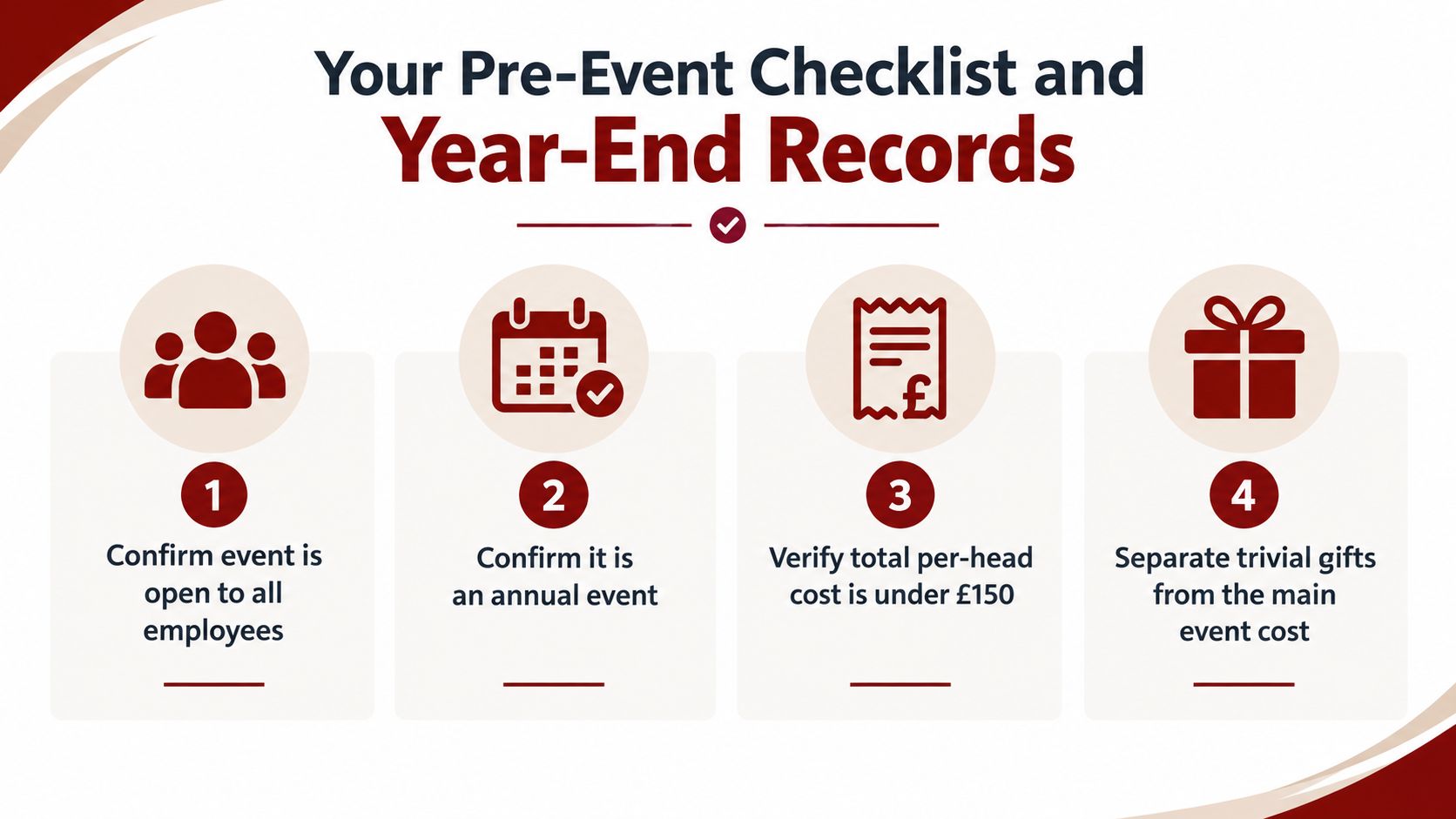
The director's pre-booking check
- Confirm the event is open to all employees: Keep the staff invitation and explain any location-based arrangement.
- Confirm it is annual: Record the event as part of the company's recurring social calendar.
- Verify the complete per-head cost: Add venue, food, drink, VAT, entertainment, transport and accommodation, then compare the result with £150 using HMRC's annual functions guidance.
- Separate gifts from the event: Test hampers, wine, vouchers and other presents under the relevant benefit rules instead of treating them as a Christmas allowance.
Don't rely on the venue's initial headcount. Update the calculation when employees confirm attendance, when partners are added and when the supplier issues the final invoice. If the company pays for accommodation or transport after the booking, add those costs before deciding that the exemption applies.
The year-end file
Retain a clean evidence pack containing:
- The event invitation and description.
- The final employee and guest attendance list.
- Venue, catering, transport, accommodation and entertainment invoices.
- VAT details and the company's calculation of the inclusive cost per attendee.
- A schedule of other annual functions held during the tax year.
- Any payroll, P11D, Class 1A NIC or PAYE Settlement Agreement paperwork where the threshold was exceeded.
Best practice: Save the calculation when the event is booked, then update it after the final invoice arrives. The second check is the one that catches the expensive surprises.
A well-organised file lets your accountant post the expense correctly and answer an HMRC query without reconstructing the evening from bank transactions. Use a broader year-end accounts checklist to make sure the party records sit alongside the company's other compliance evidence.
Action Accountants Limited can review your proposed event budget, attendee calculation and year-end records before you book. Visit Action Accountants Limited for practical support with payroll, benefits reporting, corporation tax and Ltd company accounts.