How to Read a Profit and Loss Statement
Learn how to read a profit and loss statement with clear steps for non-accountants, including margins, trends, and tips for UK small businesses.

You open the month-end P&L expecting reassurance. Revenue is up, the bottom line is green, and yet the business account is uncomfortably low. Payroll is due, VAT is approaching, and a customer still hasn't paid an invoice issued weeks ago. That's the moment most founders realise that profit isn't the same as cash, and that knowing how to read a profit and loss statement is an owner's responsibility, not a task to outsource blindly.
A P&L shows how the business performed during a defined period. Read properly, it tells you whether pricing works, whether delivery costs are rising, whether overheads are under control, and whether growth is creating value or just increasing activity. Read casually, it can make a struggling company look healthy until the bank balance forces the issue.
Table of Contents
- Why Founders Who Read Their P&L Make Better Decisions
- The Core Sections of a Profit and Loss Statement
- Calculating Margins and What Good Looks Like in 2024
- Where a Profitable P&L Hides Cash Problems
- Reading Trends Month by Month Without Losing the Plot
- A Practical Action Plan to Improve Profitability
- Questions Founders Ask After Their First Read
Why Founders Who Read Their P&L Make Better Decisions
A founder who can read the P&L doesn't need to become an accountant. They do need to recognise the difference between turnover, gross profit, operating profit, and cash. That basic fluency changes the quality and speed of decisions about hiring, pricing, marketing spend, supplier negotiations, and whether the company can afford another fixed commitment.
Consider a London consultancy that has won several new contracts. Turnover looks impressive, but subcontractor costs have risen, delivery hours are taking longer, and the gross margin is narrowing. A founder who looks only at revenue may hire ahead of demand. A founder who checks gross profit first may discover that the business is selling more work without earning enough from it.
The same issue appears in investor and lender conversations. A clean P&L gives other people a way to understand the trading model, but founders should be able to explain the movements themselves. If every question goes back to the bookkeeper, the owner loses time and misses the chance to act while a problem is still manageable.
Owner's rule: Never approve a major spend because revenue is rising. Approve it when the underlying margin and cash position support it.
For UK companies, the P&L also has a statutory role. GOV.UK explains that the profit and loss account shows sales, running costs, and profit or loss for the financial year, and Companies House accounts must include the P&L in the specified statutory format. Most private limited companies must prepare annual accounts, although eligible micro-entities can use simpler accounts and may publish less detail. That means you must know whether you're looking at a condensed statutory statement or fuller management accounts before drawing conclusions from a ratio.
Founders preparing for the next trading year should also connect P&L interpretation with 2026 planning for startups, particularly when forecasting hiring, funding needs, and tax obligations. If financial terminology still slows you down, this practical guide on staying financially steady when numbers aren't your native language is a useful companion.
The standard is simple. You should be able to open the report, identify what changed, ask why it changed, and decide what happens next.
The Core Sections of a Profit and Loss Statement
Read the statement from top to bottom. Don't jump straight to net profit. Each line answers a different management question, and the earlier lines explain why the later lines look the way they do.
Take a UK service-based micro business with monthly revenue of £40,000. Assume it pays delivery contractors and project-specific costs, then covers staff, premises, software, marketing, professional fees, and finance costs.
| Line Item | Amount (£) | What It Means |
|---|---|---|
| Revenue | 40,000 | Sales earned during the period |
| Direct costs | 12,000 | Costs directly linked to delivering client work |
| Gross profit | 28,000 | Revenue left after direct delivery costs |
| Operating expenses | 19,000 | Overheads required to run the business |
| Operating profit | 9,000 | Profit before finance costs and tax |
| Finance costs | 1,000 | Interest and related borrowing costs |
| Profit before tax | 8,000 | Amount remaining before tax |
Start with revenue
Revenue, also called turnover, is the income earned from selling services or products. Ask whether it's recurring, contracted, project-based, concentrated in a small number of customers, or inflated by one-off work. A revenue increase is useful only if the business retains enough margin after delivering it.
Under accrual accounting, revenue may appear when it has been earned even though the customer hasn't paid. Under cash accounting, it generally appears when the money is received. Your accounting basis therefore affects the timing of the figure, not the underlying commercial activity.
Separate direct costs from overheads
Direct costs, sometimes called cost of sales or COGS, relate to a specific job or unit sold. For a contractor, that may include a subcontractor hired for one project. For a retailer, it may include the stock purchased for resale. Rent, general software, bookkeeping, and broad marketing normally belong in operating expenses instead.
Subtract direct costs from revenue to get gross profit. In this example, £40,000 less £12,000 produces £28,000. This is the amount available to cover overheads and leave an operating profit.
Finish with operating profit and the bottom line
Operating expenses include payroll, premises, insurance, software, marketing, administration, and professional services. Subtracting £19,000 from £28,000 leaves £9,000 operating profit. Finance costs then reduce that result to £8,000 profit before tax.
VAT usually isn't revenue or an expense when it's recoverable. It's a tax collected from customers and paid to HMRC, subject to the business's VAT position. PAYE deducted from employees' wages is also a liability rather than an extra payroll expense. Dividends don't reduce trading profit. They're distributions of available company profits, recorded outside the P&L.
Your statutory accounts must be accurate, but management accounts should be useful. If your current report lumps all income into one line or hides delivery costs inside general expenses, fix the chart of accounts. Founders comparing accounting platforms can use specialist financial reporting software reviews and picks, but no software can rescue poorly categorised bookkeeping.
Calculating Margins and What Good Looks Like in 2024
Margins turn pounds into comparable signals. They show how much of each pound of revenue remains after a particular layer of cost.
Using the example above:
- Gross margin: £28,000 gross profit divided by £40,000 revenue equals 70%.
- Operating margin: £9,000 operating profit divided by £40,000 revenue equals 22.5%.
- Pre-tax margin: £8,000 profit before tax divided by £40,000 revenue equals 20%.
These ratios tell a clearer story than revenue alone. A 70% gross margin gives the business room to absorb overhead. The difference between gross and operating margin shows that overheads consume a substantial part of that room. The final movement reflects finance costs.
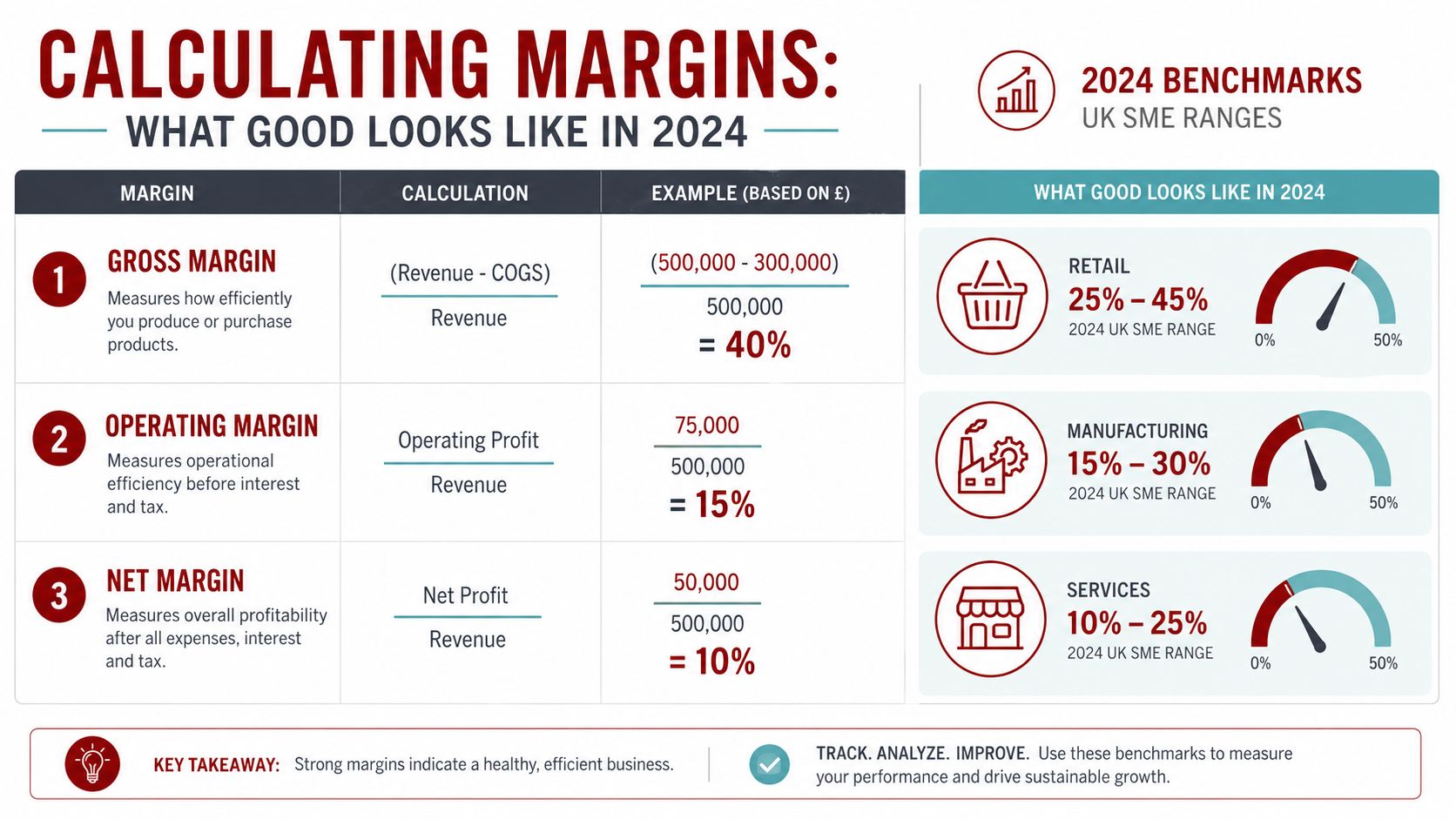
Don't use a single universal definition of “good”. A contractor or professional services firm usually has a thinner direct-cost base than construction, retail, hospitality, or manufacturing. That means a service business may show a high gross margin while still needing close control of payroll and subcontractor utilisation. A construction firm needs to analyse materials, labour, subcontractors, variations, and project overruns before comparing its performance with an agency.
UK profitability data reinforces the need for context. The Longitudinal Small Business Survey 2024 found that 77% of SME employers reported a profit or surplus in their last financial year, compared with 76% of micro businesses. Roughly one in four smaller firms therefore didn't report a profit, and profitability rises with business size.
A broader UK benchmark is even more useful when treated carefully. In 2025, 71% of SMEs reported a profit, while 10% to 14% reported a loss and 6% to 7% broke even, according to UK business statistics from Money.co.uk. Health SMEs reported profitability of 76%, while hotels and restaurants reported 57%, demonstrating why sector comparisons matter.
Track these ratios every month:
- Gross margin by service line or product category.
- Operating expenses as a percentage of revenue.
- Operating margin.
- Net or pre-tax margin.
- Revenue growth alongside margin movement.
For a more detailed review, use financial ratio analysis to connect the P&L with liquidity, efficiency, and balance-sheet measures.
Where a Profitable P&L Hides Cash Problems
A design studio can report £40,000 net profit and still struggle to pay payroll. That isn't a contradiction. The P&L measures income earned and costs incurred over a period, while the bank account reflects the timing of actual receipts and payments.
Accruals create the first gap. If the studio completed work and earned revenue but hasn't collected the invoice, the P&L may show the income before the cash arrives. The profit is real in an accounting sense, but it isn't available to pay suppliers today.
Debtors create the second gap. A customer who routinely pays after extended terms forces the studio to finance delivery from its own cash. The business may pay staff, contractors, and software providers long before the customer settles.
Tax timing creates a third pressure point. VAT, PAYE, corporation tax, and other obligations can fall due according to statutory deadlines rather than the date customers pay. Director drawings and loan repayments can also reduce the bank balance without appearing as ordinary operating expenses.
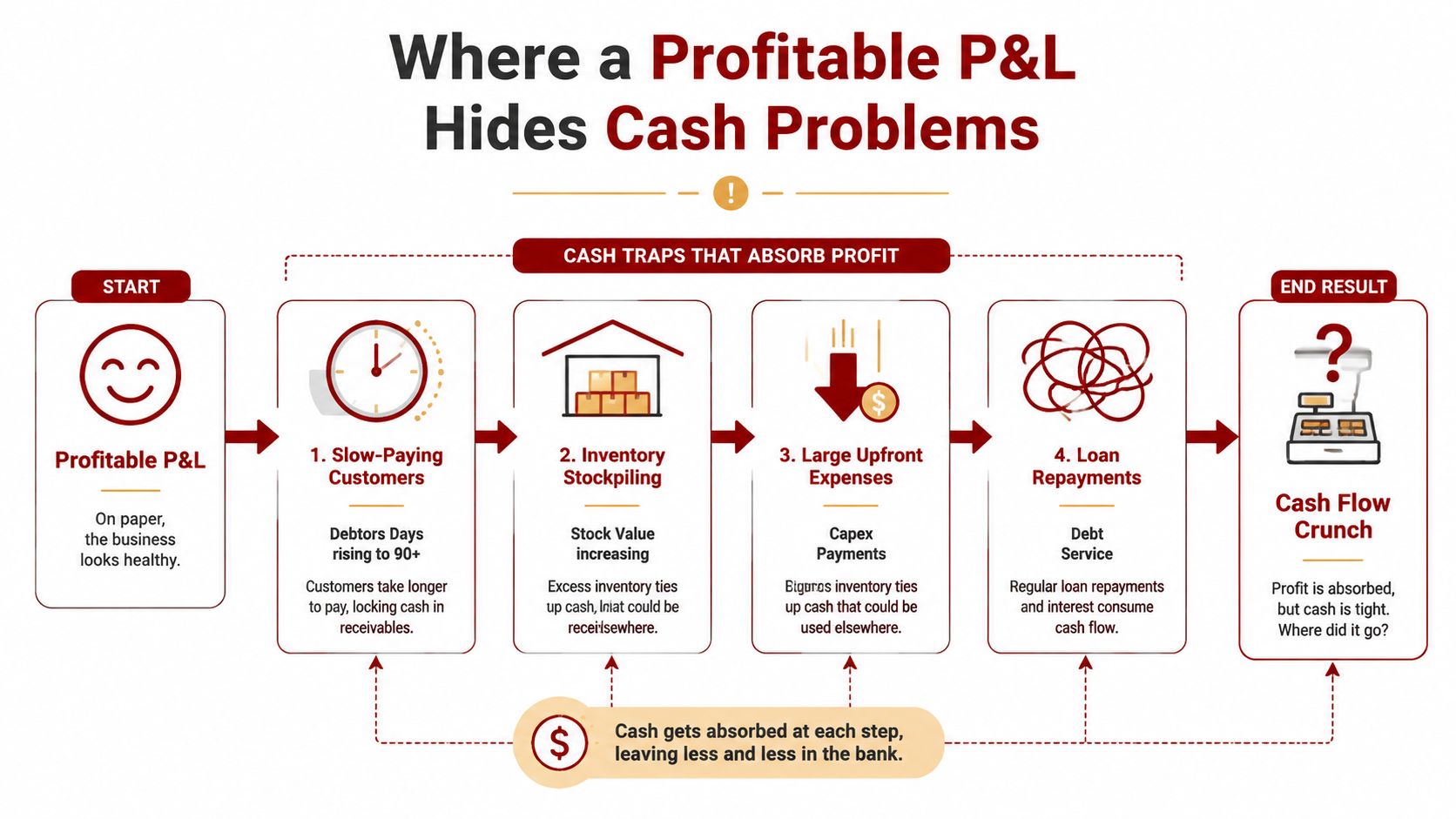
Consider a business with £100,000 revenue, a 40% gross margin, and £15,000 profit. If customers pay after a long debtor cycle, the company may have delivered the work and paid the associated costs before collecting the invoices. Add quarterly tax bills, VAT settlements, payroll, and supplier payments, and the bank can move into overdraft despite the reported profit. The example illustrates timing risk, not a universal cash outcome.
UK businesses regularly experience this tension. Government survey data for 2023 found that 94% of small businesses had at least one month when costs exceeded income, while 23% experienced higher monthly outgoings than revenues for more than six months. The same survey identified energy prices, competition, and taxation as major obstacles to success.
Cash discipline: Treat reported profit as a measure of earning performance, not as money you can spend.
Reconcile profit to cash every month. Review debtor days, unpaid invoices, creditor timing, VAT and PAYE liabilities, and tax reserves. A rolling cash-flow forecasting process makes the pressure visible before it becomes a payment crisis. For practical operating ideas, founders can also review Logivo's cash flow advice.
Use the P&L to decide whether the model works. Use the cash forecast to decide whether the business can survive the next payment cycle.
Reading Trends Month by Month Without Losing the Plot
A single month is evidence, not a verdict. One large project, delayed invoice, annual insurance payment, or holiday shutdown can distort the report. Your job is to identify the pattern underneath the noise.
Use this four-part review each time the books close:
- Compare with the prior month. Look for sudden changes in revenue, direct costs, payroll, and overheads. A movement needs an explanation, not an automatic reaction.
- Compare with the same month last year. This helps separate seasonality from genuine growth, particularly for hospitality, property, construction, and project-led businesses.
- Compare with budget and forecast. A business can beat last month and still miss the plan. Review the variance by line, not just the total.
- Investigate the reason. Ask whether the movement came from price, volume, mix, timing, classification, or a one-off event.
Set an internal investigation trigger for a deviation of more than 5%, and document the reason. The threshold isn't a law or a universal standard. It's a practical management rule that stops small changes being ignored while preventing every minor fluctuation from becoming a crisis.
Focus on the relationship between lines
Revenue rising while gross margin falls is a pricing, delivery, or customer-mix warning. Fixed costs growing faster than revenue can signal premature hiring, unused software, or an office commitment that the current model can't support. Operating profit falling while gross profit remains stable points directly towards overhead control.
Strip out non-recurring items such as an asset sale, a bad-debt write-off, or a temporary support payment when assessing underlying trading. Don't erase them from the statutory record. Separate them in management reporting so you can see the result the core business produced.
Seasonal businesses should use a rolling twelve-month view rather than relying on a single month. Patterns that persist across three to six months deserve more attention than one unusual period. Sage's tracker reported small-business profit growth of 3.7% year on year in Q2 2025, 5.7% in Q3, and 6.2% in Q4, but the published tracker also illustrates why profit movement must be read alongside cash timing and obligations.
A Practical Action Plan to Improve Profitability
Profitability improves when you change the drivers behind the lines, not when you make random cuts. Start with the two or three movements that have the greatest effect on gross profit and operating profit. A small subscription reduction won't repair an underpriced service.
Weeks one and two
Break revenue and direct costs down by service line, customer type, project, or product. Identify which work produces acceptable gross margin and which work consumes senior time without paying for it. Contractors should separate labour, subcontractor, materials, travel, and project-specific costs rather than treating every payment as a general expense.
Review pricing and mix before cutting people. A price review, minimum project fee, revised scope, or shift towards better-margin work can improve the top layer without damaging delivery capacity. Supplier renegotiation belongs here too, particularly where materials, subcontractors, or recurring service contracts have become more expensive.
Weeks three to ten
Test the changes rather than announcing a sweeping restructuring. Quote new work using the margin you need, renegotiate the largest supplier commitments, remove unused software, and match headcount to productive demand. Use payroll and utilisation data to understand whether labour is creating capacity or increasing fixed cost.
UK-specific planning can include checking contractor status and the distinction between salary and dividends, reviewing capital allowance timing, and asking whether qualifying development activity supports an R&D claim under the applicable rules. These areas need professional review. They aren't shortcuts for disguising personal spending or avoiding liabilities.
Use cost-reduction strategies that target waste, duplication, and weak commercial terms. Don't cut essential controls, compliance work, or customer delivery just because those lines are visible.
Weeks eleven and twelve
Lock the new pricing, supplier terms, approval rules, and monthly reporting rhythm into normal operations. Assign an owner to each major cost category, and require a brief explanation for material variances. If the P&L still takes hours to interpret, improve the bookkeeping structure or get support rather than continuing to make decisions from an unreliable report.
Action Accountants Limited is one option for UK founders who need bookkeeping, statutory accounts, VAT, tax, payroll, or management consulting connected to profitability decisions. The right support should give you a clearer monthly view and preserve your time for running the business.
Questions Founders Ask After Their First Read
Why is net profit positive but the business account overdrawn?
Because the P&L and bank account answer different questions. Accrued revenue may not have been collected, suppliers may have been paid earlier than their costs appeared, and VAT, PAYE, tax, drawings, or loan repayments may have reduced cash. Read the cash-flow statement and balance sheet alongside the P&L, then inspect debtors and tax liabilities.
Is the P&L prepared on cash or accruals basis?
Ask your accountant or bookkeeping system which basis applies. Cash basis records transactions around payment and receipt, while accrual accounting records income when earned and costs when incurred. The difference can materially change the period in which revenue and expenses appear, especially when invoices remain unpaid or costs cover more than one period.
The basis also matters at year end. A report prepared for management may use adjustments that don't appear in a simple bank-led report, so ask what has been accrued, deferred, prepaid, or left outstanding before relying on the result.
How should a contractor read the statement?
Separate billable income from direct subcontractor or project costs, then review gross margin by contract. A sole trader's drawings aren't a company dividend, while a limited company must distinguish salary, dividends, expenses, and director loan movements. IR35 status can affect the commercial and tax treatment of engagements, so don't judge contractor profitability without checking how the work is structured.
How often should the books be closed?
Close monthly, ideally within 10 days of month end, then review performance against the forecast quarterly. Waiting for annual accounts turns preventable warnings into historical explanations. A monthly close should include reconciliations, unpaid invoices, supplier bills, payroll, VAT and PAYE control accounts, and a short explanation of significant variances.
If you still can't explain the movement from revenue to profit to cash, arrange a structured P&L review before making another major spending decision.
Action Accountants Limited helps UK founders and SMEs connect bookkeeping, payroll, VAT, tax, statutory accounts, and management reporting to practical profitability decisions. Visit Action Accountants Limited to arrange support that turns your monthly P&L into a clearer plan for pricing, spending, and cash control.