
How to Improve Business Efficiency for UK SMEs
Discover how to improve business efficiency with practical steps for UK SMEs. Streamline workflows, automate admin, and track KPIs to drive sustainable growth.

Buying more software isn't how most UK SMEs become efficient. It often does the opposite. A new platform gets added to an already confusing process, staff enter the same information in several places, approvals still sit in inboxes, and the business produces bad data faster.
The better answer to how to improve business efficiency starts with removing friction. Simplify the workflow, assign ownership, measure useful output, then automate the parts that are genuinely repetitive. For London founders, that means looking closely at bookkeeping, payroll, VAT, invoicing, expenses, approvals, and reporting before approving another technology subscription.
UK businesses face a particularly serious productivity challenge. Government evidence says growth averaged around 2% a year before the 2008 Global Financial Crisis, then slowed to around 0.4% on average afterwards. In 2022, around two-thirds of UK firms had labour productivity below the average level of £53,000 per worker. The government's evidence annex makes the implication clear: operational discipline isn't a minor cost-saving exercise. It's a foundation for survival, capacity, and profitable growth.
Table of Contents
- The Hidden Cost of Administrative Drag
- Mapping and Standardising Core Workflows
- Streamlining Financial Administration and Bookkeeping
- Setting Up a Baseline Productivity Dashboard
- Evaluating AI and Technology for Practical Impact
- Building a Sustainable Efficiency Culture
The Hidden Cost of Administrative Drag
The popular advice is to automate everything. That advice skips the most important question: what exactly are you automating?
Recent UK reporting found that SMEs spend an average of 53 minutes each working day on financial administration, while 39% say administrative burden actively prevents growth. The reporting on SME financial administration points to a problem founders experience every week: time disappears into chasing invoices, checking expenses, correcting payroll information, answering approval questions, and reconciling transactions that should have been right first time.
That burden usually comes from workflow design rather than a complete absence of technology. A founder might receive invoices by email, forward them to a bookkeeper, approve payments in a banking app, answer a query in Slack, and later search for evidence during a VAT review. Each step may look manageable. Together, they create delays, duplicated entry, unclear accountability, and a weak audit trail.
Find the friction before choosing a tool
Start with the last ten instances of a recurring task. Review ten supplier invoices, expense claims, customer payments, or payroll changes. Record:
- The starting point: Who triggers the task, and what information arrives first?
- The hand-offs: Who touches the work, and where does it move?
- The waiting time: Which steps pause because somebody must approve, clarify, or resend something?
- The rework: How often does someone correct a code, amount, supplier detail, or supporting document?
- The final output: What decision or business result does the task produce?
This simple review exposes the difference between activity and progress. A team can process a large volume of transactions while still leaving cash collection, reporting, or compliance work behind.
Practical rule: Don't automate a process until one person can explain how it works from trigger to final record.
Software can help once the process is clean. For a broader view of revenue-related workflows, B2B RevOps efficiency strategies can help founders connect sales hand-offs, customer data, and operational follow-through rather than treating each department as a separate system.
Remove recurring admin from the founder's desk
Founders often retain approval responsibility long after they stop needing to handle every administrative detail. That creates a bottleneck and makes the business dependent on one person remembering what happens next.
Set clear rules for routine purchases, expense evidence, invoice coding, payment runs, and payroll changes. Give each process one owner, one backup, one source of truth, and one escalation route. Keep exceptions visible, but don't force every normal transaction through senior management.
Cloud accounting can support this redesign through features such as digital records, bank feeds, approval workflows, and automated reminders. The practical details are covered in the benefits of cloud accounting, but the principle comes first: the platform should serve a defined process, not compensate for an undefined one.
Mapping and Standardising Core Workflows
Before automating a workflow, map it. You don't need a complicated transformation programme or a consultant's oversized process manual. You need a clear view of what happens today, where work waits, and who owns the result.
Choose one workflow with visible business impact. In a London SME, that might be quote to cash, purchase invoice to payment, employee change to payroll, or customer enquiry to booked work. Don't map the entire company at once. A narrow process produces usable findings quickly.
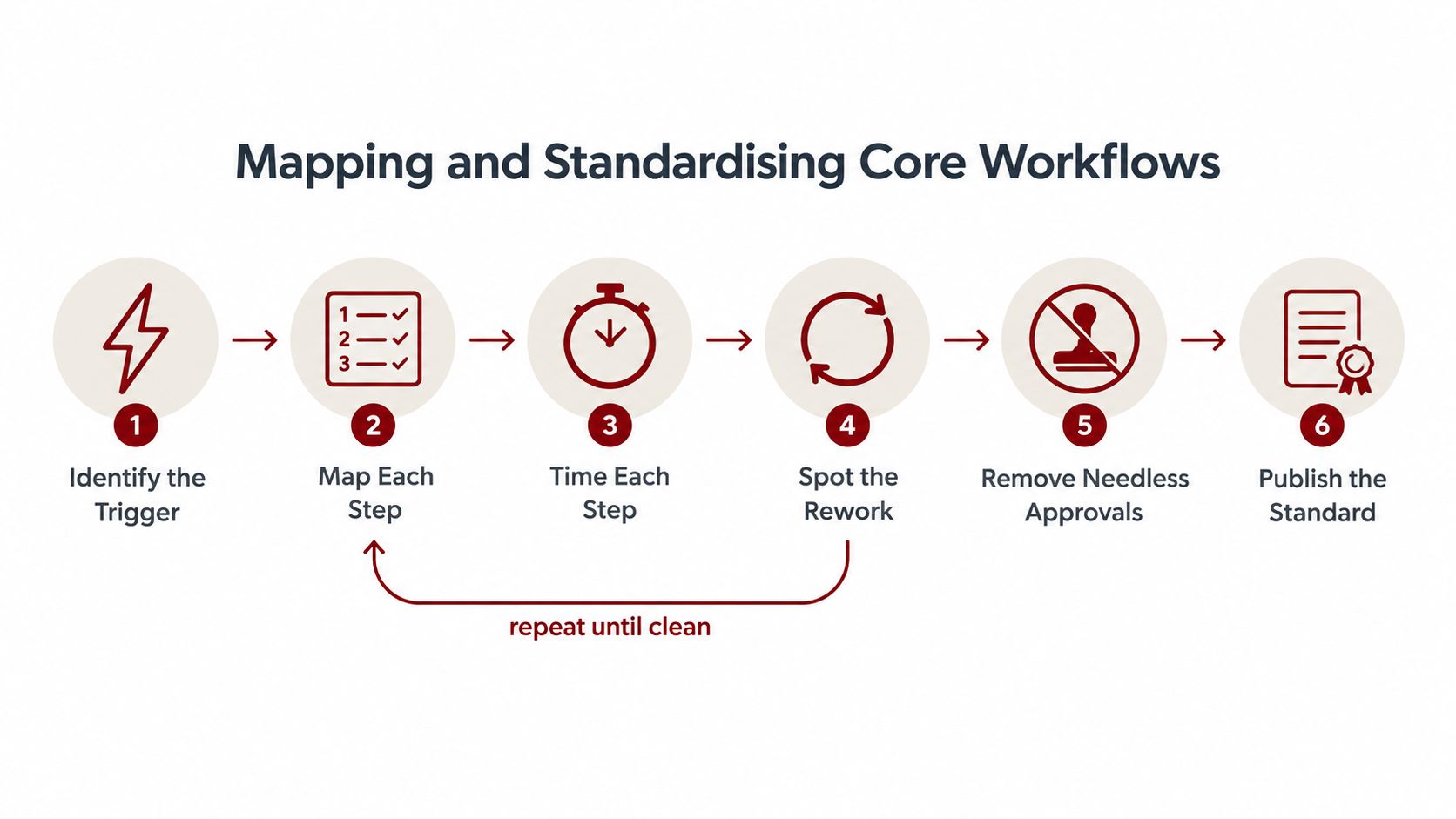
Use six questions to clean the process
Identify the trigger. Define the event that starts the work. Is it a signed proposal, a supplier invoice, a timesheet submission, or a new starter's details? If the trigger is vague, everything downstream becomes harder to control.
Map each step. Write every action in sequence, including emails, spreadsheet updates, phone calls, system entries, and approvals. Include the person responsible, not just the department name.
Time each step. Separate active work from waiting. A task may take only a few minutes to complete but remain unresolved for days because nobody knows who must act next.
Spot the rework. Mark every point where someone re-enters data, requests missing information, corrects an error, or sends work back. Rework is usually more valuable to remove than a task that takes time.
Remove needless approvals. Approval should protect the business from a defined risk. If it adds no meaningful control, remove it or replace it with a threshold, standard rule, or sample review.
Publish the standard. Create a short operating procedure with the trigger, owner, required information, decision rules, system record, and escalation path. Store it where the team works.
Don't confuse standardisation with bureaucracy. A good standard gives people a reliable default and leaves room for unusual cases. A poor standard documents every possible exception and makes ordinary work slower.
Make ownership visible
A process fails when several people are involved but nobody owns the outcome. Assign one accountable owner for each workflow. Other people may approve, prepare, review, or provide information, but the owner must know whether the process is working and must fix it when it isn't.
This discipline matters as a business expands into new customers, suppliers, employees, or markets. ONS analysis found that firms engaged in international trade between 2011 and 2022 were 35.4% more productive than non-trading firms in output per worker, after accounting for differences such as size, age, region, and industry. The ONS analysis of trade and productivity offers a useful lesson: repeatable processes, compliance controls, and disciplined operations support scale.
A workflow should be simple enough for a new team member to follow and controlled enough for the owner to trust.
Only after the workflow has been cleaned should you compare technology options. If you need an example of how integrated systems can support process improvement, improve operational efficiency with Odoo provides relevant context. For finance teams, accounting software integration can reduce duplicate entry, but integration should follow standardisation rather than replace it.
Streamlining Financial Administration and Bookkeeping
Financial administration deserves priority because it touches every part of the business. Poor bookkeeping affects cash visibility. Late invoices delay collection. Weak expense controls distort margins. Payroll errors consume management time and damage employee confidence. Disorganised VAT records create avoidable compliance pressure.
The answer isn't to ask the founder to become a part-time finance administrator. Build a predictable finance calendar and make each recurring obligation arrive with the information needed to complete it.

Create a finance operating rhythm
Use a single intake route for supplier invoices, receipts, employee expenses, timesheets, and payroll changes. Require the relevant project, client, cost category, or approval detail at the point of submission. Don't let staff send critical evidence through whichever channel they happen to use first.
A practical rhythm includes:
- Daily capture: Record sales invoices, purchase invoices, receipts, and banking activity without allowing a backlog to form.
- Weekly review: Check overdue customer balances, uncoded transactions, missing evidence, upcoming payments, and unusual costs.
- Payroll cut-off: Set a firm deadline for timesheets, starters, leavers, salary changes, bonuses, and statutory information.
- VAT preparation: Keep records coded consistently throughout the period instead of trying to reconstruct them at filing time.
- Monthly management review: Compare actual performance with the plan, investigate variances, and decide what action follows.
The objective is not merely tidy records. It's shorter decision cycles. A founder should be able to see what has been invoiced, what has been collected, what is due, and what commitments are approaching without manually assembling the answer.
Give specialist work a defined route
Construction businesses need a controlled process for CIS information, subcontractor records, deductions, and supporting documentation. Property investors and landlords need consistent treatment of rental income, property expenses, financing costs, and records for each property. Employers need reliable payroll inputs, approvals, and payroll reports.
These activities shouldn't sit in a general-purpose inbox. Create separate checklists and ownership rules for specialist obligations, then link the outputs to the core bookkeeping process. That prevents a routine bookkeeping task from becoming a late compliance problem.
For businesses that need external support, payroll and bookkeeping services can provide a defined route for transaction processing, payroll administration, and recurring finance controls. The key is to agree what the business supplies, what the finance provider owns, when information is due, and how exceptions are handled.
Stop treating every transaction as an exception
Many SMEs lose time because they review routine transactions with the same intensity as unusual ones. Establish approved suppliers, standard expense categories, purchase thresholds, and evidence requirements. Use review effort where the financial or compliance risk is higher.
This approach also improves the quality of management information. Consistent coding makes it easier to identify project overruns, margin pressure, unprofitable customers, and recurring overhead. Without that consistency, a cloud platform may contain plenty of data but little dependable insight.
Setting Up a Baseline Productivity Dashboard
You can't improve efficiency if you only measure expenditure. Labour cost matters, but it doesn't tell you whether a team delivered enough work, served customers promptly, collected cash, or created value during the hours paid for.
A UK SME survey found that nearly a third of firms don't track productivity at all, and that labour-cost measurement remains more common than output or value-added measurement. The UK SME productivity survey reinforces a practical point: internal measurement doesn't need to be perfect to be useful, but it must show what the business produces.
Build the dashboard around output
Choose 3 to 5 output KPIs per function. Keep the definitions stable, measure them weekly, and compare the result with labour hours or available capacity. A finance team might track invoices processed accurately, reconciliations completed, overdue balances reviewed, and payroll changes resolved by cut-off. A service team might track completed client work, response times, rework, and jobs delivered within the agreed scope.
Use this sequence:
- Define the output. State exactly what counts as completed work.
- Choose the period. Weekly measurement exposes bottlenecks sooner than a quarterly review.
- Record capacity. Compare output with labour hours, available staff time, or contracted delivery capacity.
- Flag the variance. Ask why output changed, rather than blaming the person closest to the problem.
- Agree one action. Change the process, allocation, standard, or support available.
- Review the effect. Keep the measure consistent so the team can see whether the change worked.
A dashboard should help a manager make a decision. If nobody can act on a metric, remove it.
Compare cost measures with output measures
| Metric Type | Example | What It Reveals | Common Pitfall |
|---|---|---|---|
| Cost metric | Labour cost for a function | Spending level and budget pressure | Costs can fall while throughput and service quality deteriorate |
| Output metric | Completed reconciliations or delivered projects | Work produced by the team | A high count can hide errors or low-value work |
| Capacity metric | Output compared with available labour hours | How effectively available time is used | It can encourage speed without quality controls |
| Value metric | Gross margin or contribution by service line | Whether activity creates commercial value | Revenue can rise while margin and cash performance weaken |
Don't use the dashboard to create theatre. A team that knows only volume is measured may rush incomplete work. Pair output with quality, timeliness, and commercial relevance.
Financial ratios can add useful context when interpreted alongside operational measures. Financial ratio analysis can help connect the dashboard to cash, margins, liquidity, and wider financial health. The measure should support a conversation about action, not become another report that nobody opens.
Measure the work your customer and your cash flow need, not just the cost of the people doing it.
Evaluating AI and Technology for Practical Impact
AI adoption is rising, but adoption isn't the same as efficiency. UK evidence shows adoption among survey respondents increased from 23% in 2023 to 54% in January 2026, yet only around one in ten firms had adopted bespoke AI. Bespoke adopters were three times more likely to have restructured job roles. The UK evidence on AI adoption and workplace change suggests that meaningful impact requires changes to work, not just access to a new tool.
The right question is not whether your business uses AI. Ask whether a specific process has enough volume, structure, and controllable risk to justify automation.
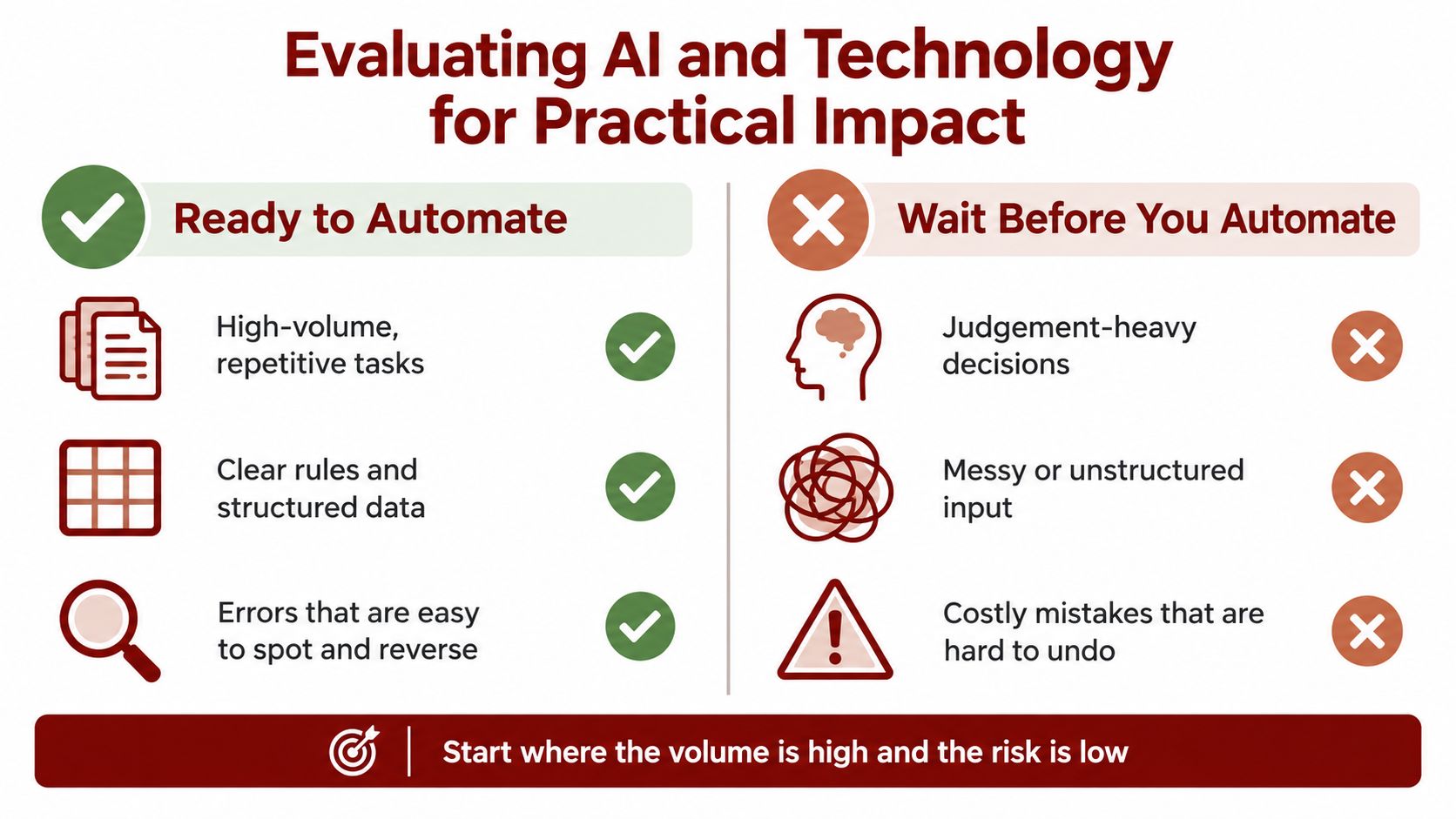
Separate suitable work from unsuitable work
| Process condition | Sensible technology approach | Management requirement |
|---|---|---|
| High volume and repetitive | Standard automation or rules-based software | Monitor exceptions and failed transactions |
| Clear rules and structured data | Workflow automation, templates, or AI assistance | Keep the source data clean and current |
| Easy-to-detect errors | Automated checks and reconciliation | Define who reviews exceptions |
| Heavy judgement | Human-led work with targeted assistance | Keep decision ownership with a qualified person |
| Messy or unstructured inputs | Process redesign before automation | Standardise information first |
| Costly or difficult-to-reverse mistakes | Limited automation with human approval | Maintain evidence, controls, and escalation |
Start with low-risk, high-volume work. Candidate examples include invoice data capture, payment reminders, meeting summaries, document classification, recurring report preparation, and internal search. These tasks still need review, especially where customer, employee, tax, or commercially sensitive information is involved.
Avoid using AI to make an unclear decision merely because the business doesn't want to define the rules. If the team can't agree what a correct outcome looks like, the technology won't solve the disagreement.
Choose standard automation before bespoke AI
Most small businesses should first use the capabilities already available in their accounting, payroll, CRM, and project tools. Standard automation is easier to govern, easier to explain, and less demanding to maintain. Bespoke AI can make sense when a repeated process has a clear business case, reliable data, a defined owner, and enough complexity to justify implementation.
The capability gap matters. Recent UK SME evidence identifies cost, skills, and privacy or data concerns as barriers to regular AI use. Treat those barriers as implementation requirements rather than reasons to buy a larger platform. Train the people who will review outputs, restrict access to sensitive records, document acceptable use, and test the system against real examples before relying on it.
Technology should reduce hand-offs and judgement-free repetition. It shouldn't remove accountability.
Building a Sustainable Efficiency Culture
Efficiency should not depend on one energetic founder. Build operating standards that continue through holidays, growth, staff changes, new clients, and more demanding compliance work. The aim is a business that runs predictably because responsibilities and decisions are clear.
Set a monthly improvement meeting with one purpose: turn operational evidence into a small, completed change. Review the dashboard, identify one recurring delay, assign an owner, and agree how to test the fix. Limit the agenda. A few maintained improvements will outperform a long transformation plan that nobody owns.
Keep the operating model current
Give every core workflow a named owner and review date. Update the documented standard when pricing, staffing, systems, services, or compliance obligations change. Ask staff where work still stops or loops back. People handling invoices, client requests, payroll inputs, and delivery tasks usually spot friction before senior management does.
Management quality has a measurable relationship with output. A 0.1-point improvement in management score was associated with a 9.6% increase in productivity, according to ONS Management and Expectations Survey data cited in The government evidence annex. For SME founders, the practical conclusion is clear: invest in supervision, defined workflows, and usable management information alongside software.
Scale only when the process is ready
Fewer than 1 in 10 established UK SMEs improve productivity while also growing turnover and employment, according to The Productive Business Index. Growth can hide weak operations. More customers and employees will multiply broken approvals, incomplete records, and unclear responsibilities unless the underlying process is ready.
A capable accountant or management adviser can connect process changes with cash flow, tax compliance, reporting, profitability, and risk. Their value extends beyond producing accounts after the event. Reliable financial information should guide pricing, hiring, capacity, investment, and controlled growth.
Choose one workflow this week. Document its current steps, measure its output, and remove one unnecessary hand-off. Make the revised process the operating standard, then review the result with its owner.
Action Accountants Limited provides bookkeeping, payroll, VAT, tax, company secretarial, and management consulting support for UK SMEs, including CIS-aware services for construction businesses and practical financial controls for landlords and growing companies. Visit Action Accountants Limited to discuss removing administrative drag, improving financial visibility, and building workflows that support profitable growth.