100 Accountancy Firms: Find Your Best Match
Compare 100 accountancy firms by sector, scale and specialism, including construction, startups, property and UK-wide support, with practical selection tips.

The biggest accountancy firm isn't automatically the best choice. A national brand may offer deep technical teams and broad geographic coverage, but a founder, contractor, landlord or owner-managed business often needs something more practical: a named contact, clear explanations, quick replies and advice that fits the way the business operates.
This roundup gives you a decision-led way to compare 100 accountancy firms across the UK. The first seven featured profiles show how to assess firms consistently by service breadth, sector specialism, client scale, geographic reach, communication style, practical support and likely fee complexity. The wider market is large and fragmented. The ICAEW's historical resources trace the profession's formal UK development back to its Royal Charter on 11 May 1880, while current market tracking demonstrates that businesses have a substantial choice of practices rather than a handful of obvious winners.
The right shortlist depends on your situation. Founders may prioritise formation and company secretarial support. Owner-managed businesses often need reliable accounts, VAT, payroll and tax guidance. Contractors and construction firms need CIS-aware controls. Landlords and property businesses may require specialist reporting and tax support. Growing companies may need management accounts, outsourced finance, audit or transaction advice.
Before contacting firms, write down:
- Business structure: Sole trader, partnership, limited company or group?
- Software: Are you using Xero, QuickBooks, Sage or another platform?
- Payroll and VAT: What filings and payroll responsibilities already exist?
- CIS obligations: Do you pay subcontractors or work under the construction scheme?
- Audit requirements: Could your size, structure or investors create an audit need?
- Tax complexity: Are property, international, employment or capital issues involved?
- Growth plans: Do you expect funding, acquisitions, hiring or an eventual exit?
- Advisory support: Do you need compliance only, or a proactive commercial adviser?
Use guides for accountants to strengthen your questions, then verify each firm's current services, availability and pricing directly.
Table of Contents
- 1. Action Accountants Limited
- 2. BDO LLP
- 3. Grant Thornton UK LLP
- 4. RSM UK
- 5. MHA
- 6. Haines Watts
- 7. Moore Kingston Smith
- 7-Firm Comparison: Leading UK Accountancy Firms
- Make the Shortlist Work for Your Business
1. Action Accountants Limited
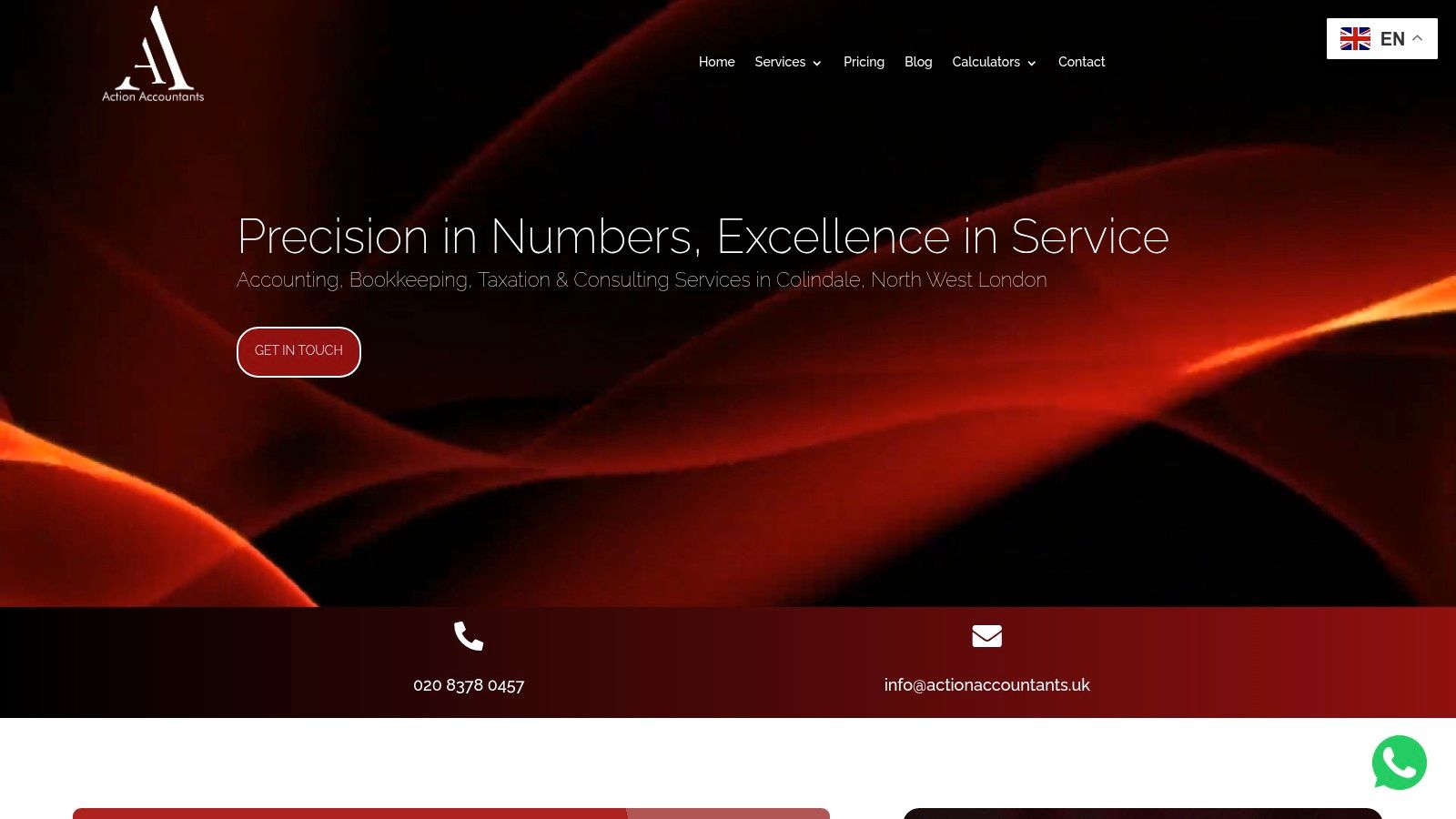
Action Accountants Limited is the strongest practical fit in this opening group for startups, owner-managed businesses, contractors and SMEs in North West London. Based in Colindale and led by founder Georgie Zdrenghea, the firm combines accountancy with management consultancy. That matters when you need more than completed returns, because the same adviser can help with formation, bookkeeping, compliance and operational decisions as the business develops.
The service range runs from new business formation and company secretarial support through day-to-day bookkeeping, payroll, statutory accounts, VAT and personal and corporate tax returns. Management consulting adds a commercial layer, helping clients examine operations, profitability and long-term value rather than treating accounting as a year-end exercise.
Why it suits hands-on business owners
Construction experience is a clear differentiator. Contractors and subcontractors need bookkeeping and tax processes that recognise CIS obligations, project controls and cash-flow pressure. Action Accountants also provides practical online tools, including salary and CIS calculators, which can make routine planning easier.
The firm's local coverage includes Colindale, Kingsbury, Queensbury, Edgware, Finchley and the wider North West London area, with support also available across the UK. That creates a useful balance for businesses that value local access but don't want their accountant limited to face-to-face work.
Clients quoted on the firm's website describe the team as “very understanding and very helpful”, praise its “proactive approach and responsiveness”, and commend Georgie's prompt, consistently “amazing service”. These comments support the firm's positioning around communication, but prospective clients should still test response expectations during the initial consultation.
Practical rule: Ask who will handle routine queries, how urgent CIS or VAT questions are escalated, and what turnaround the engagement includes.
Action Accountants Limited is registered in England and Wales as Company No. 10697895 and lists ICO registration ZA286067. These details provide useful governance and data-protection transparency. However, the website doesn't publish fixed pricing. You'll need to request a consultation and custom quote, so send a complete brief if you want a meaningful comparison with other firms.
Where it may not be the right fit
This is a specialist practice for SMEs and contractors, not a visibly structured large-enterprise or multi-jurisdiction platform. If you need complex international reporting, extensive capital-markets work or a large audit infrastructure, a bigger firm may be more suitable. For a founder, landlord, sole trader or growing local company seeking responsive support across formation, bookkeeping, payroll, VAT, tax and advisory work, that trade-off is often favourable.
Before engaging, use this guide to choosing an accountant and compare the scope, contact model, software process and quote. Action Accountants is particularly compelling when you want one practical adviser to understand both your compliance obligations and your commercial objectives.
2. BDO LLP
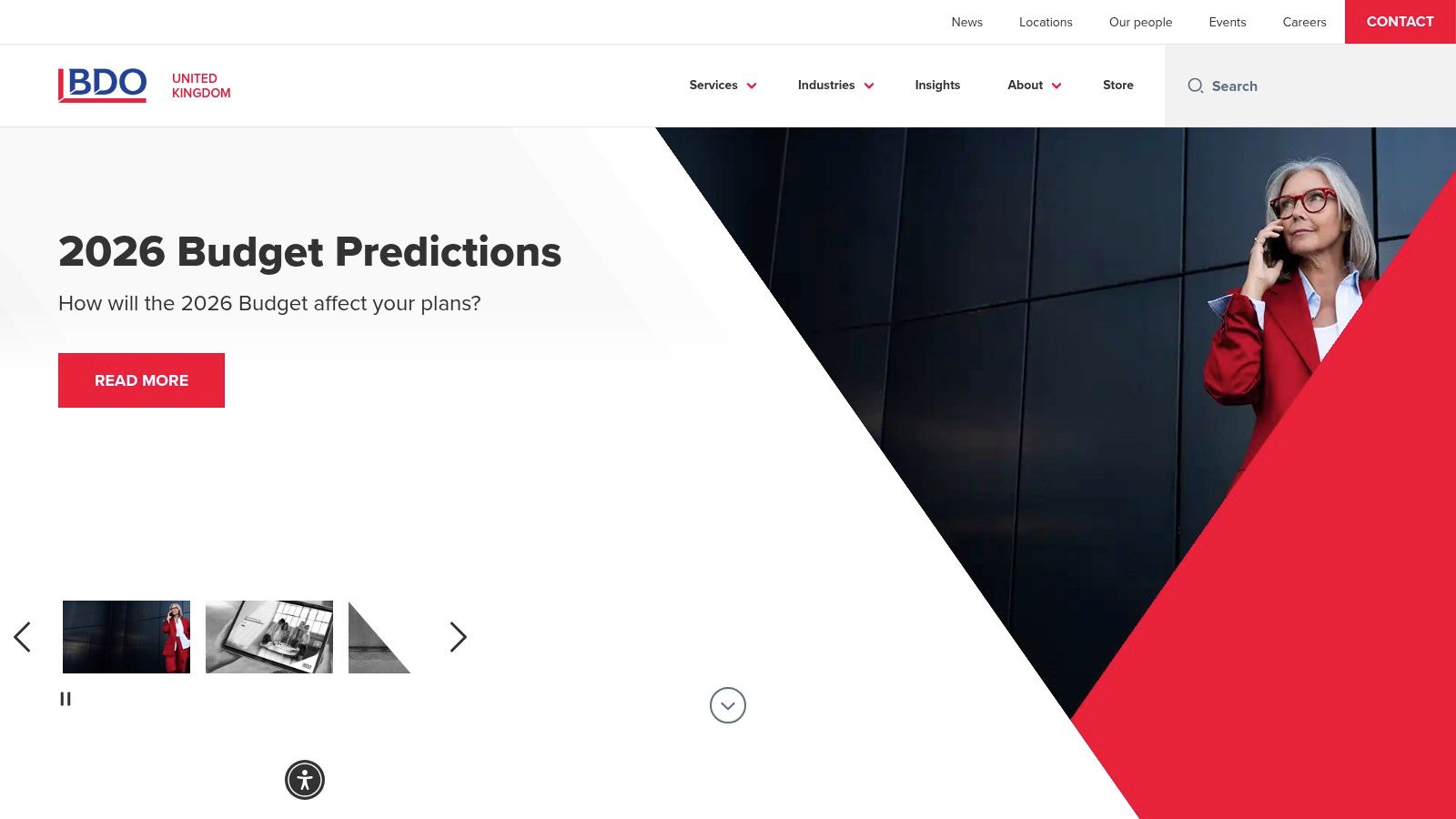
BDO LLP occupies a useful position for businesses that have outgrown a small local practice but don't need the most heavyweight global structure. It combines audit, tax, deals, consulting, risk and outsourcing, giving scaling companies a route from routine compliance into finance transformation, transactions and strategic advice.
Its Real Estate and Construction practice includes more than 350 specialists, according to the firm's sector material, making it a serious option for developers, contractors, investors and businesses with substantial property exposure. The firm also publishes sector-focused insight, which can help management teams monitor changes affecting construction and real estate.
Best use case
Choose BDO when you need mid-market capability with national UK coverage and international reach through the BDO global network. A growing company may begin with accounts and tax, then add outsourced finance, transaction support, risk work or consulting. Having those disciplines in one organisation can reduce the need to appoint several advisers as requirements become more complex.
The construction and property focus also makes BDO more relevant than a generalist practice for clients dealing with development, project reporting, investment or sector-specific tax questions. Its market publications can support management discussions, although published insight shouldn't replace advice specific to your own contracts and structure.
Scale helps when your requirements are changing quickly, but it can add process and cost.
Trade-offs to test
BDO will normally carry a higher fee expectation than a small local accountant, particularly where the engagement involves audit, deals, specialist tax or consulting. Very small businesses may also find the process more formal than necessary for straightforward bookkeeping and annual accounts.
Ask for the proposed team structure, the distinction between included compliance and chargeable advisory work, and the point at which work moves to a specialist department. If your business needs an audit, understand the applicable exemption position and discuss it early using this practical resource on audit exemption thresholds.
BDO is a strong contender for established SMEs, property businesses and construction companies preparing for expansion. It isn't the default choice for every micro-business. Its value improves when you need breadth, specialist depth and a platform capable of supporting a more involved finance function.
3. Grant Thornton UK LLP
Grant Thornton UK is well suited to dynamic mid-market businesses that want compliance and strategic advice under one roof. Its offer spans audit, tax and advisory work, with a substantial Real Estate and Construction practice covering the property lifecycle from strategy and transactions to audit, valuations, financial advisory and tax.
That breadth makes the firm relevant to businesses whose accounting needs are becoming decision-critical. A property company may need reporting and tax support today, then restructuring or valuation advice later. A construction group may need audit, modelling, funding support or help with expansion. Grant Thornton can bring those capabilities together rather than forcing the client to coordinate every specialist independently.

Strength in sector-led advice
The firm's sector-led delivery model is its most persuasive feature for real estate and construction clients. It covers audit, tax, restructuring, valuations, modelling and ESG-related work, alongside support for international expansion and cross-border coordination.
That combination is valuable when the business has stakeholders beyond the owner, including lenders, investors, shareholders or overseas entities. UK-wide coverage can also give clients access to senior expertise without requiring the firm to be based in one specific city.
For a founder with a simple domestic company, however, this breadth may exceed what is needed. A small business should avoid paying for a platform designed around complex engagements if its immediate requirements are bookkeeping, VAT, payroll and annual accounts.
Questions about engagement complexity
Grant Thornton may apply minimum engagement sizes for some services, and onboarding can feel process-heavy compared with a local practice. Ask for a plain-English scope before signing. Confirm which partner or manager owns the relationship, which tasks are handled by specialists, and how the firm separates recurring compliance from one-off advisory work.
Choose Grant Thornton when future transactions, restructuring or international growth are realistic requirements, not merely distant possibilities.
Businesses planning an eventual sale should also consider the quality of exit preparation, not just annual compliance. This overview of a business exit plan can help you identify the questions to raise.
Grant Thornton is a sound choice for ambitious SMEs, property groups and construction businesses with increasing advisory complexity. It may be less efficient for a sole trader or very small company that primarily needs accessible, routine support.
4. RSM UK
RSM UK makes the most sense for mid-market businesses that need accounting, tax and consulting support alongside a scalable outsourced finance function. Its Real Estate and Construction team works with investors, developers, contractors and funds, so the firm can accommodate different positions within the property and construction ecosystem.
The service model covers audit, tax, consulting, outsourced finance and restructuring. That gives a growing business options beyond annual compliance, particularly when the finance function needs stronger reporting, improved controls or temporary external capacity.
A good fit for changing market conditions
RSM publishes Real Estate 360° research and practical commentary on construction trends, insolvencies and policy impacts. The firm also addresses tax issues such as SDLT, LBTT and LTT, as well as development viability. For property and construction leaders, that kind of sector framing can make conversations more commercially useful than a purely transactional compliance service.
RSM is particularly attractive to mid-market and private-equity-backed growth companies. These clients often need consistent reporting, stronger governance and advice that can keep pace with funding, ownership or operational changes.
Where buyers need clarity
International coverage comes through the RSM network, which can mean coordination with member firms when work crosses borders. Highly niche assignments may also be routed to specific network teams. That isn't necessarily a weakness, but it can affect who owns the relationship and how quickly decisions move.
Ask whether your engagement has one UK lead, how overseas work is coordinated, and whether network fees or separate scopes apply. You should also establish whether outsourced finance means transaction processing only, management reporting, forecasting or a broader finance-leadership role.
A strong sector team should explain how its advice changes your decisions, not just describe its credentials.
Financial reporting changes can create avoidable disruption when businesses leave preparation too late. Use this guidance on FRS 102 changes as a prompt for your initial discussion.
RSM is a strong choice for investors, developers, contractors and growing groups that need specialist market insight plus operational finance support. A smaller practice may still offer better access and lower complexity for straightforward local compliance.
5. MHA
MHA is designed for growth-oriented and owner-managed businesses that want national reach without abandoning practical sector knowledge. It operates as a single UK firm with more than 20 offices, while its connection to Baker Tilly International provides access to broader cross-border capability when required.
Its Construction and Real Estate practice supports developers, contractors and subcontractors with accounting, tax, R&D claims, project reporting and HMRC interactions. The focus on construction is especially relevant to businesses that need more than annual accounts, because project performance, employment status, tax treatment and compliance risks can affect cash flow throughout the year.

Why construction clients should look closely
MHA's construction offering includes CIS-relevant support, project reporting, IR35 and employment tax guidance, fundraising advice and HMRC inquiry experience. Those capabilities can be valuable for firms managing subcontractors, multiple projects or a changing workforce.
The firm also maintains sector commentary and leadership content across construction and real estate. That gives clients a basis for wider commercial conversations, although you should still ask who will apply the guidance to your specific contracts and records.
For an owner-managed business, the appeal is direct. MHA can provide a more structured platform than a small local accountant while retaining a clear focus on entrepreneurial and mid-market clients.
The limits of the model
For very large capital-markets work or highly complex international assignments, some businesses may prefer a firm with a more prominent FTSE-heavy or global delivery structure. Baker Tilly International provides network access, but cross-border work may involve partner coordination rather than one integrated international team.
Ask whether your engagement will remain with a consistent UK team, how specialist referrals are managed, and what happens when a routine compliance assignment develops into a tax investigation or funding project. Also separate the recurring fee from work such as R&D claims, HMRC support and detailed project reporting.
MHA is a compelling option for construction businesses, property companies and owner-managed firms entering a more advanced growth phase. Its main trade-off is that the broader the assignment becomes, the more important it is to understand the network and specialist boundaries.
6. Haines Watts
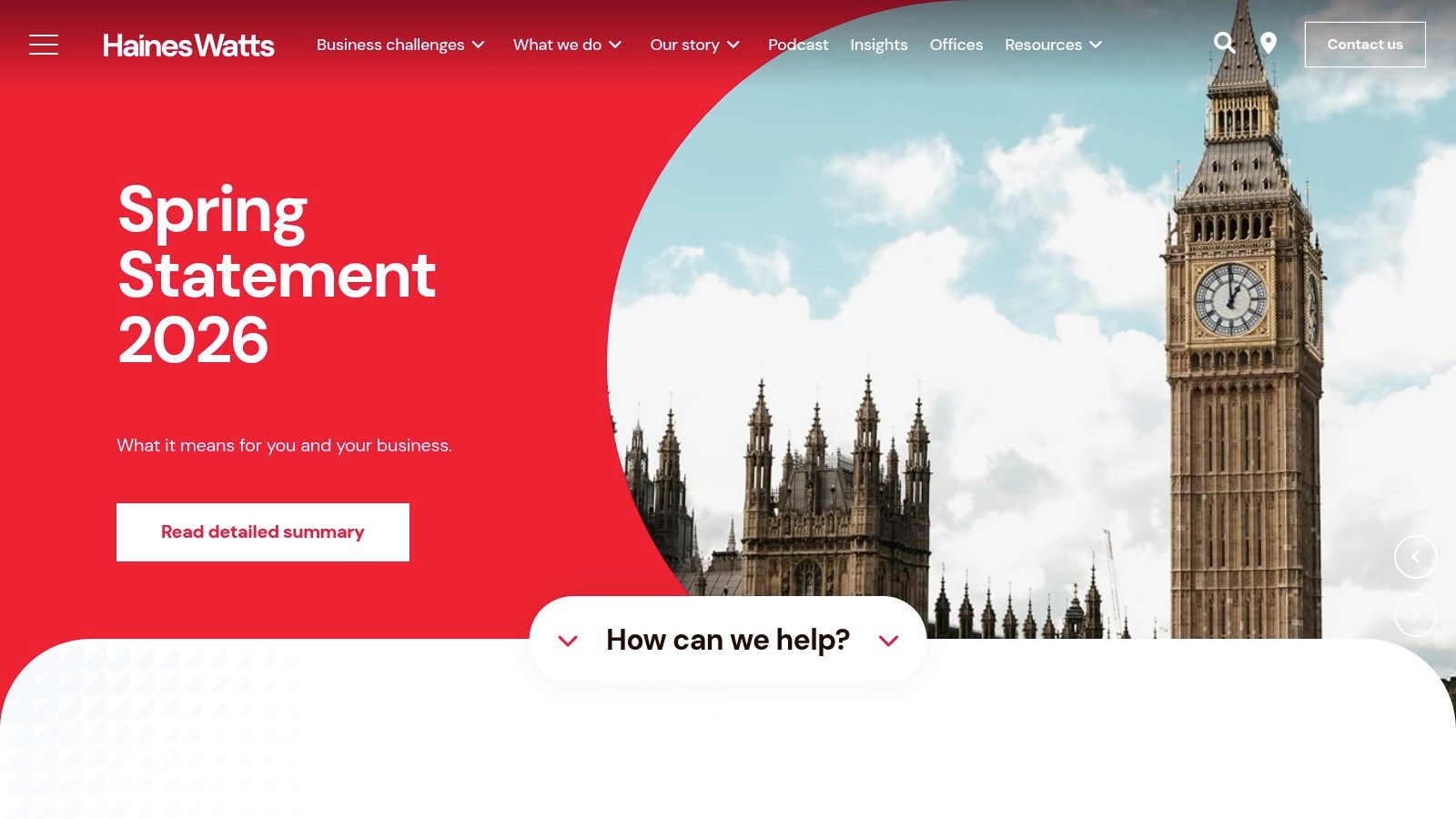
Haines Watts takes a clear SME and entrepreneur focus. The firm provides accounts, audit, VAT, payroll and advisory services through a UK-wide network with a London presence. That positioning makes it a practical candidate for startups and established owner-managed companies that want hands-on compliance support without beginning with a large corporate platform.
Its tax team's experience with PAYE investigations and CIS employer compliance reviews is relevant to contractors, subcontractors and businesses that employ staff across operational sites. The firm also supports clients with cloud accounting onboarding, which can be useful when records are still split between spreadsheets, desktop applications and newer online systems.
Accessibility over prestige
Haines Watts is a sensible choice when you value pragmatic guidance, regular contact and help with everyday compliance. Many SMEs don't need a large transaction team. They need someone to keep VAT, payroll, accounts and tax moving while explaining what needs attention before a deadline becomes a problem.
The network model can offer local access, but the actual experience depends on the office and team you appoint. Ask to meet the proposed contact before signing, not just the senior person involved in the pitch.
The right accountant should make your records easier to operate, not simply report on problems after the year ends.
Important limitations
Complex cross-border structuring, capital-markets work and large international assignments may require a larger platform. Haines Watts can be a strong fit for an SME, but it isn't the obvious choice for every group with overseas entities, institutional investors or extensive transaction requirements.
Clarify software compatibility, onboarding responsibilities and the treatment of out-of-scope work. Ask whether payroll, CIS reviews, tax investigations and advisory meetings are included or billed separately. A low-complexity engagement can remain efficient if the scope is clear. Costs and friction can rise when the business assumes that occasional advice is included without confirming it.
Haines Watts deserves consideration from founders, owner-managed companies, contractors and growing SMEs that want a practical UK-wide service. Compare the local office's responsiveness and sector knowledge rather than relying on the network name alone.
7. Moore Kingston Smith
Moore Kingston Smith is a London-led, multi-disciplinary firm serving entrepreneurial businesses, with access to the Moore Global network. Its strongest fit in this list is for London and South East property, construction and investment clients that need specialist reporting, audit or tax advice alongside broader business support.
The Real Estate and Construction hub covers construction, property development and investment. The firm also offers capital allowances expertise with in-house MRICS capability, giving property businesses access to relevant technical knowledge without automatically appointing a separate adviser for every issue.
Specialist property capability
Moore Kingston Smith stands out for real estate audit and financial reporting, including work involving REITs and listed property companies. That makes it more relevant to complex property structures than a general small-business accountant, particularly where reporting quality, capital allowances or investor expectations matter.
Its sector hub also provides guidance on VAT and financial reporting changes. Businesses should use that material to shape questions, then ask the engagement team how the issues apply to their own property vehicles, development plans and reporting timetable.
A London location can be a practical advantage for founders and SMEs in and around the capital. Local meetings, existing professional connections and access to a concentrated specialist team may matter more than a nominally nationwide footprint.
Geographic trade-offs
The firm is primarily London and South East centric. Wider coverage is available through the Moore Global network, but clients outside its core geography may encounter more network coordination than they would with a firm whose own office network is denser across the UK.
Ask who will deliver work outside London, whether the same service standards apply across network firms, and how responsibility is divided. Also confirm whether your business needs property audit, capital allowances, routine accounts or a combination of all three. The right answer depends on the complexity of the assets and reporting obligations, not the brand's overall size.
Moore Kingston Smith is a strong shortlist candidate for London property businesses, entrepreneurial companies and clients requiring specialist real estate reporting. A smaller practice may offer better value for a simple company, while a larger international firm may be preferable for extensive cross-border work.
7-Firm Comparison: Leading UK Accountancy Firms
| Provider | Implementation complexity 🔄 | Resource requirements ⚡ | Expected outcomes 📊 ⭐ | Ideal use cases 💡 | Key advantages ⭐ |
|---|---|---|---|---|---|
| Action Accountants Limited | Low 🔄, hands‑on, flexible onboarding | Low ⚡, small team, online tools | Reliable compliance & operational gains 📊, ⭐⭐⭐⭐ | Local SMEs, contractors, startups, CIS clients | CIS expertise, proactive support, fast turnaround |
| BDO LLP (UK) | Medium‑High 🔄, formal, structured processes | High ⚡, large specialist teams, higher fees | Broad compliance, deals & outsourcing impact 📊, ⭐⭐⭐⭐ | Scaling mid‑market firms needing transactions & international reach | Full‑service mid‑market capability, large REC team |
| Grant Thornton UK LLP | Medium‑High 🔄, process‑led onboarding | High ⚡, senior specialists, cross‑border resources | Strong audit, tax and transaction outcomes 📊, ⭐⭐⭐⭐ | Mid‑market businesses pursuing growth and cross‑border work | Comprehensive REC offering, cross‑border coordination |
| RSM UK | Medium 🔄, scalable processes for growth clients | Medium‑High ⚡, multi‑service teams, network support | Practical advisory + timely market insight 📊, ⭐⭐⭐⭐ | Mid‑market and PE‑backed growth companies | Ongoing research (Real Estate 360°), practical tax guidance |
| MHA (Baker Tilly member) | Medium 🔄, UK‑wide but practical approach | Medium ⚡, 20+ offices, sector teams | Good SME outcomes with HMRC readiness 📊, ⭐⭐⭐ | Owner‑managed construction businesses, project reporting | CIS/HMRC experience, nationwide coverage |
| Haines Watts | Low‑Medium 🔄, pragmatic, SME‑friendly processes | Low‑Medium ⚡, local network resources | Solid compliance and onboarding outcomes 📊, ⭐⭐⭐ | Startups, owner‑managed SMEs, contractors | Hands‑on support, PAYE/CIS investigation experience |
| Moore Kingston Smith | Medium 🔄, specialist sector workflows | Medium ⚡, London hub with global network | Strong REC audit and reporting outcomes 📊, ⭐⭐⭐⭐ | London‑based developers, REITs, listed property companies | Capital allowances, MRICS capability, specialist audit |
Make the Shortlist Work for Your Business
A list of 100 accountancy firms only becomes useful when you reduce it to realistic candidates. Don't contact every name. Select three firms that match your business stage, sector, location and likely engagement complexity, then give each one the same brief.
Include your business structure, sector, turnover or growth stage, current pain points, required services, operating locations, important deadlines and expected communication style. Say whether you want annual compliance, monthly reporting, payroll, VAT, CIS support, tax planning, audit, outsourced finance or management advice. The more precise the brief, the easier it is to compare proposals on substance rather than presentation.
Ask every firm the same questions:
- Relevant experience: Which clients have similar structures, sectors or operational issues?
- Named responsibility: Who will handle the account, and who covers them during absence?
- Response standards: How are urgent questions handled, and what response time should you expect?
- Software compatibility: Can the firm work with your existing system, and who manages migration or setup?
- Onboarding: What records, permissions and historic information must you provide?
- Scope boundaries: Which services are included in the recurring fee?
- Additional charges: How are advisory meetings, investigations, amended returns and specialist work billed?
- Network hand-offs: Will another office or partner firm become involved?
- Review frequency: How often will the firm review performance, tax exposure and changing needs?
Construction businesses should confirm practical CIS capability, not merely a generic claim of construction experience. Ask how the firm handles subcontractor records, verification, deductions, payroll interaction, project reporting and HMRC correspondence. A firm that understands construction cash flow and control weaknesses can be more valuable than one with a bigger logo but less operational familiarity.
Property businesses should test experience with development, investment, rental activity, capital allowances, VAT and financial reporting where relevant. Growing companies should ask whether the proposed adviser can support funding, hiring, management reporting, systems improvement or an eventual sale. Don't pay for capabilities you'll never use, but don't choose a provider that will force a disruptive move as soon as your business becomes more complex.
Technology should form part of the comparison. UK accountancy-firm data found that 81% of firms reported at least half of their technology stack was cloud-based, while 45% said their stack was mostly or fully cloud-based and 19% remained predominantly desktop-based. The same Bright survey results recorded bookkeeping software use at 74%, compared with 56% for accounts production, 36% for tax software, 35% for practice management and 20% for company secretarial software. The lesson is practical. Don't assume a firm's cloud claim means every workflow is integrated. Ask specifically about accounts production, tax, company secretarial work, document exchange and approvals.
Security and change management deserve equal attention. A separate survey of 100 accountants found 47% used cloud-based software, 34% used a hybrid cloud and on-premises setup, and 81% had at least some cloud exposure. Respondents identified accessibility and productivity or time savings as leading benefits, while cyber-attacks and data security were prominent concerns, as detailed in Wolters Kluwer's UK cloud accounting report. Ask how the firm controls access, backs up data, manages permissions and trains staff.
For many buyers, the final decision should come down to fit, access and clarity. A national or mid-market firm can be the right answer when you need audit, transactions, international coordination or specialist teams. A focused local firm can be the better answer when you need quick decisions, consistent contact and practical help with bookkeeping, VAT, payroll, tax and operations.
Action Accountants Limited is a natural enquiry option for businesses in Colindale, Kingsbury, Queensbury, Edgware, Finchley and wider North West London, as well as clients across the UK seeking hands-on support. Its combination of formation, bookkeeping, payroll, statutory accounts, VAT, personal and corporate tax, CIS-aware construction support and management consultancy is especially relevant to founders, SMEs, contractors and property-related businesses. The absence of published fixed pricing means you should request a quote and compare it on exactly the same scope as the other two proposals.
The UK market is mature and structured, with a long professional history and enough firms to compare by size, service and specialism. Use that choice properly. Pick the provider that understands your work, answers clearly, uses suitable systems, defines its fees and can support the next stage of your business.
Action Accountants Limited provides formation, bookkeeping, payroll, VAT, tax, statutory accounts, CIS-aware construction support and management consultancy for startups, SMEs, contractors and property-related businesses. Compare its hands-on North West London and UK-wide support with the other firms on your shortlist by visiting Action Accountants Limited and requesting a consultation and quote.