
What Is Working Capital Management and How to Master It
Learn what is working capital management, how it drives cash flow, and practical strategies to optimise working capital for growing UK businesses.

Working capital management is the day-to-day control of cash tied up in stock, receivables and payables to keep a business liquid. In the UK, the cash conversion cycle was 39.6 days in 2025, meaning cash typically remains committed between paying suppliers and receiving customer payments.
A growing business can look successful on paper while its bank balance tells a different story. Sales have increased, invoices are being raised, and the order book is healthy, yet payroll is approaching, tax is due, and suppliers are asking when they'll be paid.
That tension is the heart of working capital management. It isn't primarily a profitability problem. It's a timing problem. Your business may have earned a profit, but the cash from that profit could still be sitting in unfinished work, unsold stock, unpaid invoices, or rent due from a tenant.
The UK benchmark makes the issue tangible. Allianz Trade reports a national cash conversion cycle of 39.6 days in 2025, with a projection of about 41 days in 2026, while businesses wait an average of 58 days to receive customer payments, measured as days sales outstanding. These figures are reported in this UK working capital management overview.
A founder selling products, a contractor waiting for a certified application, and a landlord managing a property portfolio face different versions of the same challenge. Cash leaves at one point in the operating cycle and arrives later. If the gap widens, growth can consume the money needed to fund the next month.
This guide explains the idea from the ground up, then moves into the four components, the metrics that matter, the reasons profitable businesses run short of cash, and practical fixes. If you're reviewing the wider picture, Action Accountants' guide to improving cash flow provides a useful companion resource. Businesses handling customer payments across different markets may also find Sambapay merchant services Singapore helpful when assessing payment infrastructure and settlement timing.
Table of Contents
- Introduction Why Cash Flow Matters More Than Profit
- Understanding What Working Capital Really Means
- The Four Building Blocks That Drive Working Capital
- How to Measure Working Capital Health With Confidence
- Why Growing Businesses Run Out of Cash
- Practical Strategies to Optimise Working Capital and Cash Flow
- Taking Control of Working Capital for Sustainable Growth
Introduction Why Cash Flow Matters More Than Profit
Profit and cash answer different questions. Profit asks whether your income exceeded your costs over an accounting period. Cash flow asks whether money has arrived in your bank account in time to meet the obligations in front of you.
Suppose a contractor completes work in March, raises an invoice, and records the revenue. The project may be profitable, but the customer might not pay until later. In the meantime, the contractor still needs to cover wages, materials, subcontractor costs, VAT, and other commitments. The profit exists in the accounts, but the cash is unavailable.
A product business can experience the same squeeze by buying stock ahead of demand. The purchase reduces cash immediately, while the sale and customer payment happen later. A landlord may collect regular rent but face a gap when a property becomes vacant, maintenance is required, or a tenant pays late.
The practical distinction: Profit measures performance. Working capital management protects timing.
The cash conversion cycle gives you a practical way to see that timing. It measures how long cash stays tied up between paying suppliers and collecting from customers. A longer cycle usually means the business must fund more of its operations before customers return cash to it.
That's why working capital deserves attention even when sales and margins look healthy. Poor timing can force a business to delay investment, rely on short-term borrowing, negotiate awkwardly with suppliers, or put payroll under pressure. Better timing releases flexibility.
The right response isn't to chase every invoice aggressively or delay every supplier payment. Sustainable control comes from understanding where cash is held, identifying avoidable delays, and matching funding to the operating cycle. The following sections turn that principle into a practical system for founders, SMEs, contractors, and landlords.
Understanding What Working Capital Really Means
The simplest definition is:
Working capital = current assets minus current liabilities
Current assets are resources expected to become cash or be used in the short term. They commonly include cash, inventory, and trade receivables. Current liabilities are obligations due in the short term, such as trade payables and short-term borrowing.
A business with positive working capital has more current assets than current liabilities. That can provide room to meet near-term obligations. Negative working capital means short-term liabilities exceed current assets, which may create pressure unless the business collects cash quickly or has reliable funding.
Positive working capital isn't automatically good, though. Excess stock or overdue invoices can inflate current assets without helping you pay this week's bills. A large balance may show that cash is trapped in the wrong places.
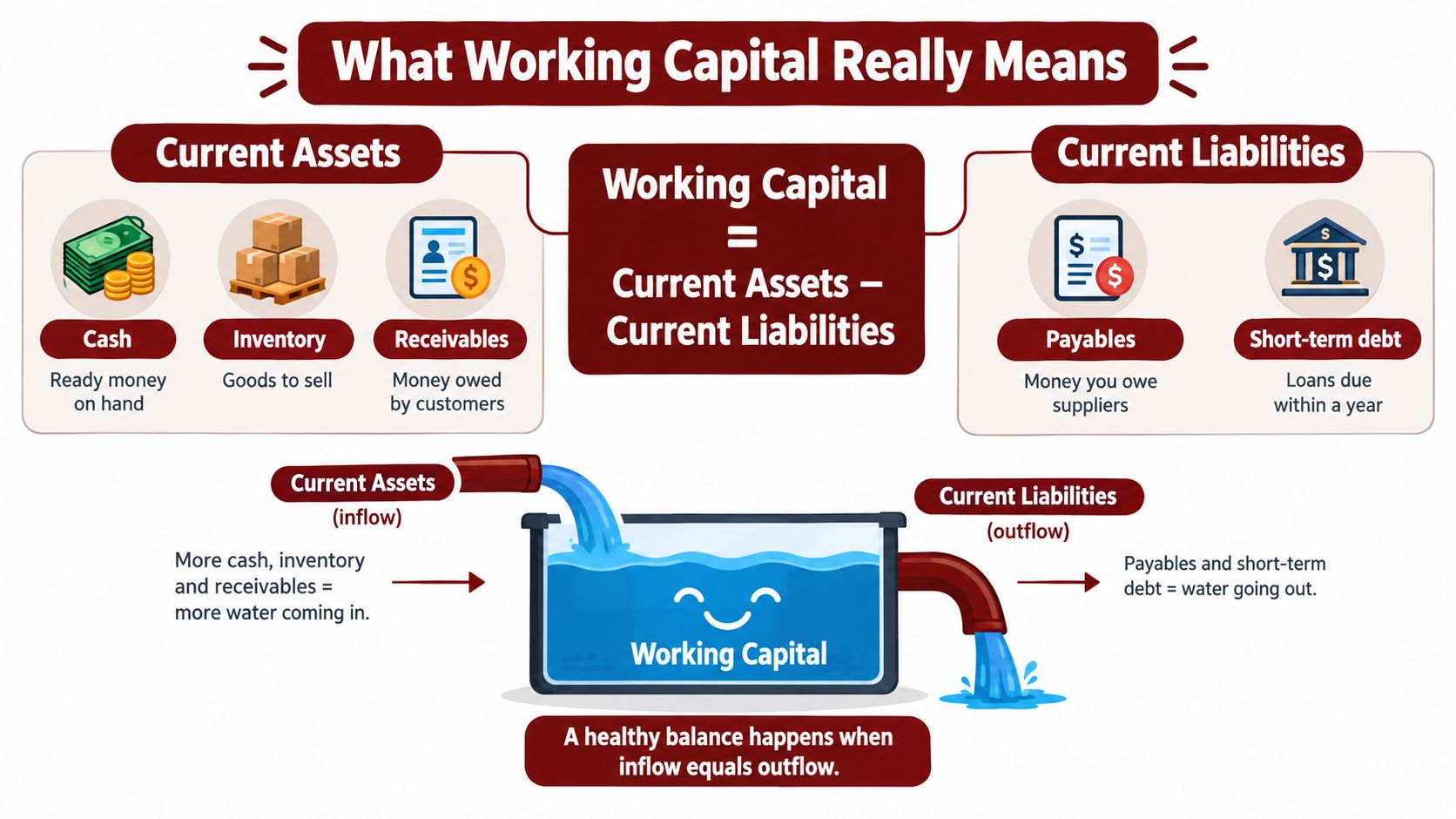
Think of working capital as a water tank
Imagine your business as a tank. Customer payments flow in. Supplier payments, payroll, tax, rent, and operating costs flow out. Inventory and unpaid invoices are water held in pipes or containers outside the main tank. They may eventually return as cash, but they can't fund an immediate payment while they're stuck there.
Working capital management controls those flows. You decide how much stock to hold, which customers receive credit, when to invoice, how quickly to follow up overdue balances, and when supplier invoices should be paid. The objective is a reliable level of liquidity, not the largest possible current asset balance.
For a clearer accounting perspective, this guide to working capital management for small business can help connect the formula with everyday decisions. You can also use financial ratio analysis to place working capital measures alongside other indicators of business health.
The balance matters more than the label
A business can operate with low or even negative working capital if customers pay before the business pays suppliers. Some retailers benefit from collecting at the point of sale while supplier payments happen later. Conversely, a contractor may need substantial working capital because it pays for labour and materials well before receiving certified project income.
That's why the static working capital figure needs context. Ask what makes up the current assets, how soon receivables will be collected, whether inventory can be sold, and when liabilities fall due. Management is the ongoing work of aligning those dates.
The Four Building Blocks That Drive Working Capital
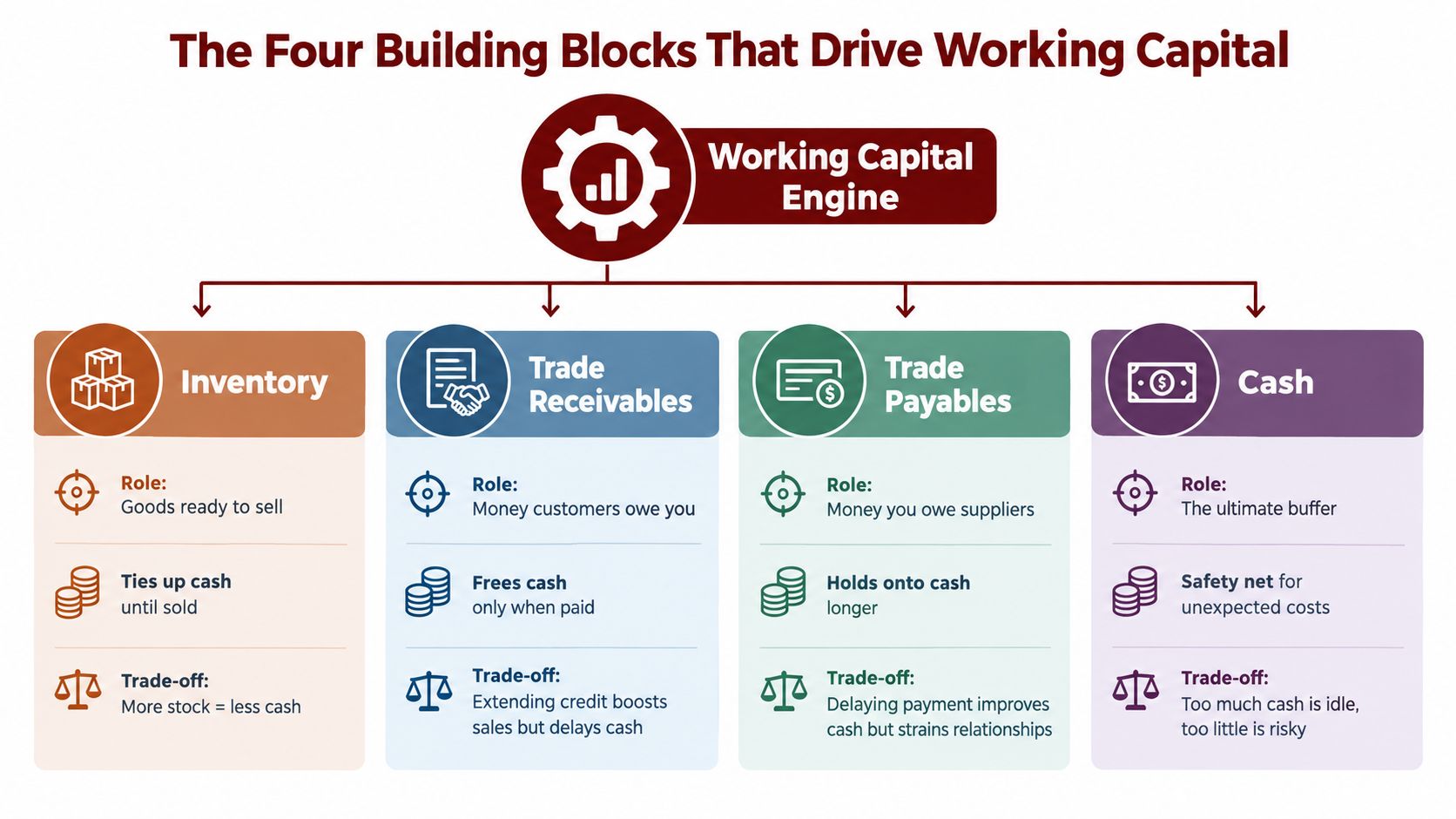
Working capital becomes easier to control when you separate it into four connected building blocks: inventory, trade receivables, trade payables, and cash. Each one affects the others, so improving a single area can create a new problem if the wider cycle is ignored.
Inventory keeps products available, but locks up money
Inventory is cash converted into goods. A retailer needs enough stock to fulfil orders, but every unsold item remains money that can't pay a supplier or fund payroll. Slow-moving, obsolete, or poorly forecast stock creates a particularly stubborn trap because the business may need to discount it before recovering the original cash.
A product company should review stock movement, purchasing patterns, and customer demand together. Ordering smaller quantities more frequently may reduce the cash committed to stock, provided the supply chain can support it. A discount can also be sensible if it converts stagnant inventory into usable cash.
Receivables represent sales that haven't become cash
Trade receivables are amounts customers owe you. Extending credit can support sales, but it also means your business funds the customer until payment arrives.
Invoicing promptly, checking that invoices contain the required information, agreeing terms before work starts, and monitoring overdue balances all shorten the distance between delivery and payment. For a service business, the invoice often becomes the main working capital lever.
Payables provide time, but trust has a value
Trade payables are amounts owed to suppliers. Paying on the due date rather than unnecessarily early can preserve cash, but delaying payment beyond agreed terms can damage relationships, interrupt supply, and create legal or financing costs.
A responsible policy matches payment timing with the cash cycle. It doesn't use small suppliers as an informal overdraft.
Cash is the buffer that absorbs surprises
Cash is the most flexible component. It covers immediate commitments and gives you options when a customer pays late, a vehicle needs repair, or a project costs more than expected. Too little cash creates fragility, while cash that sits idle may represent an opportunity cost.
Core relationship: Inventory and receivables absorb cash. Payables delay cash leaving. Cash provides the buffer between the two.
The interaction varies by business. A manufacturer may focus on stock purchasing. A consultancy may have little inventory but depend heavily on invoice collection. A landlord may concentrate on rent arrears, void periods, and planned maintenance. If you're considering receivables funding, this explanation of invoice discounting outlines one route without treating finance as a substitute for good controls.
How to Measure Working Capital Health With Confidence
The figures become useful when they answer operational questions. How long does cash remain committed? Can current assets cover near-term liabilities? Is your business performing differently from similar organisations?
Start with the cash conversion cycle
The cash conversion cycle, or CCC, focuses on the time between cash leaving and cash returning. A common structure is:
CCC = inventory days + receivables days minus payables days
A shorter CCC generally means cash moves through the business more quickly. A longer CCC means the business needs more funding to support the same level of activity. Don't assess it in isolation. A construction company naturally has a different cycle from a consultancy.
The UK SME benchmark data cited in the Grant Thornton material show construction typically operating around a 50 to 80 day CCC, while professional services are around 25 to 45 days. The same source indicates typical current ratios near 1.1 to 1.3 for construction and 1.5 to 2.5 for professional services. These figures come from industry benchmark data discussed alongside Grant Thornton's study of 3,081 companies with revenue of at least £100 million in its statutory accounts analysis. See the Grant Thornton UK Working Capital Study.
Use the current ratio as a cover test
The current ratio is:
Current assets ÷ current liabilities
It indicates how much current asset cover exists for each unit of short-term liabilities. A lower figure may be normal in a business that collects cash quickly. A higher figure may be necessary where projects take longer to bill or stock takes longer to sell.
| Sector | Typical CCC Range | Typical Current Ratio | What It Means |
|---|---|---|---|
| Construction | 50 to 80 days | 1.1 to 1.3 | Cash is often tied to work completed, certification, retentions, and materials |
| Professional services | 25 to 45 days | 1.5 to 2.5 | Receivables timing matters, while inventory usually has less influence |
Track the direction, not just today's result
Net working capital days express working capital in relation to business activity. They help show whether more cash is being consumed as revenue grows. Compare the measure with your own history, budget, payment terms, and sector.
Warning signs include receivables rising faster than sales, inventory accumulating without confirmed demand, or payables being delayed because the business lacks a cash plan. A monthly ratio review becomes much more valuable when paired with an aged debtor report and a forward cash forecast.
Why Growing Businesses Run Out of Cash
Growth can create a cash shortage because costs often arrive before revenue becomes collectible. A business may hire staff, buy materials, accept larger orders, or give customers more generous terms before it receives the cash generated by those decisions.
This is sometimes called overtrading. The business isn't necessarily failing to sell. It's accepting more work than its available cash can support. Each new order can increase the amount tied up in stock, labour, delivery, or unpaid invoices.
A contractor offers a clear example. The firm wins a larger project, pays subcontractors and suppliers, and completes stages of the work. If applications require certification or payments include retentions, the contractor may carry substantial costs while waiting for cash. The project margin can remain positive, yet the bank account becomes strained.
A landlord faces a different pattern. Rent may normally arrive on schedule, but a void period can remove the expected inflow while maintenance, insurance, financing, and compliance costs continue. The property may be profitable over its ownership period, but the timing gap still requires funding.
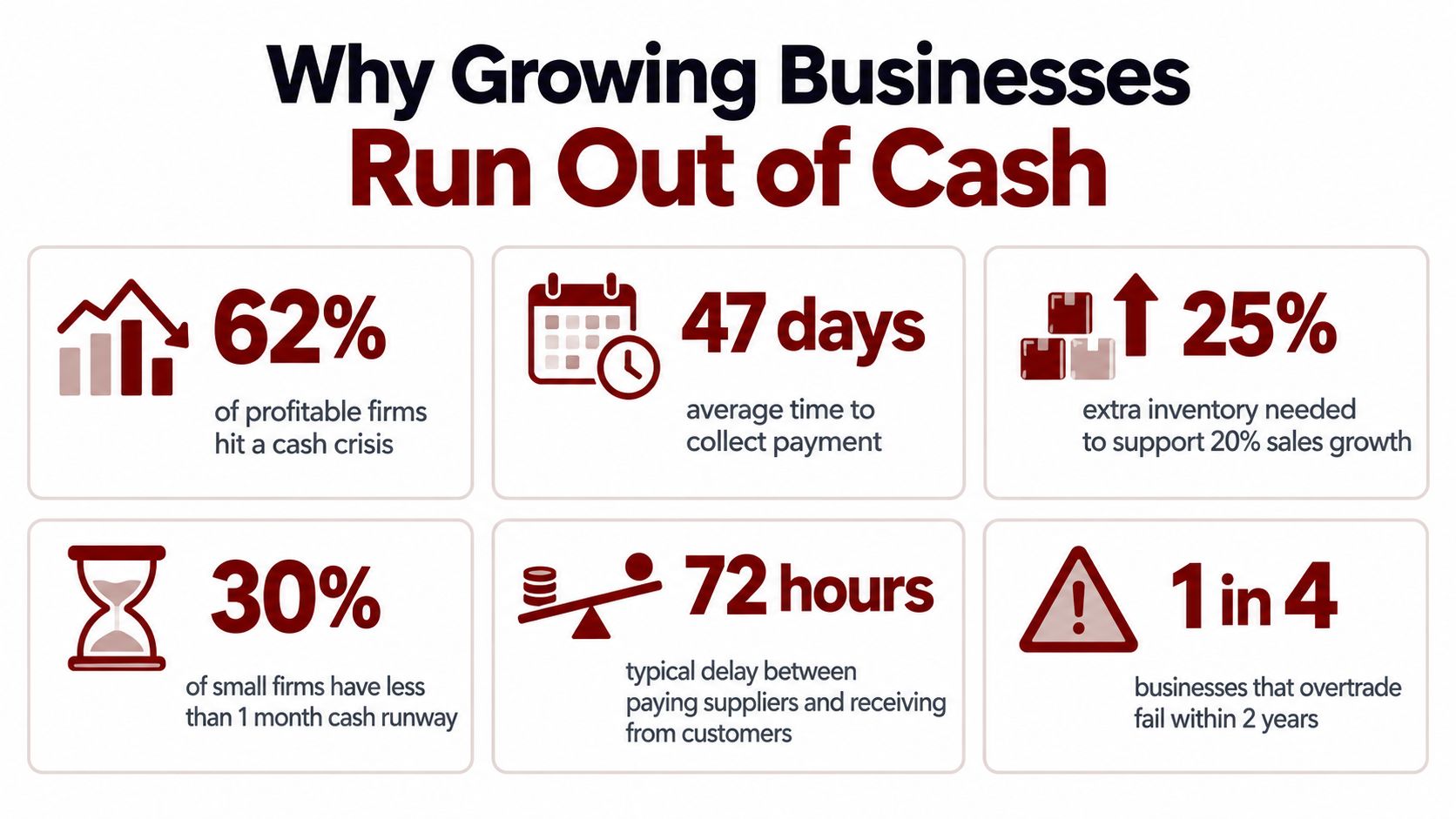
The UK trend adds weight to this diagnosis. PwC reported that UK net working capital days had risen by almost 50% since 2015, with inventory days increasing sharply in 2019 to 2020 and later pressure from falling days payable outstanding. That means businesses have faced a longer period in which cash remains committed, as described in the PwC UK working capital study.
The danger is greatest when the owner treats the bank balance as a surprise rather than a measurable outcome. A growing order book can conceal a widening gap between costs and collections. By the time the shortage becomes visible, the business may have limited room to negotiate.
A useful diagnostic: Ask which event turns a sale into cash, then identify every delay between delivery, approval, invoicing, certification, and payment.
Practical Strategies to Optimise Working Capital and Cash Flow
Improvement starts by assigning an owner to each cash movement. Sales should understand credit terms, operations should understand stock commitments, accounts should track invoices and payables, and the owner should see the forward cash position.
Release cash without damaging the operation
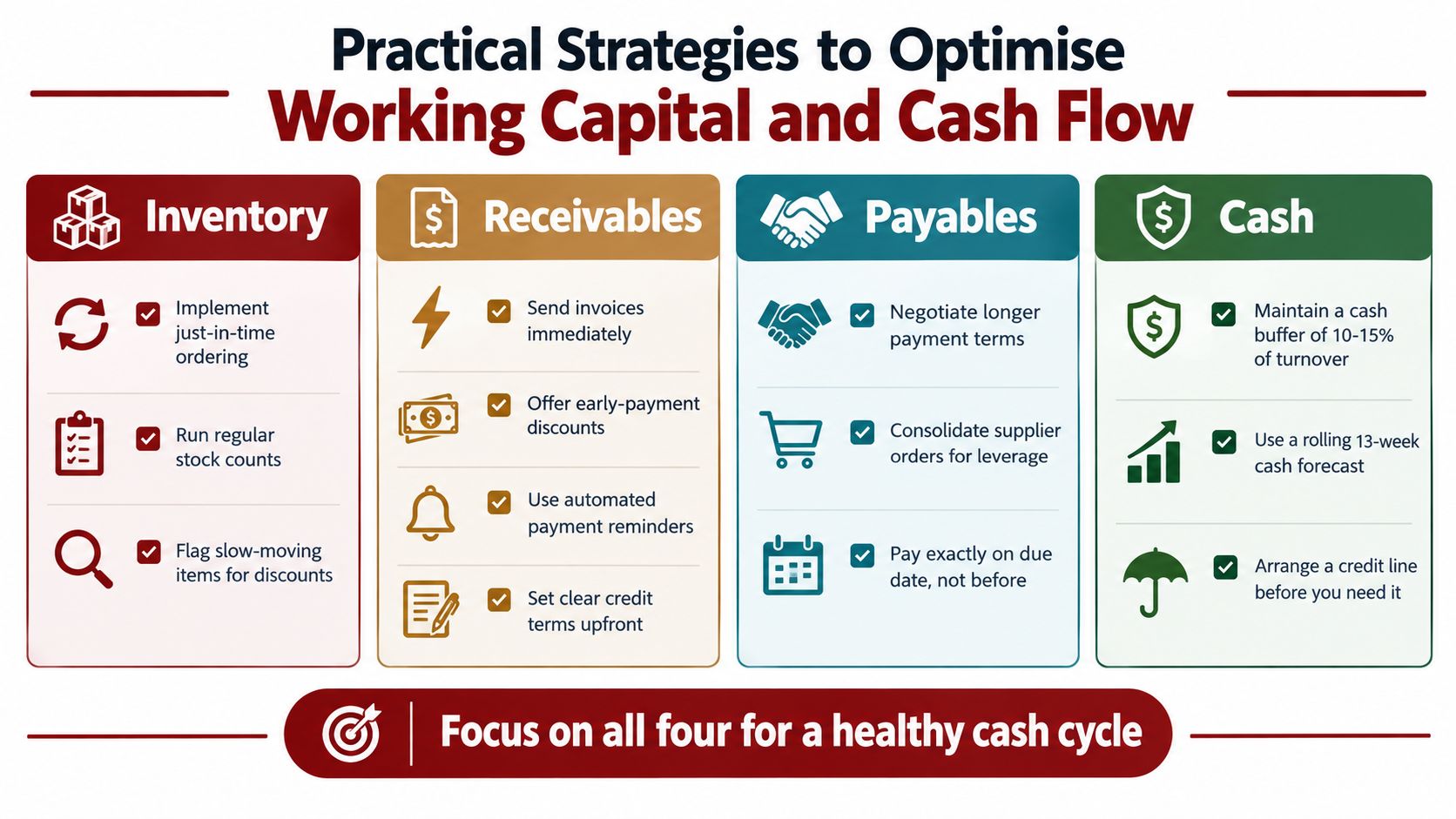
Inventory: Match purchasing to realistic demand, count stock regularly, and identify slow-moving items before they become obsolete. A discount that converts dormant stock into cash may be more useful than protecting an unrealistic margin.
Receivables: Send complete invoices as soon as the contractual trigger occurs. Confirm who approves payment, record disputes separately from undisputed balances, and use structured reminders rather than waiting until an account becomes seriously overdue. For tradespeople who need consistent documentation, an invoice template for painters can support clear, professional billing.
Payables: Review supplier terms and pay on the agreed due date, not automatically as soon as an invoice arrives. Discuss revised terms before a cash problem appears. Preserving supplier confidence is part of working capital management, especially where replacement suppliers are limited.
Cash: Maintain a rolling forecast that shows expected inflows, committed outflows, tax, payroll, debt payments, and likely delays. Action Accountants' guide to cash flow forecasting covers the mechanics of building that visibility.
Build a 13-week view for decisions
A rolling 13-week forecast is particularly useful for contractors because it brings project timing into the same view as committed costs. List certified applications, expected payment dates, retentions, subcontractor payments, materials, payroll, tax, and financing obligations. Update it when certification or payment assumptions change.
For landlords, include rent collection by property, expected voids, maintenance, insurance, mortgage payments, and planned compliance work. This prevents a portfolio-level surplus from hiding a property-level shortfall.
The UK construction data show why generic advice is insufficient. Construction insolvencies reached 3,827 in the 12 months to March 2026 and 3,803 in the 12 months to June 2026, the highest absolute total of any industry in England and Wales, according to Quantim's construction cash-flow analysis. Certification delays, retentions, and payment timing therefore deserve direct attention.
When customers pay slowly, compare the cost of receivables finance with the operational and relationship cost of stretching suppliers. Invoice finance can release receivables, but it carries fees and requires careful assessment. It may be more appropriate than using small suppliers as a source of emergency funding.
Payment enforcement may also change the calculation. UK coverage says payment delays continue to strain SMEs despite a new crackdown, while commentary on the proposed Late Payment Bill 2026 discusses default 30-day terms and statutory late-payment penalties. Treat those developments as planning considerations, not a reason to build your forecast around hoped-for legislation.
Action Accountants Limited can support businesses with bookkeeping, management information, tax work, and cash flow forecasting, while contractors may also need CIS-aware controls. The right combination depends on your contracts, customers, stock profile, properties, and funding arrangements.
Taking Control of Working Capital for Sustainable Growth
Working capital management turns a balance-sheet concept into a daily operating discipline. You control when stock is purchased, when work becomes billable, when invoices are collected, and when suppliers are paid. Those decisions determine whether growth generates usable cash or absorbs it.
Start with the cash conversion cycle and net working capital days, then examine the detail behind each movement. The UK corporate benchmark shows why small timing changes can matter. In a study of 3,081 companies with revenue of at least £100 million, PwC reported that cash-to-cash days improved from 31.6 days to 30.5 days in one year, releasing an estimated £8.8 billion in cash to UK corporates. The figures are set out in the PwC working capital study.
That lesson applies at a smaller scale too. A contractor can improve cash by submitting accurate applications earlier and tracking certification. A landlord can separate rent collection from maintenance planning. A service business can tighten credit terms and resolve invoice disputes before they delay payment.
Review working capital at least quarterly, and update your cash forecast whenever sales, staffing, projects, stock purchases, or payment terms change. Proactive control gives you more choices before a shortage becomes urgent.
Action Accountants Limited helps founders, SMEs, contractors, subcontractors, landlords, and property investors with bookkeeping, payroll, tax, accounts, and practical cash-flow support. Visit Action Accountants Limited to discuss a review of your working capital, forecasting process, and next steps for more resilient growth.