VAT on Employee Entertainment: A UK Compliance Guide
Learn how VAT on employee entertainment works in the UK, including reclaim rules, apportionment, scale charges, and common pitfalls for SMEs and contractors.
You're halfway through booking a staff Christmas lunch when the managing director asks the question that can derail the whole invoice: “Can we reclaim the VAT on this?” The answer depends less on the menu, venue or occasion than on who attended and why the business paid for it.
VAT on employee entertainment is usually recoverable where an event is provided for employees as part of running the business. The position changes sharply when directors attend alone, clients join the table, or the records don't prove the split. This guide gives you a practical way to code the cost, calculate the reclaim and keep the evidence a bookkeeper can defend.
Table of Contents
- What Staff Entertainment Actually Means in UK VAT
- Why HMRC Treats Staff Events Differently From Client Hospitality
- How to Apportion VAT When the Guest List Is Mixed
- Staff Welfare Versus Business Entertaining at a Glance
- Worked Examples for SMEs and Construction Contractors
- Scale Charges, Invoices, and Records HMRC Expects
- Common Pitfalls That Block Reclaims or Trigger Penalties
- A Practical Checklist to Stay Compliant This Year
What Staff Entertainment Actually Means in UK VAT
Staff entertainment is anything a business provides for its own employees' enjoyment, welfare or employment-related benefit. That can include a Christmas lunch, team-building exercise, staff outing, away day, meal, event ticket or similar social activity. HMRC specifically recognises staff parties, team-building exercises and staff outings as examples where input VAT is generally recoverable under its business entertainment and VAT guidance.
The important distinction is between employees receiving an employment-related benefit and outsiders receiving hospitality. A business may provide the same meal in both situations, but the VAT treatment isn't the same. A lunch for the workforce is staff entertainment. A lunch intended to entertain clients, suppliers or prospects is business entertainment.
That classification should happen before the invoice reaches your bookkeeping software. Don't let a supplier description such as “corporate lunch” decide the treatment. Read the attendee list and the purpose of the event.
Start with the recipient
Ask one question first: who was the business entertaining?
- Employees only: The cost will generally qualify for input VAT recovery, subject to a valid VAT invoice and the exclusions described by HMRC.
- UK non-employees only: The input VAT is blocked as business entertainment.
- Employees and non-employees: Separate the employee element from the non-employee element using a fair apportionment method.
Directors, partners and sole proprietors need particular care. HMRC excludes entertainment provided solely to those individuals from the staff entertainment treatment. Employees who act as hosts for non-employees also create a problem, because the event isn't merely an employee benefit.
Practical rule: Code the cost according to the people receiving the entertainment, not the label used by the venue.
The safest file contains the invoice, the event purpose and a guest record. If the event was solely for staff, record that clearly. If outsiders attended, record them rather than forcing the whole cost into staff welfare.
Why HMRC Treats Staff Events Differently From Client Hospitality
A company summer party for employees and a lunch with a prospective client may both appear as social spending in the accounts. Their VAT treatment is different because HMRC looks at who received the entertainment and why the business paid for it. That distinction matters most in the awkward cases, such as a directors-only event or a client lunch attended by employees.
HMRC's VAT Notice 700/65, linked in the previous section, states that input tax on employee entertainment is generally recoverable because staff entertainment is treated as serving business purposes. VAT on business entertainment for UK non-employees remains blocked. The fact that an event might support morale, strengthen a relationship or lead to future work does not change that classification.
The employment relationship matters
Staff parties, team-building activities and staff outings usually relate directly to the employment relationship. The business is providing a benefit to its workforce, so the cost is treated as an employment overhead rather than hospitality supplied to an outsider.
Client hospitality falls outside that treatment. A lunch for a client, supplier or prospect is entertainment for a non-employee. Calling it “business development” does not make the input VAT recoverable. The invoice description is not decisive. The attendee list and purpose are.
| Factor | Staff entertainment | Client hospitality |
|---|---|---|
| Recipient | Employees of the business | Clients, suppliers, prospects or other non-employees |
| Purpose | Employee welfare, morale, team-building or an employment-related benefit | Hospitality connected with an external relationship |
| Input VAT | Generally recoverable, subject to the rules and evidence | Generally blocked for UK non-employees |
| Main risk | Directors-only attendance or employees hosting outsiders | Misclassification as staff costs |
| Mixed attendance | Recover the identifiable employee portion | Block the non-employee portion |
Directors, partners and sole proprietors need separate attention. A function provided only for those individuals does not automatically qualify as staff entertainment. Employees attending as hosts at a client event also do not turn the whole cost into employee welfare.
For wider background, the guide to VAT for small businesses is useful, but apply the attendee test first.
Purpose isn't enough on its own
A genuine commercial aim does not make client hospitality recoverable. Equally, employees enjoying a party does not remove its business character. The relevant question is whether the supply was made to employees in their capacity as employees, or to outsiders as hospitality.
Mixed-attendee events require a defensible split. Do not reclaim the full invoice merely because employees were present. Record the guest categories, retain the VAT invoice and apportion the employee and non-employee elements using a fair method. That is the position a bookkeeper can defend when the directors-only summer party or mixed client lunch reaches review.
How to Apportion VAT When the Guest List Is Mixed
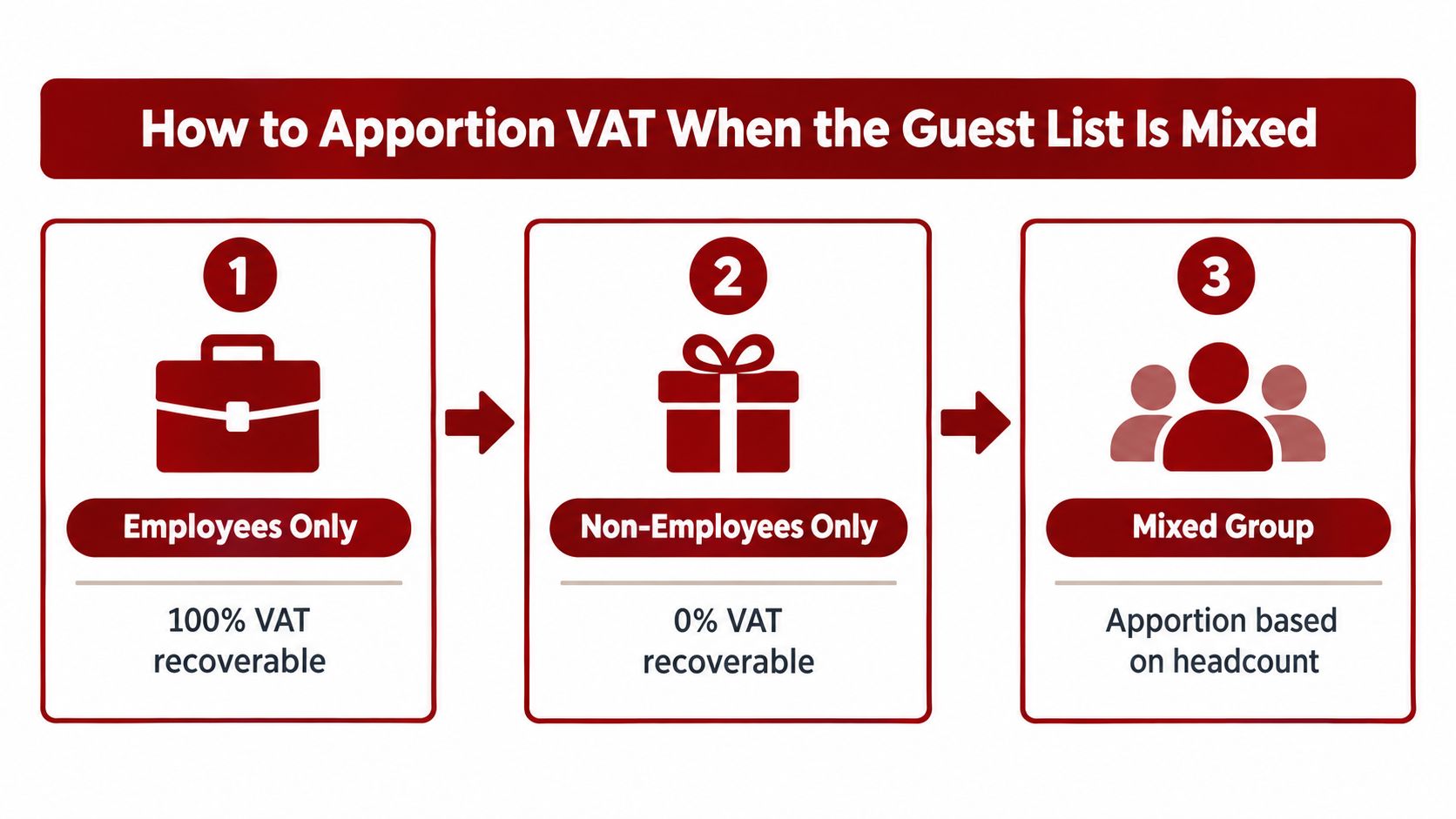
Mixed events are where otherwise careful bookkeeping goes wrong. The three basic situations are straightforward:
- Employees only: HMRC's compliance guidance says 100% of VAT is reclaimable where every attendee is an employee.
- UK non-employees only: No VAT is reclaimable where the entertainment is provided to UK non-employees.
- Employees and non-employees: Apportion the VAT between the two groups using headcount or another fair and reasonable method.
These rules are set out in HMRC's VAT input tax toolkit. You'll also need a valid VAT invoice or receipt. Without the supporting document, a correct calculation still isn't enough.
Apply the calculation
A Manchester design agency holds a summer party for 32 staff and 18 clients. The total cost is £2,500 plus £500 VAT.
The headcount is 50 people. The employee fraction is:
32 employees ÷ 50 attendees = 32/50
Apply that fraction to the VAT:
£500 VAT × 32/50 = £320 recoverable VAT
The balance is blocked:
£500 VAT minus £320 = £180 blocked VAT
The bookkeeper should post the recoverable amount as input VAT and treat the blocked portion as part of the entertainment cost. Keep the attendee register with the invoice and note that headcount was the chosen apportionment method.
A bookkeeping guide to categorising business expenses can help teams keep the underlying expense coding consistent, but it won't replace the VAT analysis.
Don't improve the answer by guessing
Use headcount where each person received broadly the same benefit. If the costs differ materially, use a more appropriate fair method and document why. Don't use a round figure just because it looks tidy.
Food that is zero-rated doesn't remove the need to understand the invoice. Check the VAT charged on each line, then apportion only the relevant VAT. Where cars or accommodation are involved, a scale charge may need separate consideration rather than a simple event split. For the recovery mechanics and return treatment, refer to this UK VAT reclaim guide.
Staff Welfare Versus Business Entertaining at a Glance
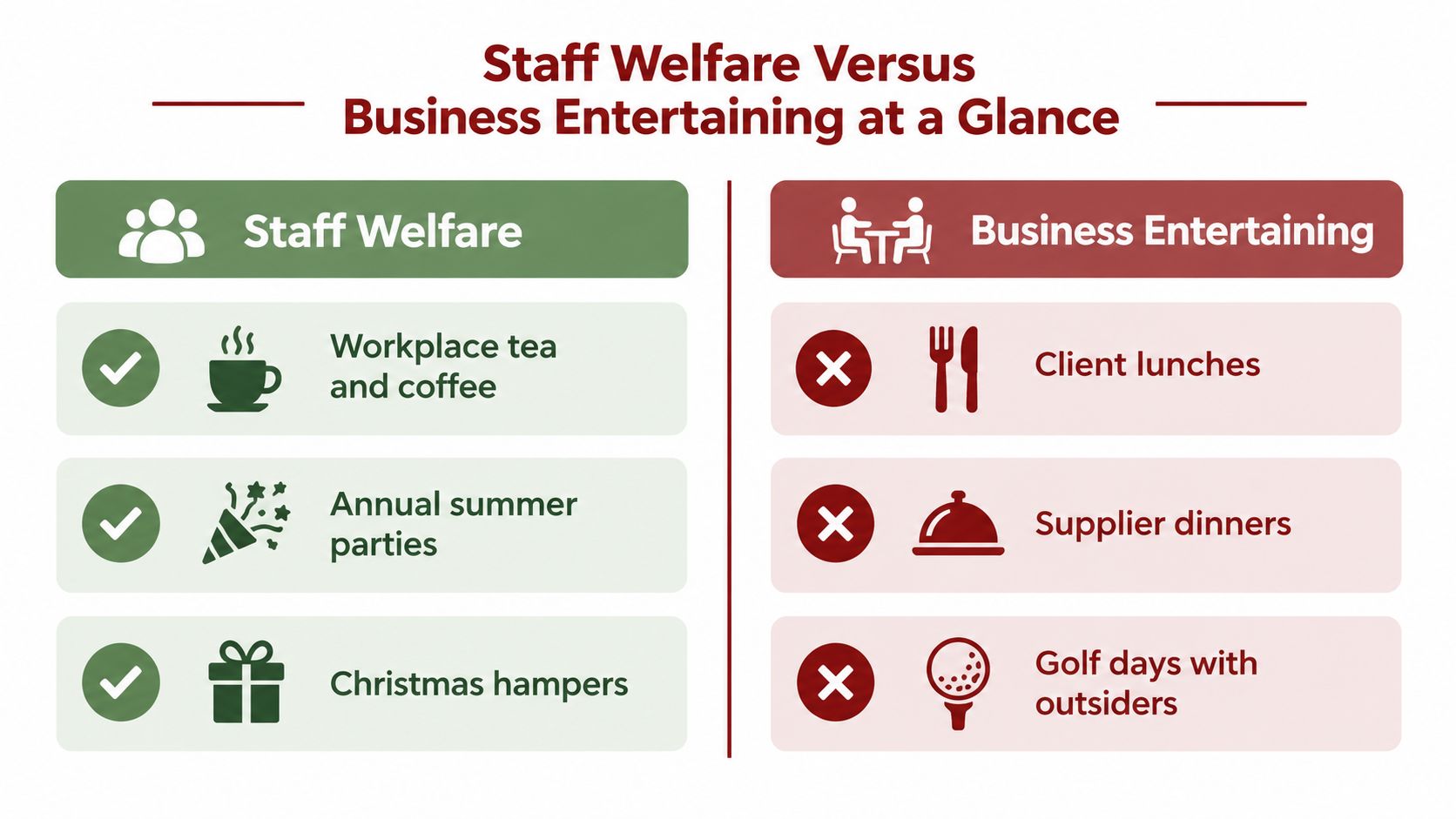
Businesses often lump every food, drink and hospitality cost into one nominal code. That shortcut is the source of many bad VAT returns. Classify the recipient first, then consider the purpose.
Staff welfare generally covers items provided to employees as employees. Workplace tea and coffee, on-site vending, staff canteen meals and an annual event open to the workforce can fit this category. Modest welfare gifts may also be treated differently from hospitality, but the invoice and the recipient still matter.
Business entertaining covers hospitality for people outside the workforce. Client lunches, prospect dinners, meals for agents or suppliers and tickets given to non-employees belong in the blocked category.
Use the recipient test for grey areas
Some costs need a closer look:
| Expense | Starting point | Question to resolve |
|---|---|---|
| Gym membership | Potential staff welfare | Is it provided as an employee benefit, or is it personal entertainment for selected individuals? |
| Season ticket | Potential mixed use | Who used it, employees or clients, and can the use be evidenced? |
| Reception refreshments | Depends on the audience | Are they for employees, or primarily for visitors and prospective customers? |
| Christmas event | Generally staff entertainment | Were directors-only attendance or external guests involved? |
| Supplier meal | Business entertaining | Was the supplier an outsider receiving hospitality? |
The cleanest question is: was the supply made to the employee in their capacity as an employee, or was hospitality provided to win, retain or manage an external relationship?
That question resolves most disputes. A staff canteen meal supports the workforce. A meal offered to a visiting client supports an external relationship. A shared reception area needs evidence of the dominant use and may require a reasoned allocation.
Don't assume an event is recoverable because the business paid for it for morale. Don't assume it's blocked because food was served away from the workplace. The setting is secondary. The recipient and purpose lead the decision.
Worked Examples for SMEs and Construction Contractors
Numbers make mixed events easier to review, provided the numbers come from the actual invoice and guest list. The following examples show how a bookkeeper can apply the headcount method when each attendee receives a comparable benefit.
Example one, café Christmas party
A North West London café hosts a Christmas event for 8 staff and 6 regular clients. The venue-hire and catering package costs £1,400 plus £101.17 VAT.
There are 14 attendees. The employee fraction is 8/14. Apply it to the VAT:
£101.17 × 8/14 = £57.81 recoverable VAT
The remaining £43.36 is blocked business entertainment. The amount to enter in box 4 for this invoice is £57.81, assuming the invoice is valid and the business uses this headcount method.
File the supplier's VAT invoice, the dated attendee list and a note showing the calculation. For construction-specific bookkeeping and sector controls, see this accounting guide for contractors and construction businesses.
Example two, contractor site barbecue
A Merseyside construction contractor holds a Friday site barbecue for 22 operatives, 4 subcontractor staff and 3 visiting clients. The cost is £580 plus £83.92 VAT.
The total attendance is 29. The straightforward employee fraction is 22/29, giving:
£83.92 × 22/29 = £63.66 recoverable VAT
The blocked balance is £20.26. The contractor should enter £63.66 in box 4 for this invoice, subject to checking the invoice and the status of the attendees.
The four subcontractor staff are the difficult part. They aren't automatically employees of the contractor, so don't include them in the staff fraction without care. Establish who employed them and why they attended. If they are non-employees receiving hospitality, the allocation needs to reflect that. If the food was provided on-site to support work and productivity rather than as entertainment, analyse that welfare position separately and document the operational purpose.
| Line item | Café Christmas Party | Contractor Site BBQ |
|---|---|---|
| Employees | 8 staff | 22 operatives |
| Other attendees | 6 clients | 4 subcontractor staff and 3 clients |
| Total attendees | 14 | 29 |
| VAT charged | £101.17 | £83.92 |
| Employee fraction | 8/14 | 22/29 |
| Recoverable VAT | £57.81 | £63.66 |
| Blocked VAT | £43.36 | £20.26 |
| Box 4 amount | £57.81 | £63.66 |
The lesson is simple: contractors shouldn't treat everyone wearing a site vest as an employee for VAT purposes. Employment status and the purpose of the food need to be recorded before the return is prepared.
Scale Charges, Invoices, and Records HMRC Expects
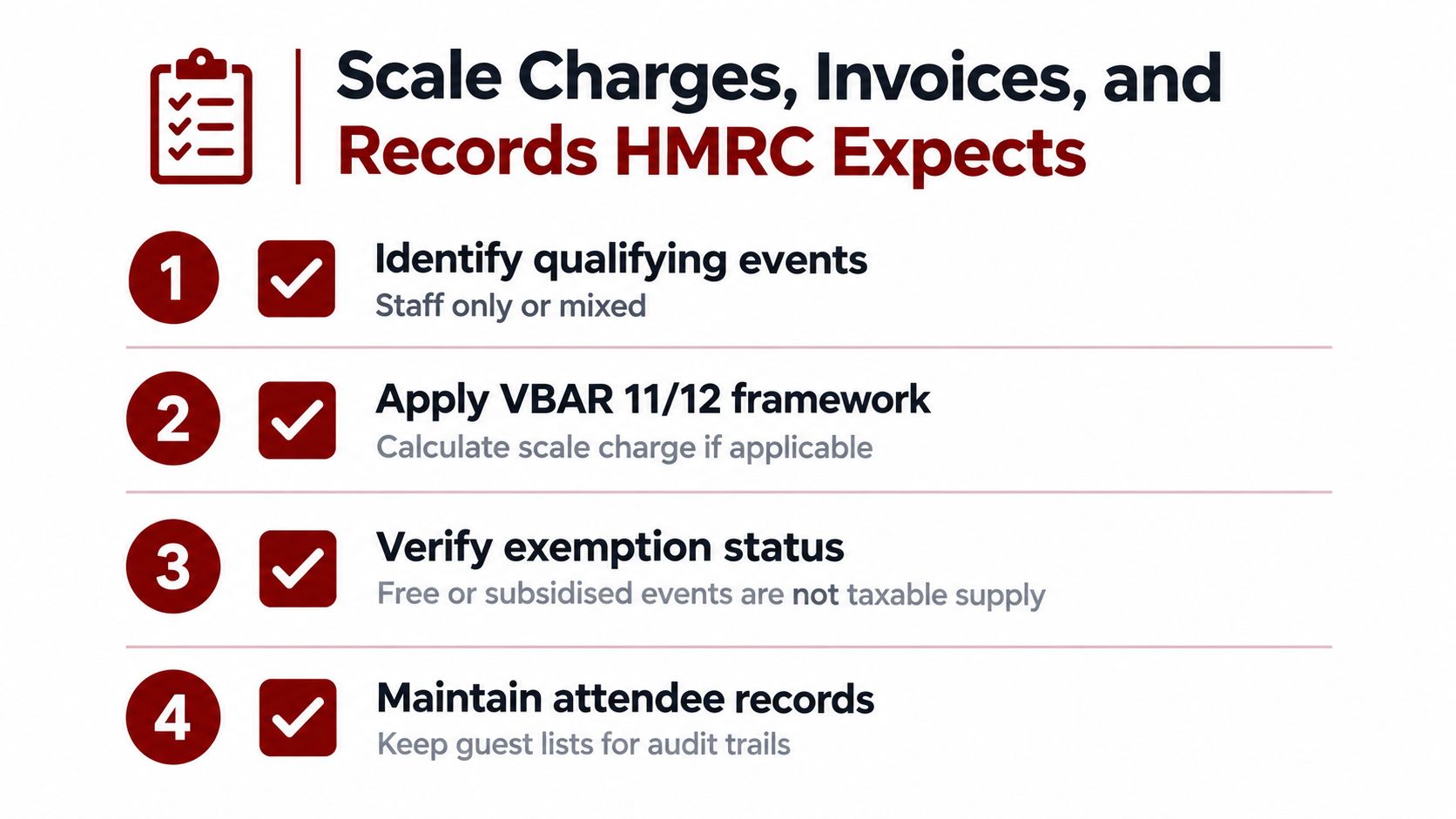
Scale charges are a separate issue from the basic employee entertainment rule. If a company vehicle or another relevant benefit is used in connection with entertaining, check the applicable VBAR 11/12 framework rather than assuming the input VAT calculation ends the matter.
Free or subsidised staff events aren't themselves taxable supplies merely because employees receive a benefit. That doesn't mean every director event is harmless. A directors-only summer party at a private villa may raise benefit-in-kind questions, but that is different from imposing a VAT output liability or allowing input VAT recovery.
Build the file before the return
A defensible VAT file should contain:
- Supplier evidence: A dated, valid VAT invoice showing the VAT separately.
- Attendance evidence: A guest list identifying employees, directors, subcontractors, clients and other outsiders.
- Purpose evidence: An event agenda, booking note or internal memo explaining the employment or operational purpose.
- Calculation evidence: The headcount, fraction, recoverable VAT and blocked VAT.
- Review evidence: A signed note explaining any unusual classification or scale charge decision.
Map the recoverable VAT to input tax on the VAT return. Keep the blocked element out of the reclaim. A VAT compliance checklist can help turn those checks into a repeatable month-end or quarter-end process.
Don't rely on the bookkeeping narrative alone. “Staff event” in Xero or Sage doesn't prove that all attendees were employees, and “marketing” doesn't make client hospitality recoverable. The invoice and attendance evidence need to tell the same story.
Common Pitfalls That Block Reclaims or Trigger Penalties
The same mistakes appear repeatedly because entertainment invoices arrive after the event, when nobody wants to reconstruct the guest list. Fix the process, not just the individual return.
| Pitfall | Why HMRC rejects it | Quick fix |
|---|---|---|
| Claiming VAT on client lunches | The attendees are UK non-employees receiving business entertainment | Block the input VAT and correct the next return if needed |
| Calling hospitality staff welfare | The ledger label doesn't change the recipient or purpose | Review the guest list and recode the expense |
| Missing directors in the split | Directors-only entertainment is excluded, and directors attending a mixed event need proper classification | Identify directors separately and document the treatment |
| Claiming all VAT on a mixed event | Non-employee attendance blocks the relevant portion | Apportion by headcount or another fair method |
| Using a round VAT figure | The calculation doesn't reconcile to the invoice | Recalculate from the actual VAT charged |
| Ignoring gifts over £50 | Gift rules have their own conditions and shouldn't be folded into entertainment automatically | Review the gift separately before reclaiming |
| Overlooking company-car use | A scale-charge issue may arise independently of the event claim | Check the vehicle use and apply the relevant framework |
| Assuming subcontractors are employees | Their employment relationship may sit with another business | Confirm status and record the reason for attendance |
| Keeping no attendee record | You can't evidence the employee and non-employee split | Use a register at booking and finalise it after the event |
The directors-only mistake deserves special attention in small companies. When the owners are also directors, a private meal can be mistaken for a staff event. HMRC's guidance specifically excludes entertainment solely for directors, partners or sole proprietors, so the business should not claim input VAT just because those people work in the business.
If a prior return contains an incorrect claim, don't hide it in a later posting. Establish the error, quantify the adjustment from the source invoice and take the appropriate correction route. Where the issue is material or repeated, disclose it voluntarily and get advice before submitting the next return.
A Practical Checklist to Stay Compliant This Year
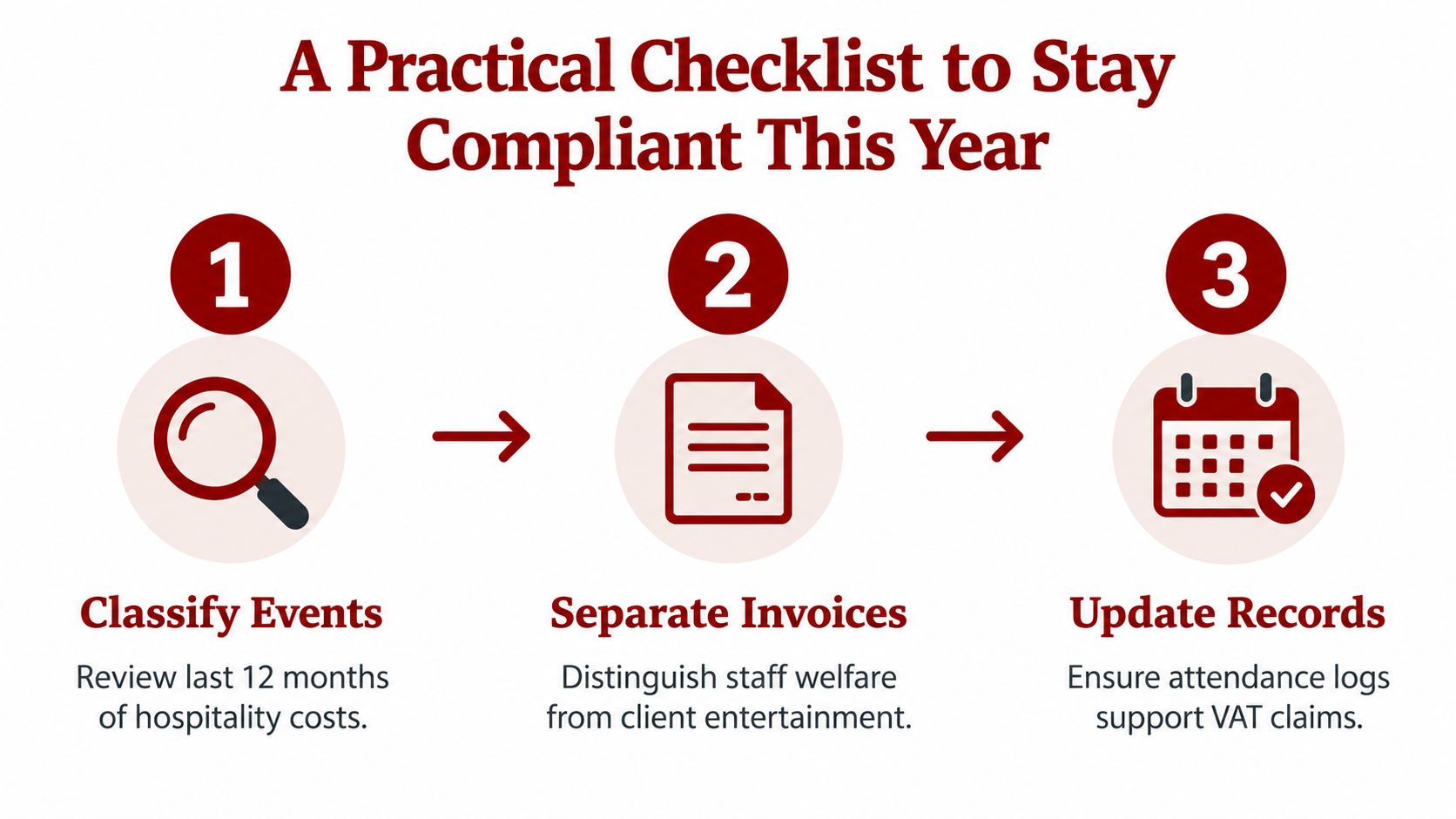
Spend this week cleaning up the process. Start with every entertainment invoice from the last 12 months and put each event into one of three categories: staff welfare, business entertaining or mixed. Confirm that the VAT coding on the return matches the attendee evidence, not the description in the accounting system.
The three actions to complete
- Classify the past events. Mark employee-only events for normal input VAT review, block UK business entertainment and identify every mixed event requiring an allocation.
- Create an attendee register. Record names, employer, role and headcount, then store the register with the supplier invoice and calculation.
- Set the coding before booking. Review upcoming events before committing funds so the organiser knows what evidence to collect.
Add a quarterly review for company vehicles used in connection with entertaining and a year-end check for director-only hospitality. For broader administrative controls, guidance on automating travel expense reports can help your team capture supporting information closer to the time of the expense.
A short review now is cheaper than reconstructing guest lists during an HMRC enquiry. Treat the attendee record as part of the invoice, not optional paperwork.
Action Accountants Limited can review your entertainment invoices, test mixed-attendee apportionments and align the treatment with your VAT return records. Visit Action Accountants Limited to arrange practical VAT and bookkeeping support for your business.