
Is PILON Taxable? Yes, and How UK Tax Applies
Is PILON taxable? Yes. In the UK, payment in lieu of notice is taxed as employment income and attracts Class 1 NICs, outside the £30,000 allowance.

Yes, PILON is taxable in the UK. It's taxed as employment income through PAYE with employee Class 1 National Insurance, and the £30,000 termination allowance does not cover it.
That single sentence settles the question many employees are asking. And yet the same mistake turns up month after month: an employee gets a redundancy package of £20,000, assumes the whole thing sits under the threshold, and then finds tax deducted. The employer is puzzled too. Both parties were thinking in totals when they should have been thinking in elements.
A termination payment isn't one thing. It's a stack of separate items bundled into one figure, and each item has its own tax treatment. Notice pay is earnings. Holiday pay is earnings. Statutory redundancy is compensation. Enhanced redundancy is compensation up to a limit. Miss that distinction and the arithmetic goes wrong in both directions: employees overpay tax they could have avoided, and employers under-deduct tax they'll have to recover later.
The law changed on purpose. HM Revenue & Customs set out the modern rule when it explained that the change was designed to ensure employees pay tax and employee NICs on the basic pay they would have received had they worked their notice in full. The reform came through the Finance (No. 2) Act 2017 and took effect for payments received, and employments ending, on or after 6 April 2018, as HMRC's guidance on the new rules for taxation of termination payments confirms. Before that date, a non-contractual PILON could often be dressed up as damages and escape tax. That door is closed.
Table of Contents
- "Yes, PILON Is Taxable Under UK Rules"
- Why the £30,000 Allowance Does Not Protect Notice Pay
- How Labels and Payment Routes Change the Tax Result
- How to Work Out the Taxable Notice Pay Element
- Employer Costs and Reporting on Large Termination Payments
- Check the Payslip and Confirm Payroll Before Paying
"Yes, PILON Is Taxable Under UK Rules"
Here's the verdict in plain terms. A payment in lieu of notice is taxable employment income. Employers must subject the portion of a termination payment representing notice pay to Income Tax and Class 1 National Insurance contributions, regardless of whether the PILON was contractual, as HMRC's termination payment guidance states. Contractual, customary, or purely discretionary, the treatment is the same.
The technical name for the taxable slice is post-employment notice pay (PENP). It identifies the earnings attributable to the unworked notice period. It goes through payroll as earnings. Not as a termination award, not as compensation, not as an ex-gratia gesture.
Read your package element by element. This is the table I'd hand to any employee or employer staring at a settlement figure.
| Payment element | Income Tax | Class 1 NICs | Inside £30,000 allowance |
|---|---|---|---|
| PILON or post-employment notice pay | Yes, through PAYE | Yes | No |
| Accrued holiday pay and unpaid salary | Yes, through PAYE | Yes | No |
| Statutory redundancy pay | No | No | Yes, counts towards the limit |
| Enhanced redundancy compensation | Only the amount above the combined £30,000 | Employee: No; employer Class 1A on the excess | Yes, up to £30,000 combined |
Notice how few rows say no tax. Only the redundancy rows do, and even enhanced redundancy stops being tax-free once the combined total passes the threshold. Everything that smells of wages carries a full charge.
The rule to remember: notice pay is taxed even when the rest of the package is tax-free. Work out the notice element first, every time.
That's the whole answer, and it's why "is PILON taxable" has such a short answer and such a long consequence. The consequence is where people get caught.
Why the £30,000 Allowance Does Not Protect Notice Pay
A package well under £30,000 can still have tax taken out of it. That is the trap. It is not a payroll mistake.
The allowance is a second-stage calculation. Before any payment is tested against the threshold, the legislation first identifies amounts treated as earnings, including post-employment notice pay. The HMRC employment income manual on the termination payment threshold confirms that the threshold does not apply to post-employment notice pay. Notice pay never enters the £30,000 test.
Consider a £50,000 package with £12,000 of notice pay and £38,000 of other qualifying compensation. The £12,000 is taxed through PAYE and carries Class 1 NICs. Only the remaining £38,000 is tested against the threshold. The threshold never sees the notice pay.
Shrink that to a more typical settlement. A package of £24,000 with £9,000 of notice pay and £15,000 of statutory and enhanced redundancy still taxes the £9,000 as earnings. The £15,000 sits inside the allowance. The headline total is below £30,000. Tax is still deducted. Both facts stand at the same time, which is why a single "under the limit" answer misleads people.
Statutory redundancy can still use the allowance. It counts towards the £30,000 limit, subject to the wider rules. PILON cannot hide behind a small total. A £15,000 package with £8,000 of notice pay taxes that £8,000 in full. The other £7,000 may be free of tax. The notice slice is not.
From 6 April 2018, certain termination payments became chargeable as general earnings and stopped benefiting from the threshold, as the GOV.UK guidance on tax when you leave a job sets out. A modern settlement has to be split before anyone applies the allowance.
Put one question to the employer, in writing. Ask for the notice-pay figure, and for the separate amount the £30,000 allowance was applied to.
Ask this, not "why was I taxed": "Please tell me the PENP figure, and confirm which part of my settlement you applied the £30,000 allowance to."
One combined total and one tax figure means the split was never done. Two figures means the payroll can be checked.
How Labels and Payment Routes Change the Tax Result
They don't, and that's the point worth arguing about. The words compensation, settlement, ex gratia, damages, and non-contractual termination amount are all labels. None of them changes the tax on notice pay.

I'll be direct about this because a lot of settlement negotiation runs on the opposite assumption. HMRC looks at the underlying character of each element rather than relying on the label, as the GOV.UK guidance on what you pay tax and National Insurance on when you leave a job makes clear. A clause that renames salary as compensation is decoration on a payroll file.
Where the label does have some weight is in different routes to payment. The HMRC employment income manual on payments in lieu of notice and loss of employment draws the distinction between compensation for loss of employment and payments made because an employee did not receive contractual notice. A PILON remains taxable earnings even if redundancy triggered it. A payment described as damages may fall under termination-payment rules in some circumstances, but an amount that economically represents notice pay stays exposed. Relabelling salary as compensation is not a reliable planning strategy, and anyone selling it as one is selling you risk.
Here's how the scenarios play out.
| Scenario | Income Tax result | NIC result | Payroll action |
|---|---|---|---|
| Contractual PILON on dismissal | Taxable through PAYE | Class 1 NICs apply | Process the notice element as earnings |
| Non-contractual PILON after redundancy | Taxable through PAYE | Class 1 NICs apply | Process as earnings, then test the rest against £30,000 |
| Statutory redundancy pay only | Within the exemption | No NICs | Record as a termination payment |
| Enhanced redundancy above £30,000 combined | Amount above £30,000 is taxable | Employee: none; employer Class 1A on the excess | Split the excess and report it |
| Settlement agreement settling a contractual PILON | Taxable like the PILON | Class 1 NICs apply | Do not treat as compensation |
The second row is the one that catches founders and small business owners mid-exit. Redundancy feels like a tax-free event, so the whole payment gets coded as severance. It isn't. The notice element runs as earnings and the remainder gets tested against the limit. Getting that backwards triggers a payroll correction and, in the worst cases, an HMRC enquiry.
Before anyone estimates a net figure, insist on an itemised breakdown with each of these on its own line: salary, holiday pay, bonus or commission, PILON or PENP, statutory redundancy, and enhanced compensation. Six lines, six treatments. If you're reviewing the contract terms that determine notice entitlement in the first place, it's worth understanding how employment contracts set notice periods and pay terms before the exit conversation happens, not after.
Practical rule: separate the notice element first, then decide what the redundancy and compensation elements can use. Reverse that order and you'll over-deduct or under-deduct.
How to Work Out the Taxable Notice Pay Element
Work through it in sequence. The order is the whole discipline.
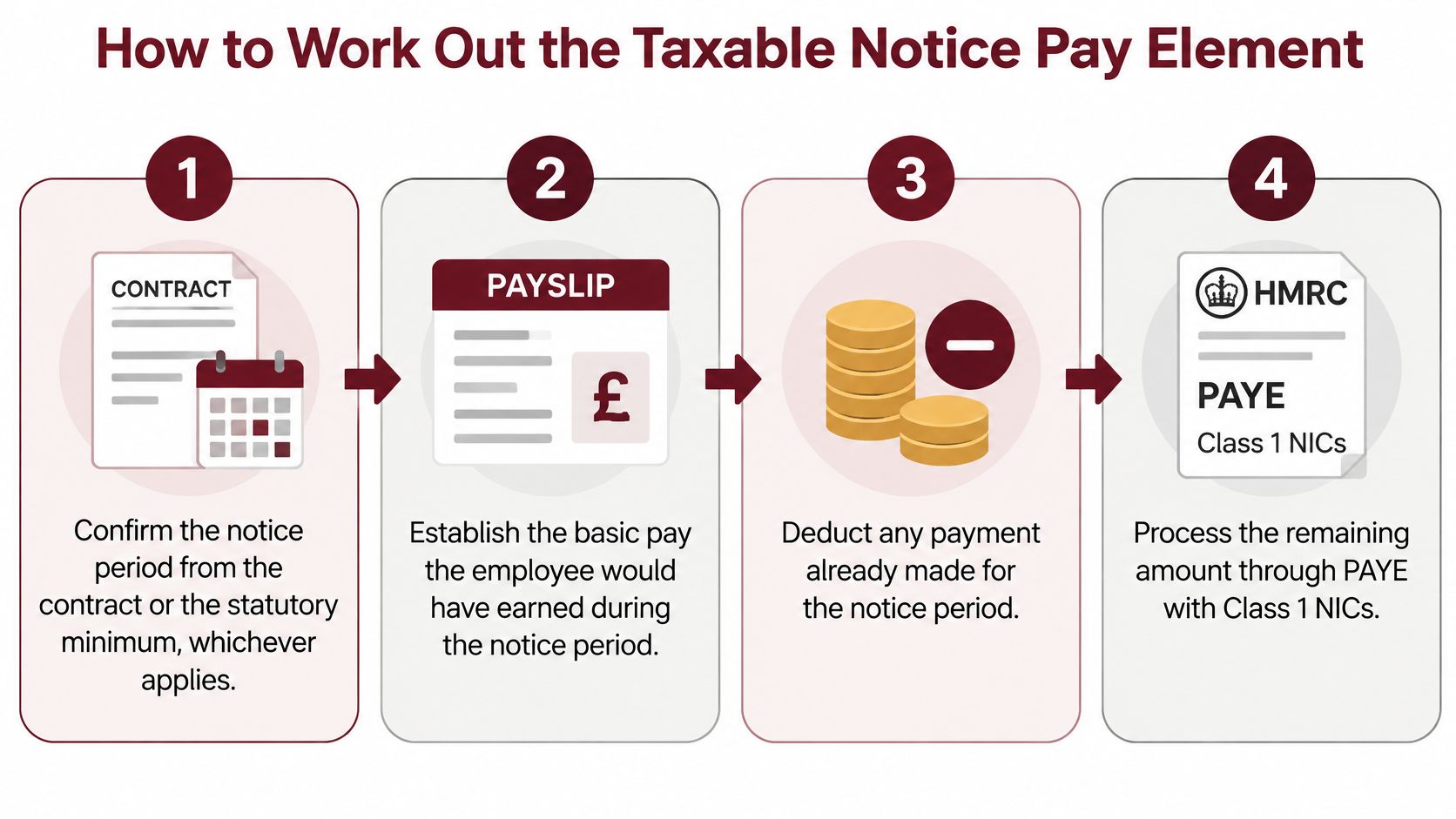
- Confirm the notice period. Take it from the contract or the statutory minimum, whichever applies, and whichever is longer. The usual error is using the contractual figure when the statutory one runs longer, or forgetting that notice already given shortens the period.
- Establish the basic pay for that period. Basic pay only. Overtime, commission, bonuses, and benefits in kind are treated separately. The common slip is building the notice figure from total earnings, which inflates the taxable element well beyond what the statute requires.
- Count the days in the relevant payment period. The statutory calculation uses the number of days in that period as a divisor, so a monthly-paid employee isn't divided by 28 or 31 by accident. Getting the day count wrong shifts the result and the payslip won't reconcile.
- Apply the post-employment notice pay calculation. This is the statutory formula that isolates the earnings attributable to the unworked notice period. HMRC's National Insurance manual guidance on payments in lieu of notice confirms PENP is treated as general earnings and is excluded from the separate £30,000 exemption. Don't approximate this step.
- Process it through PAYE with Class 1 NICs. As earnings, in the pay period it's paid, with real time reporting filed on or before the payment date. The usual failure is running it through an off-cycle payment without an FPS.
- Test only the remainder against the threshold. Split what's left into statutory redundancy and other qualifying compensation, then measure that against the £30,000 limit. Applying the threshold before PENP is removed is the error that produces the "why was I taxed" phone call.
A worked example makes it concrete. Say an employee is on £3,000 a month with one month of contractual notice that goes unworked. The PENP is roughly £3,000. That £3,000 goes through PAYE with Class 1 NICs as earnings. Only the redundancy or other qualifying amount left over is tested against the £30,000 threshold.
If you want to sanity-check the net effect before signing anything, run the gross figure through a salary and net pay calculator and compare it with what the employer has quoted. A gap between the two usually means an element has been misclassified.
Sequence matters more than arithmetic: calculate PENP before assessing whether any genuinely additional compensation qualifies for relief.
Employer Costs and Reporting on Large Termination Payments
Sign nothing until the employer's National Insurance is in the figures. The employee's tax bill is not the whole cost. For the 2024 to 2025 tax year, employers owe Class 1A National Insurance on termination awards above £30,000, as set out in HMRC's rates and thresholds for employers 2024 to 2025. That charge sits on the employer. It does not come off the employee's net pay, so the payroll run will not flag it with a deduction.
Total the package, then take out anything that is not a termination award. Notice pay is earnings. It never uses the £30,000 allowance, and it takes Class 1 NICs in the pay run rather than this Class 1A charge. A label such as compensation does not move it. Leave notice pay inside the award and you understate Class 1 while creating a Class 1A bill that should not exist.
What is left above £30,000 is the excess. Apply the Class 1A rate HMRC publishes for that year to the excess only. Small payroll teams miss this because no employee deduction on the payslip forces the sum.
Report that Class 1A amount on the employer's annual return for the tax year, then tie the figure to the payroll records and the final Full Payment Submission. A number that does not match is the query that drags on for weeks.
Have a payroll adviser check the split before anyone signs. Confirm the PAYE payment deadlines for any off-cycle payment going out with the settlement. Once the money has left, the correction is amended returns, an earlier year update, and an HMRC conversation you do not want.
Check the Payslip and Confirm Payroll Before Paying
Do not pay a settlement until the payslip proves the tax treatment. A single "compensation" line is not proof. Notice pay is earnings. It goes through PAYE with employee Class 1 National Insurance, whatever the settlement agreement calls it.
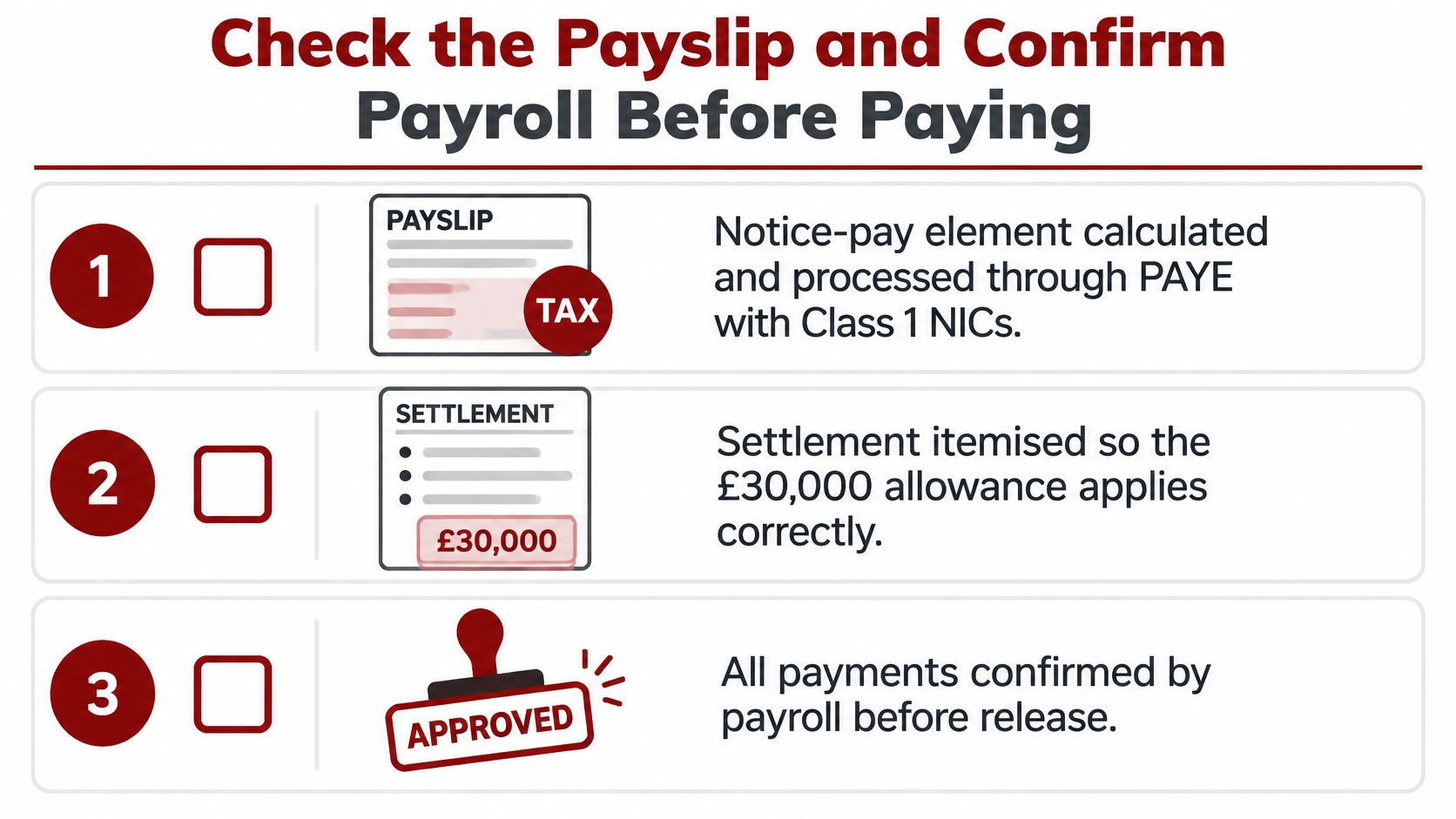
Three things have to be true before the money moves. The notice-pay element has been calculated and run through PAYE with Class 1 NICs. The settlement is itemised so the £30,000 allowance is used only on qualifying amounts. Each element sits on its own payslip line, labelled according to its nature.
Run this checklist against the final payslip:
- A separate labelled line for the notice-pay element, shown as earnings rather than a termination payment. If it sits inside a lump sum, you cannot verify the treatment.
- Income Tax deducted through PAYE on that element, with employee Class 1 NICs alongside. The rule applies however the payment is described, so a notice line with no deductions is a red flag.
- Holiday pay and unpaid salary on their own earnings lines. Both are taxable and NICable on their own. Bundling them hides the reconciliation.
- Statutory redundancy pay shown separately and untaxed. It should stand on its own, not folded into compensation.
- The amount above £30,000 identified where one applies, so the employer's Class 1A charge can be calculated and reported correctly.
A payslip with one lump sum and no tax deducted needs a query before anyone banks it. So does a notice line that carries no NICs.
If the entries look wrong, ask the employer in writing for the PENP calculation and a corrected payslip before the tax year closes. A written request creates a record. An in-year payroll correction is simpler than one made after 5 April.
Getting the compliance side right across a growing business is why a broader UK tax compliance guide for small businesses from Lighthouse Consultants belongs on your reading list, particularly if several exits or a restructure fall in the same tax year.
Action Accountants Limited runs payroll administration as a standing service: PAYE, National Insurance, statutory sick pay and statutory maternity pay, plus the P60 and P45 forms that have to be issued to employees and filed with HMRC. A termination payment has to pass through that same payroll. Payroll support for small businesses covers that administration.
The firm instruction: read the payslip line by line before you pay. A label such as compensation does not turn notice pay into an exempt lump sum.
If you are working through a settlement, a redundancy package, or a leaver's final payroll, contact the team at Action Accountants Limited before anything is signed or paid. The firm administers PAYE and National Insurance and prepares the P45 and P60 paperwork.