
Tax Returns for Small Businesses: A UK Filing Guide
Learn which tax returns for small businesses are due in the UK, their deadlines, how to file each one with HMRC and the errors that cost money.

HMRC estimated the small-business Corporation Tax gap at £17.3 billion, or 44.6% of theoretical liability, for 2024–2025, according to its Corporation Tax gap estimates. That's not a measure of missing forms alone. It's a warning that submitting a return and submitting defensible figures are different jobs.
The work in tax returns for small businesses is the evidence trail: where income came from, why an expense belongs to the business, and how you calculated any adjustment. Build that trail throughout the year and filing becomes manageable. Leave it until the deadline and you're asking software to solve problems it can't recognise.
Table of Contents
- Which Tax Returns Your Business Needs and When They Are Due
- How to Prepare Your Records Before You File
- How to File Each Return Step by Step
- Making Tax Digital Thresholds and Quarterly Updates
- Construction and Landlord Returns You Must Handle Differently
- Common Filing Errors and How to Avoid Them
- Cut the Bill While You Prepare the Return
- Decide Whether to File Yourself or Hire an Accountant
Which Tax Returns Your Business Needs and When They Are Due
Use this filing map as a checklist, not a menu. List every income source and your trading structure, then check whether you employ anyone, operate CIS or have a VAT registration.
Tax returns small businesses must file in the UK
| Return | Who files it | Key deadline | How it is filed |
|---|---|---|---|
| Self Assessment | Sole traders, partners and landlords with a filing obligation | Annual online Self Assessment deadline | HMRC online services or suitable software |
| Corporation Tax (CT600) | Limited companies with a filing obligation | Company return deadline calculated from the accounting period; track payment separately | Compatible software or an agent |
| VAT Return | VAT-registered businesses | Deadline shown for the assigned VAT accounting period | MTD-compatible software |
| PAYE Full Payment Submission | Employers paying staff | Payroll reporting deadline associated with payday | Payroll software |
| Employer Payment Summary | Employers where an EPS is required | Relevant tax-month reporting deadline | Payroll software or HMRC tools |
| CIS Monthly Return | Contractors within CIS | Deadline for the relevant CIS tax month | HMRC online services or software |
| MTD for Income Tax quarterly updates | Sole traders and landlords within the qualifying-income rules | Update deadline for the assigned reporting period | MTD-compatible software |
Self Assessment reports an individual's taxable income, so business profits and relevant personal income need to be considered together. A partnership also needs its own reporting workflow, rather than assuming each partner's personal return settles everything.
A company's Corporation Tax return belongs to the company. Its directors' personal reporting obligations are separate, and filing annual accounts at Companies House doesn't replace filing with HMRC.
VAT concerns transactions and their VAT treatment. Payroll concerns employee pay and deductions, while an EPS addresses particular adjustments or reporting circumstances, not an automatic duplicate of every payroll submission.
CIS adds another reporting stream for relevant construction payments. MTD for Income Tax introduces periodic reporting for individuals within its scope, rather than replacing company tax or VAT obligations.
Build a calendar around your business
A limited company with employees and a VAT registration can have several reporting obligations running simultaneously. There isn't one universal small-business tax deadline.
Create a calendar containing:
- Reporting period: Record exactly which transactions each return covers.
- Submission date: Copy the applicable deadline from the relevant HMRC account or notice.
- Payment date: Track payment separately from submission.
- Named owner: Assign responsibility for preparation, approval and payment.
Don't guess a deadline from last year's diary. Confirm your accounting period, registrations and outstanding notices before setting reminders.
How to Prepare Your Records Before You File
Records should prove every figure on the return. A bank payment proves money moved, but it doesn't necessarily prove the business purpose, the correct category or the deductible amount.
Keep the preparation checklist beside your bookkeeping workspace.
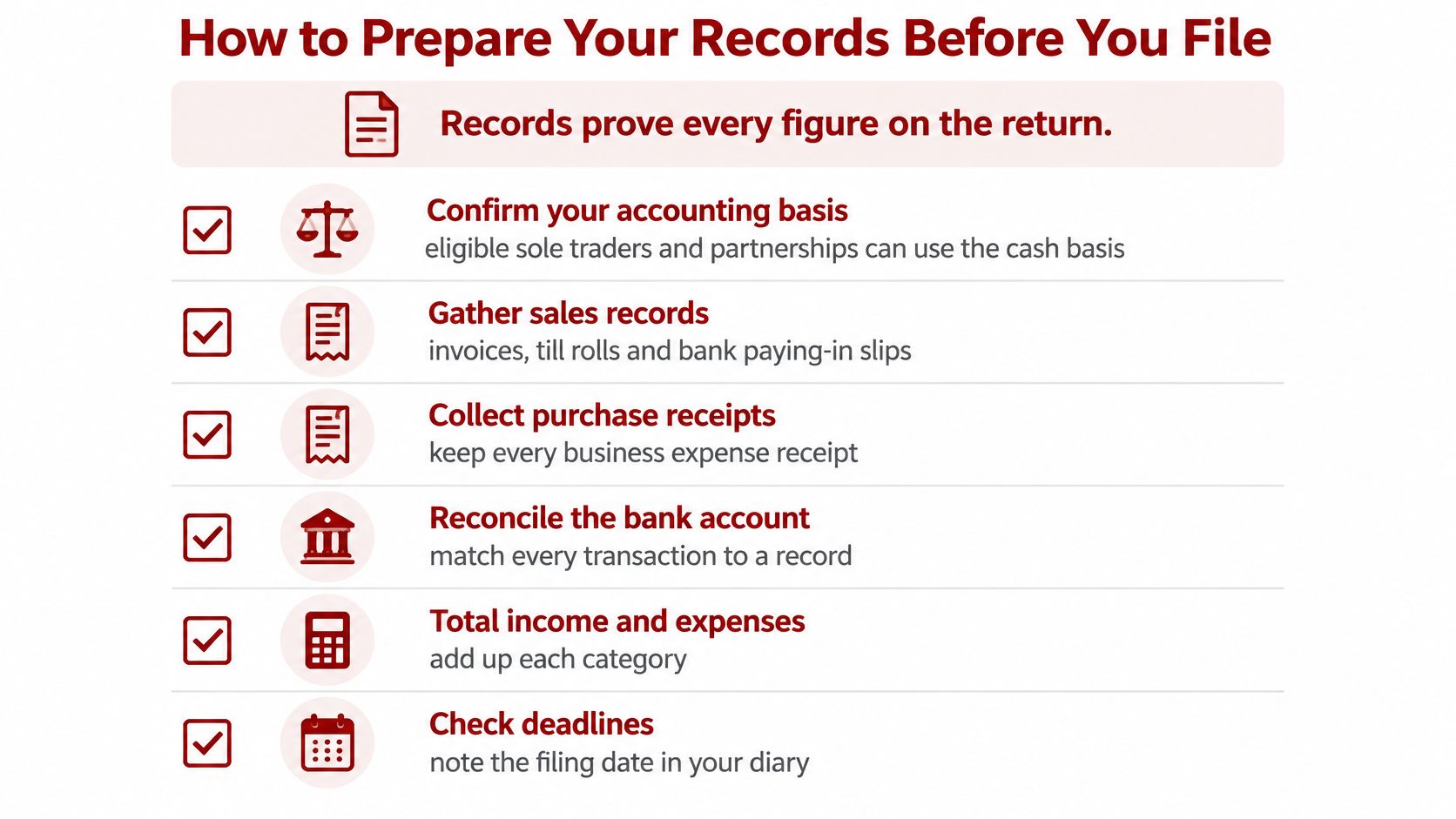
- Confirm your accounting basis. Eligible sole traders and partnerships can use the cash basis, recording income when received and expenses when paid, while retaining supporting records, as explained in HMRC's self-employment return guidance.
- Reconcile sales against bank accounts, card processors and cash records, including business receipts paid into a personal account, so turnover isn't understated.
- Build separate schedules for sales, purchases, payroll, mileage, finance costs and assets, making each return total traceable to its underlying transactions.
- Split mixed business and private costs, recording the method used, so you can explain the business share rather than defend an unsupported estimate.
- Keep equipment and other capital purchases on a separate schedule, because the correct tax treatment needs checking against your accounting basis and the asset involved.
- Preserve invoices, receipts and statements in an organised archive, with a retention policy appropriate to the tax and business structure.
- Agree the final profit calculation to the figures entered on the return, investigating every unexplained difference before submission.
The registration trap comes before filing: someone becoming liable to file generally needs to notify HMRC by 5 October after the relevant tax year ends, under that same guidance. Put registration on the task list, not just return preparation.
Make the supporting folder usable
For time-based businesses, connect work records to invoices before reconciling receipts. BlokNotes explains how to set up client codes for invoicing, which can help you trace a payment back to the customer and work performed.
Use consistent filenames and keep a short explanation beside unusual transactions. Our bookkeeping guide for sole traders provides a practical foundation for organising the underlying books.
Copy this checklist into your shared folder:
- Income evidence: Sales invoices, cash records and processor statements.
- Expense evidence: Supplier documents, payment proof and business purpose.
- Judgement notes: Private-use calculations and disputed classifications.
- Final checks: Reconciled schedules, approved figures and unresolved queries.
How to File Each Return Step by Step
HMRC's deadline announcement reported 11,205,810 online returns for 2023–2024. That same announcement confirms the 31 January online deadline after the tax year, and late-filing penalties can apply even when no tax is payable. Do not start typing until each figure has a record and a reason you could defend if HMRC asked. A provisional total in the form looks like progress. It is not.
Use the process graphic as a workflow prompt, then confirm the registrations that apply to you.
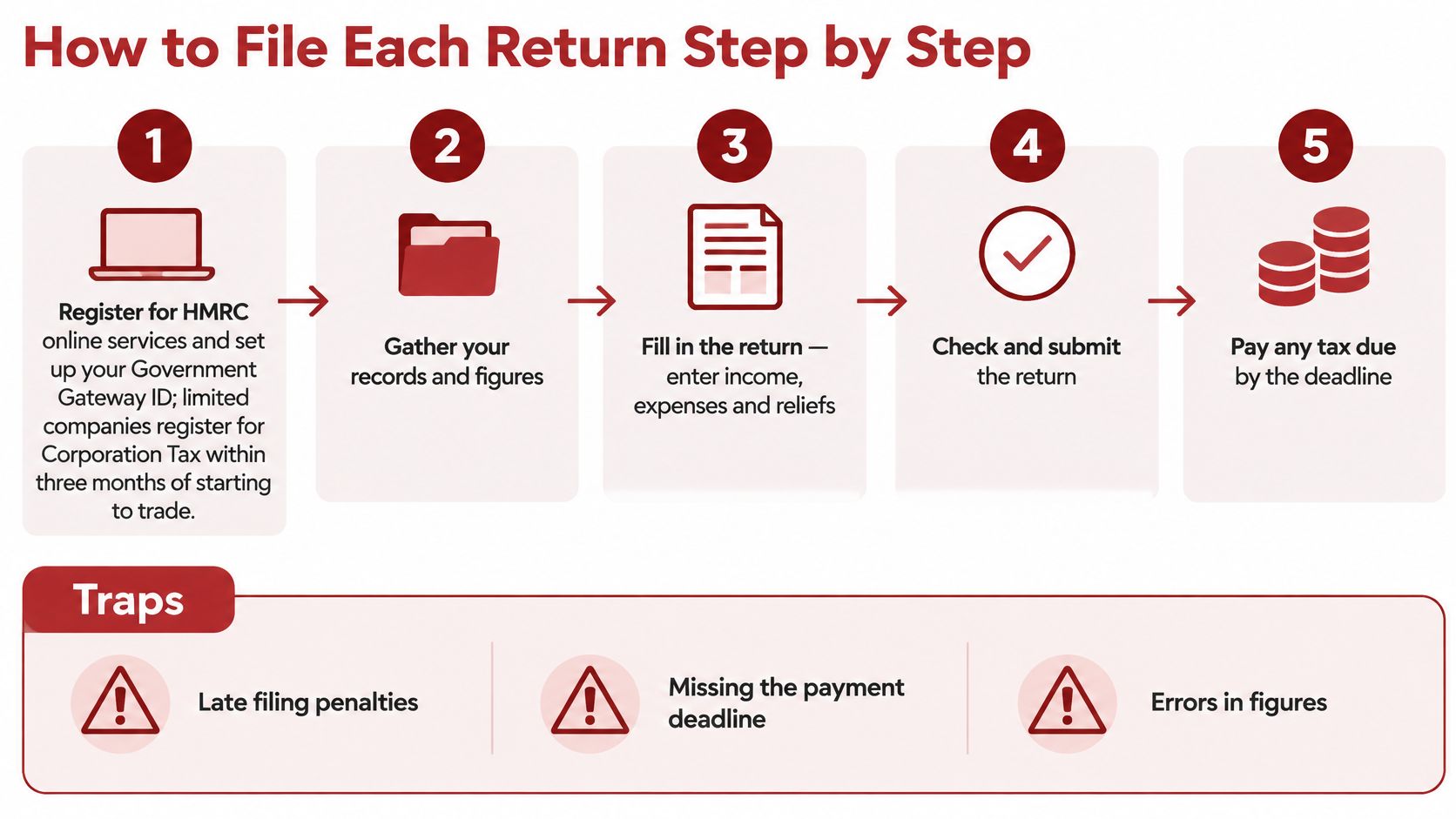
- Confirm access and registrations. Check that you can enter the correct HMRC account and open the tax service you are about to file. A login does not prove every service is activated.
- Choose software that supports the return you are filing, or authorise an accountant through the agent process. Do not share your login.
- Calculate and review the liability. Match turnover, expenses, adjustments and reliefs to signed-off schedules. Write the reason for each adjustment next to the figure, so the software result rests on inputs you can explain.
- Submit the approved return and save the acknowledgement with the exact version filed. That pair is your proof of what HMRC received.
- Arrange payment separately. Use the correct payment reference and keep the payment evidence. Submitting the return does not move the money.
- Check the HMRC account after processing. Chase a missing return, an unmatched payment or an unexpected balance. Do not assume the account has cleared.
Apply the workflow to the right return
On Self Assessment, review every income source before you approve the calculation. Business accounts will not show employment income, rental income or other personal entries. If those figures are missing, the tax figure is wrong even when the trading accounts look tidy.
On a company return, keep the bridge from accounting profit to taxable profit. A reviewer should follow each adjustment from the accounts to the return without rebuilding your reasoning from old emails.
On VAT, check the period, the treatment of each transaction and the reconciliation to the VAT control account before you submit. Our guide to filing a VAT return sets out that submission workflow.
Practical rule: Keep the filed return, supporting calculation, submission receipt and payment evidence together. They answer different questions.
Set a completion date well before the statutory deadline. Leave time for a rejected submission, a missing document and a wrong payment reference. The final evening is a bad time to discover any of those.
Making Tax Digital Thresholds and Quarterly Updates
HMRC has published the income thresholds that bring sole traders and landlords into Making Tax Digital for Income Tax. HMRC's transformation roadmap update schedules that rollout at above £50,000 from 6 April 2026, above £30,000 from April 2027, and above £20,000 from April 2028.
Use that published timetable, then test your own qualifying income against it. The reporting change does not remove the judgement behind each figure. If HMRC asks later, you still need the record and the reason for the amount you sent.
MTD for Income Tax start dates by qualifying income
| Qualifying income | Scheduled MTD for Income Tax start |
|---|---|
| Above £50,000 | 6 April 2026 |
| Above £30,000 | April 2027 |
| Above £20,000 | April 2028 |
Read the income table for the timetable. The illustration below is a workflow aid, not a substitute for those published dates.
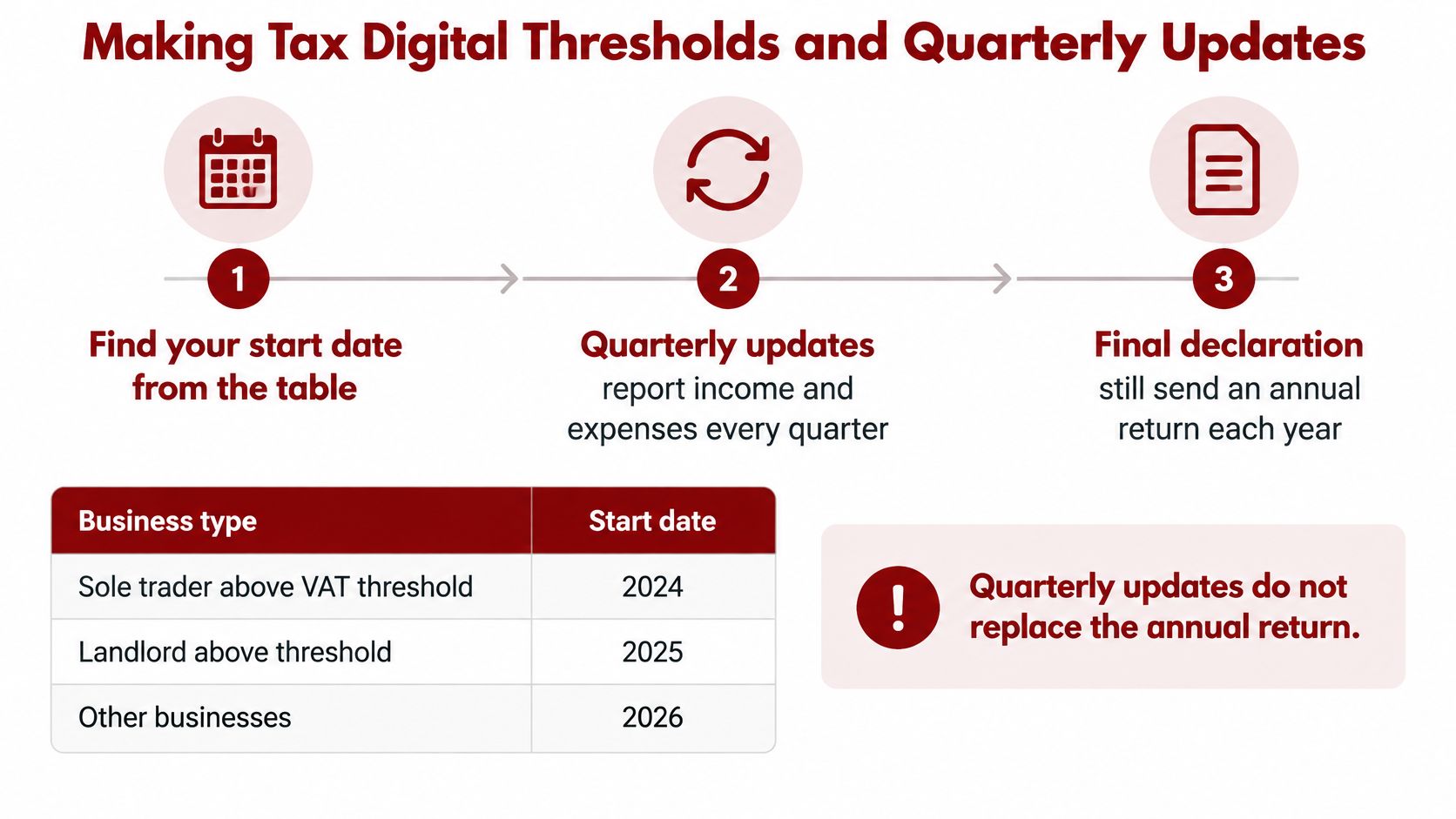
What changes in practice
Once you are in scope, keep compatible digital records, send quarterly updates, and still complete the annual tax return. Quarterly updates report in-year figures. They do not create a separate quarterly tax-payment bill.
A spreadsheet can stay if a compatible bridge sends the data through to HMRC. Emailing a workbook to your accountant does not create that digital link.
Test qualifying income on gross business and property receipts. Leave PAYE salary out. Adding salary to turnover will put you over a threshold you have not crossed.
If turnover is climbing, check the reference-year and entry rules before you fix a start date. Growing sales are a reason to review software and registration. They are not a reason to switch systems halfway through a quarter and leave the earlier updates without a trail.
Prepare for the workload before it arrives
Build the evidence while the quarter is still open. A landlord needs a fixed method for agent statements, rent received and costs in the period those updates cover. An inbox dump at year end cannot explain a quarterly figure HMRC already holds.
- Check qualifying income: Split gross business and property receipts from profit and from other income.
- Test the software: Confirm the records can produce the update and transmit it.
- Schedule the work: Name who reviews each update, and the records behind it, before it goes.
Use the quarterly figures to reset your tax reserve. Clearer cash planning does not make those in-year numbers the final profit.
Construction and Landlord Returns You Must Handle Differently
Construction deductions and property expenditure need dedicated schedules. Don't bury either in a general expenses spreadsheet and expect the annual return to sort out the detail.
Construction deductions need a complete chain
Contractors should establish the correct subcontractor verification and deduction treatment before processing payments. Keep the verification outcome, invoice, payment calculation and deduction statement connected to the same subcontractor record.
Say a subcontractor invoices for labour and materials. The contractor needs enough detail to support the deduction calculation, rather than applying a percentage mechanically to an unexplained invoice total.
For subcontractors, reconcile gross invoiced income, deductions withheld and net receipts. Recording only the amount that reached the bank can conceal both turnover and tax already deducted.
A CIS deduction statement isn't just correspondence. It supports the link between your gross income and the tax withheld from your payment.
Use a dedicated folder for statements and investigate missing documents while the contractor can still retrieve them easily. Our guide to CIS monthly returns helps contractors organise the reporting side.
Property costs need a description of the work
Landlords should separate rental records from trading records and retain a schedule for each property. Keep tenancy agreements, letting-agent statements, finance documents and invoices identifiable by property address.
The description on a building invoice matters. Replacing a failed component and extending a property raise different tax questions, so request an itemised description rather than accepting a vague entry for building work.
A replacement boiler may be a repair, whereas an extension ordinarily creates an improvement. The surrounding facts still matter, including whether the work formed part of a wider redevelopment.
Don't assume that the full mortgage payment is deductible expenditure. Separate capital repayments from finance costs and check the applicable treatment for the ownership structure.
Keep these controls in place:
- Separate banking: Use a dedicated account to make rental movements easier to identify.
- Agent reconciliation: Record gross rent and fees separately, not just the net transfer.
- Vacancy records: Retain dates, advertising and correspondence explaining empty periods.
- Work evidence: Keep specifications and photographs where they help establish what changed.
Common Filing Errors and How to Avoid Them
Weak records create more than administrative inconvenience. HMRC's small-business compliance publication reports that small businesses accounted for an estimated 60% of the tax gap, or £23.9 billion, in 2022–2023, covering behaviour ranging from mistakes to deliberate evasion.
Don't interpret that as evidence that every error is dishonest. Interpret it as a reason to test your figures before filing.
Common filing errors, causes and fixes
| Error | Why it happens | Fix |
|---|---|---|
| Wrong VAT amount or VAT code | Invoices coded by habit | Review VAT invoice by invoice |
| VAT claimed on insurance | Expense treatment confused with VAT recovery | Remove unsupported VAT and document the treatment |
| Private costs deducted in full | Mixed use ignored | Record a defensible business-use calculation |
| Income missing from the return | Cash or other accounts overlooked | Reconcile every sales channel |
| Capital purchases expensed incorrectly | Asset treatment not reviewed | Keep an asset schedule and check the applicable deduction |
| Late return penalty | Deadline ownership unclear | Set reminders and an earlier internal completion date |
Close the books before preparing the return
Run a monthly close that matches bank and processor balances, checks relevant CIS deductions and resolves suspense entries. Lock the reviewed period so later changes remain visible.
Then ask another person to test the risky areas: missing turnover, owner drawings, stock, vehicle use, subcontractor records and asset classification. Re-keying every transaction is less useful than challenging the assumptions behind a questionable total.
Reasonable care needs a written trail. Save the review checklist, the questions raised and the answers that changed the figures.
If you discover an error after filing, establish whether the appropriate amendment route remains available. Make the correction through the relevant process or notify HMRC, retaining the original submission and a clear explanation of the change.
Don't overwrite the spreadsheet and lose the history. Your records should show what was wrong, what you corrected and how the revised liability was calculated.
Cut the Bill While You Prepare the Return
Claim what you can support, not what produces the smallest software total. Tax efficiency starts with the right treatment of real expenditure, not creative descriptions added after the event.
Use these decisions while the working schedules are still open.
Make the deductions defensible
- Review the accounting basis before finalising totals. Check that receipt and payment dates have been treated consistently, and don't change methods because a particular result looks cheaper.
- Examine the asset schedule separately from everyday purchases. Confirm the deduction or allowance available under the applicable rules instead of assuming every equipment purchase receives identical treatment.
- Capture legitimate running costs completely. Search business cards, payment platforms and supplier accounts for omitted subscriptions, consumables and professional costs, then remove any private element.
- For property expenditure, use the invoice description and scope of works to establish the correct treatment. Keep finance-cost calculations separate from repair schedules so neither gets lost in a generic property-expenses total.
- Reconcile tax already withheld. Match CIS records to the return entries so a supported credit isn't missed or entered twice.
- Build a payment forecast from the completed calculation. Include any balancing liability and relevant payments on account, rather than reserving only the amount you expected before preparing the return.
Our guide to tax-deductible expenses for the self-employed helps you identify categories worth reviewing. A category list is the starting point, not permission to claim every transaction carrying that label.
Don't spend merely to obtain relief
Bringing forward a necessary purchase can affect timing, but unnecessary spending still reduces your available cash. Decide whether the business needs the purchase before considering the tax consequence.
Cash discipline: A deduction reduces the profit used in the tax calculation. It doesn't turn the purchase into free money.
For a mixed-use phone or vehicle, retain the business-use reasoning with the expense schedule. For an unusual claim, write the explanation while you still remember why the expenditure was necessary.
The strongest tax-saving review often finds ordinary omissions. Missing receipts, unrecorded supplier charges and overlooked deductions deserve attention before complicated planning.
Decide Whether to File Yourself or Hire an Accountant
DIY is sensible when the records are simple and you understand the judgements. It stops being sensible when you're guessing how to classify transactions or cannot reconcile the figures.
Review the working papers, not just the size of the tax bill.
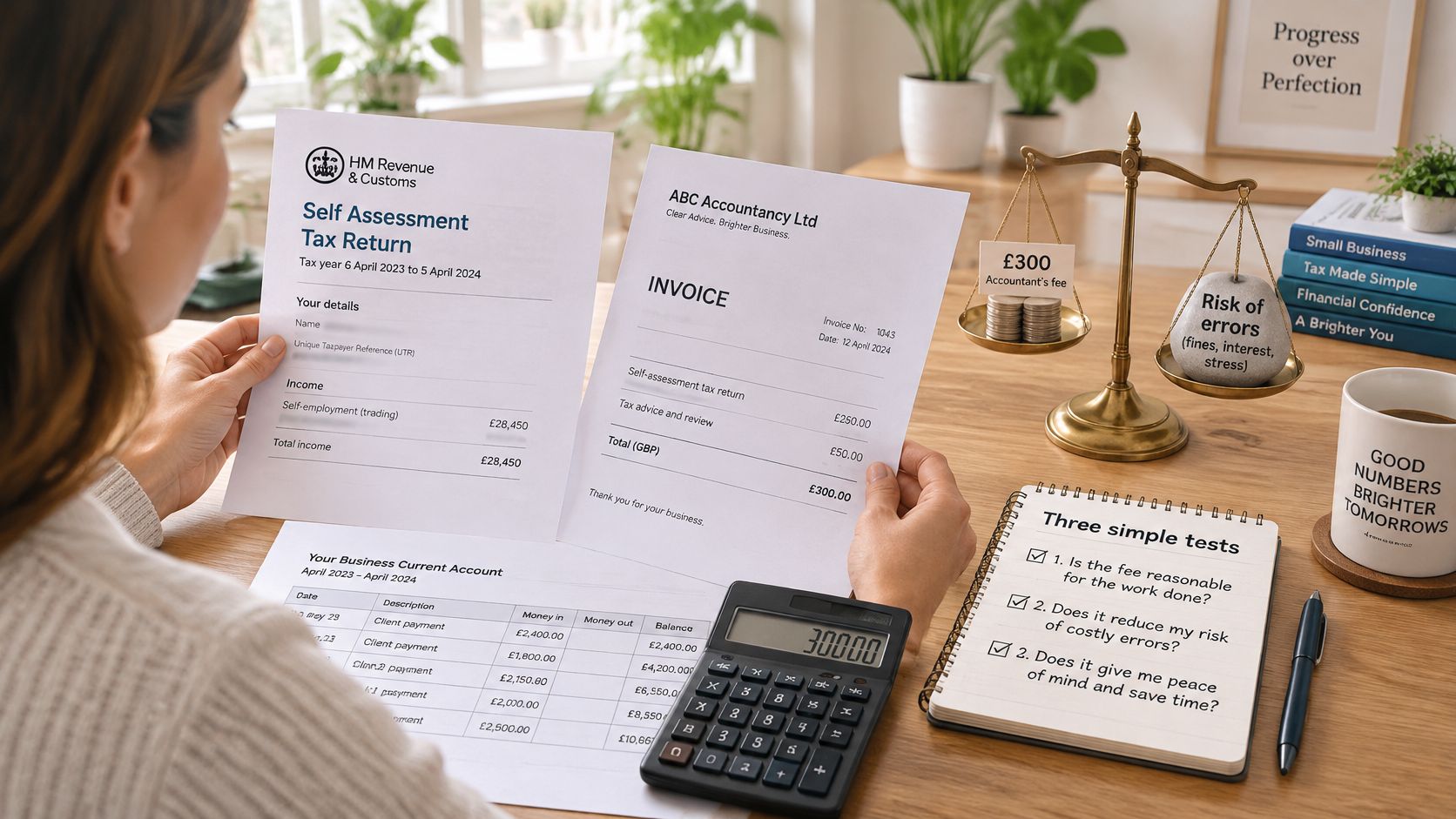
Apply the handover test
Consider filing yourself when your trade is straightforward, you have no payroll or VAT complications, and your books already reconcile. You should also be comfortable explaining each material expense without relying on a software category as the answer.
Hand the work over when company tax adjustments, property, CIS, multiple income sources or overdue returns introduce questions you can't resolve confidently. An accountant shouldn't merely reproduce uncertain figures faster.
- Records test: Can someone follow each total back to documents?
- Technical test: Can you explain the treatment of unusual transactions?
- Time test: Can you finish properly without sacrificing essential business work?
Our Basic Self-Assessment Tax Return costs £250 + VAT per annum, and a NIL return costs £200 + VAT. The Sole Trader / Partnerships / MTD Starter package starts from £42 + VAT per month, including quarterly updates, year-end accounts, Self Assessment, an annual meeting and ad-hoc advisory.
Use the video as another prompt to review your preparation.
This week, gather your previous return, bank statements, outstanding notices and a concise list of income sources. Request a quote while there's still time to resolve missing evidence, not when the submission deadline has become the only priority.
Action Accountants Limited prepares tax returns for owner-managed businesses, calculates liabilities and explains what to pay and when. Visit Action Accountants Limited to request a no-obligation quote, and bring your latest return, income-source list and outstanding HMRC notices so we can identify the work your business needs.