Capital Allowances Rental Property: Who Can Claim in 2026
Capital Allowances Rental Property rules for UK landlords in 2026: what qualifies, the FHL changes and how to claim, with a worked example.

The most repeated advice on capital allowances rental property goes like this: commission a fixtures and fittings valuation on every purchase, allocate a chunk of the price to plant, and bank the relief. It sounds like free money, and for a small group of owners it is. For most landlords buying ordinary flats to let to long-term tenants, it's a wasted fee and, in the worst cases, a claim HMRC will unwind with interest.
The dwelling-house restriction stops the claim before the valuation report is even printed. A domestic fixture serving one flat belongs to the home rather than to a business, and HMRC treats it exactly that way. The owners with something worth claiming are narrower: people who hold blocks with real communal areas, landlords sitting on expenditure that was pooled before the furnished holiday let regime closed, and anyone with a commercial element in the building.
Everything that follows is about sorting your own spend into the small pile that qualifies and the large pile that doesn't. One question decides almost every case: where the asset sits, and whose use it serves.
Table of Contents
- Which Rental Costs Qualify at a Glance
- Why Ordinary Homes Are Usually Excluded
- Tax Basis and Furnished Holiday Let Transition
- Replacement Domestic Items Relief
- Integral Features and Shared Building Systems
- Buying Fixtures With a Rental Property
- Worked Example and How to Claim the Allowance
- Records to Gather Before Your Next Return
Which Rental Costs Qualify at a Glance
Most of the money you spend furnishing a let flat doesn't qualify for capital allowances. Most of what serves the shared parts of a block does. Read that twice, because a lot of the property investment content ranking for this subject gets the ratio the wrong way round.
The table below is the short version. It maps the items landlords ask about most to the question that settles each one.
| Item | Ordinary residential let | Exception that may apply | Relief to check |
|---|---|---|---|
| Furniture and furnishings in a let flat | Generally no | None for ordinary lets; historic FHL pool only | Replacement domestic items relief on like-for-like replacements |
| Boiler or heating serving one flat | Generally no | None, unless it serves communal parts | No relief on the initial fit, because the dwelling-house restriction applies |
| Lift serving a block of two or more flats | Excluded for in-unit use | Communal share may qualify | Special rate pool at 6% a year |
| Shared lighting, fire alarm or CCTV in common parts | Excluded for in-unit use | Communal share may qualify | Apportioned claim, assessed item by item |
| Commercial element of a mixed-use building | Not applicable | Plant may qualify | Specialist fixture analysis |
| Furnished holiday let pool created before 5 April 2025 | Not applicable | Historic pool continues | Writing-down allowances until the pool is exhausted |
The last row matters more than people realise. A pool built while the property was a furnished holiday let still earns writing-down allowances, even though the regime that created it has gone. Landlords who filed the paperwork away in April 2025 have been leaving that relief unclaimed.
Three checks sort the rest of your file. First, does the item serve one dwelling or the shared parts of a building? Second, which basis is your rental income taxed on, because the cash basis blocks capital claims on ordinary residential spend. Third, was the expenditure already in a pool before the furnished holiday let rules ended?
Answer those three and you'll know which invoices deserve a closer look. For the day-to-day picture of what a landlord can deduct, our guide to rental income allowable expenses sets running costs alongside these capital rules.
Why Ordinary Homes Are Usually Excluded
Think of a house or flat as a sealed box. Anything serving the inside of that box belongs to the home rather than to a business tool, and HMRC's manual is built on precisely that division. Plant and machinery expenditure needs a qualifying activity, and a UK property business counts as one, but expenditure on plant provided for use in a dwelling-house is excluded from relief, as the HMRC Capital Allowances Manual sets out.
That single exclusion explains why a boiler serving one flat fails. It heats a home. It makes no difference that you bought it, paid for it from a business account, or that the rent covers it. Ownership isn't the test. Physical use is.

The test also catches houses in multiple occupation, which surprises landlords who assume shared space means business space. HMRC treats shared hallways, stairs, landings, attics and basements as part of the dwelling-house, so plant used there is generally excluded too.
The test to apply: ask what the asset serves, not who owns it. A lift serving six flats serves a building. A washing machine serving one flat serves a home.
A block containing two or more flats is where the door opens. A lift or a central heating system serving the building's communal parts may qualify, though the cost has to be apportioned between qualifying communal areas and non-qualifying individual flats. Apportionment is the part people skip, and it's the part HMRC checks.
Put two purchases side by side. A washing machine bought for one flat fails outright: it serves a single dwelling. A lift installed in a six-flat block passes on the communal share, because it serves the building rather than any one home. Furniture and furnishings are generally excluded for property businesses other than furnished holiday lettings, which is the same principle applied to loose items.
The discipline is identical for finance costs. Section 24 restricts relief for mortgage interest to a basic rate credit, and it bites property by property for the same reason: the tax treatment follows the asset and its use, not the shape of your overall portfolio.
Tax Basis and Furnished Holiday Let Transition
What the cash basis blocks
Under the cash basis, capital expenditure on assets used in ordinary residential properties isn't deductible. HMRC is blunt about the consequence: the Annual Investment Allowance and First-Year Allowances don't reach that spend, while cars keep their own special rules, as the property income manual on the cash basis confirms. So the first question isn't what you bought. It's how your rental income is taxed.
The pool the abolition didn't kill
Historically, a furnished holiday letting business was a separate qualifying category for plant and machinery allowances under section 15 of the Capital Allowances Act 2001, sitting alongside UK and overseas property businesses. Those businesses could claim on furniture and white goods. Ordinary property businesses never could, and the guidance on the furnished holiday lettings change draws that line clearly.
The regime closed for Income Tax on 6 April 2025 and for Corporation Tax on 1 April 2025. The pool didn't close with it. Expenditure already in a capital allowance pool by 5 April 2025 keeps receiving writing-down allowances, balancing allowances or balancing charges until the pool is exhausted or a small-pool claim clears it. New expenditure generally falls under replacement domestic items relief instead of capital allowances.
| Item or situation | Ordinary let on cash basis | Historic FHL pool | Replacement spend after 5 April 2025 |
|---|---|---|---|
| Furniture and white goods in an ordinary let | No capital allowances or Annual Investment Allowance | Not applicable | Replacement domestic items relief |
| Expenditure already pooled by 5 April 2025 | Not applicable | Writing-down allowances until pool exhausted | Not applicable |
| Cars | Special rules apply | Special rules apply | Special rules apply |
The allowance is calculated for the tax year or accounting period that forms the normal basis period, so timing follows your filing cycle rather than the date on the invoice.
Work through four questions in order:
- Confirm the basis your rental income uses with your accountant, because it decides whether a capital claim is even open to you.
- Date the acquisition and establish whether the property was a furnished holiday let at that point.
- Check the pooling date and whether the expenditure was in a pool by 5 April 2025.
- Classify the spend as a replacement or an initial furnishing, since only one of those has relief attached.
The abolition didn't wipe out every existing allowance overnight. It stops new qualifying claims while preserving relief on certain historic pools, which is a far less dramatic outcome than most coverage suggests. Our furnished holiday let tax guidance covers how the closure interacts with your other reliefs.
Replacement Domestic Items Relief
For ordinary residential landlords, this is the relief that does the work. It covers domestic items used in a let dwelling: furniture, furnishings, appliances, kitchenware and linen. It doesn't cover the building's structure or its fixed systems, which belong in the integral features rules instead.
The calculation is simple enough to do on the back of an invoice. Relief equals the cost of the replacement item, less anything you received for disposing of the old one. Replace a washing machine in a let flat for £400 and scrap the old unit for nothing, and the relief is £400. Sell the old machine for £50 and the relief drops to £350. The disposal proceeds reduce the claim, so keep the receipt for the sale as well as the purchase.
Where landlords get caught: relief covers replacement, not the first set of furniture. A landlord who buys a flat's initial furnishing gets nothing on it.
That distinction matters at the point of acquisition. Buy a furnished flat and put a new sofa in it, and you're replacing an item that came with the purchase, so you have a claim. Buy an unfurnished flat and furnish it from scratch, and you don't. The same logic separates an upgrade from a repair: swapping a broken fridge for a like-for-like one is a replacement; installing a second fridge because the tenant asked is new expenditure.
Three record checks keep the claim clean:
- Keep the invoice for the replacement item, in the name of the person or company making the claim.
- Note the old item and how it left the property, including any amount received.
- Record the replacement date, because it fixes the period the relief falls into.
Match every replacement to an entry in your asset list. If the item isn't on the list, you can't show it was ever there to replace.
Integral Features and Shared Building Systems
A building system's location and use determine how to classify its cost. HMRC lists electrical systems, space and water heating, air conditioning, hot and cold water systems, and lifts as integral features. For qualifying expenditure, the HS252 helpsheet on capital allowances sets out the special rate pool's writing-down allowance of 6% a year on a reducing-balance basis.
| Pool or allowance | Rate | Typical rental item | How it works |
|---|---|---|---|
| Main pool | 18% a year | Plant such as commercial equipment | Reducing balance |
| Special rate pool | 6% a year | Qualifying integral features, such as lifts, lighting, heating and hot water | Reducing balance |
| Annual Investment Allowance | 100% up to the annual limit | Qualifying plant bought by a business; not available for residential capital spend under the cash basis | First-year relief |
| Small pool | 100% in a single claim | Remaining small balances | Written off in full |
Classify each item by where it sits and who uses it, not by the property it serves. Separate communal systems from equipment inside individual flats, then identify which items are integral features. A contractor's refurbishment invoice may bundle a lift upgrade with a boiler serving one flat. Get the costs split before filing.
The communal share of a system may qualify, while an item used within a dwelling-house can be excluded. A heating system serving shared areas and several flats therefore needs an item-by-item assessment; the boiler inside a flat cannot be treated as communal just because it is part of the same project. Ask the contractor to split any communal heating quote between the shared system and the in-unit parts before you commit the spend. If you are deciding which heating system suits your property, make sure the quote identifies those parts separately.
Pool classification changes the rate of relief. Main-pool plant is written down at 18%, compared with 6% for qualifying integral features in the special rate pool. Misclassifying the asset can overstate the deduction for the year. A small remaining pool balance can be written off in full.
Keep an asset register with the cost, date, pool and communal share for each item. Record the system's location and use as well, so the basis for its classification is clear.
Buying Fixtures With a Rental Property
The assumption that trips up buyers is simple and expensive: if the contract allocates a value to fixtures, the buyer assumes that value is a tax deduction. It isn't. Capital allowances aren't available for the cost of the residential property or the land, and a fixture value in the contract is a valuation, not relief.
HMRC's position after the furnished holiday let abolition is more restrictive than most property articles admit. Whether a purchaser can claim on fixtures allocated through a Section 198 election depends on whether the expenditure qualifies in the purchaser's hands. Where the fixtures are for use in a dwelling-house and the purchaser runs a property business, the legislation can treat the expenditure as non-qualifying, which means neither capital allowances nor the Annual Investment Allowance is available, as the property income manual on fixtures explains.
The evidence chain matters just as much. Where fixtures are acquired from another business, the buyer generally needs evidence that the previous owner pooled the expenditure, plus a joint election allocating part of the price to those fixtures. Break the chain and future relief can be restricted or lost entirely.
Section 198 is an allocation mechanism, not a relief. It divides the price. It doesn't create a deduction where the dwelling-house restriction applies.
Four categories behave differently and shouldn't be pooled in your thinking: residential dwellings, where the restriction bites hardest; commercial property, where plant qualifies; common-area assets in a block, where the communal share can be claimed; and historic furnished holiday let pools, which keep running on their own track.
Three steps before you exchange:
- Ask the solicitor for the fixture allocation in the draft contract, in writing, with a schedule attached.
- Ask your accountant whether each fixture on that schedule qualifies in your hands, before you're committed.
- Price the deal without the allowance, so the investment case doesn't depend on relief you may never receive.
Landlords converting a former furnished holiday let into an ordinary rental after April 2025 need this most, because the property's history makes the assumption feel safer than it is.
Worked Example and How to Claim the Allowance
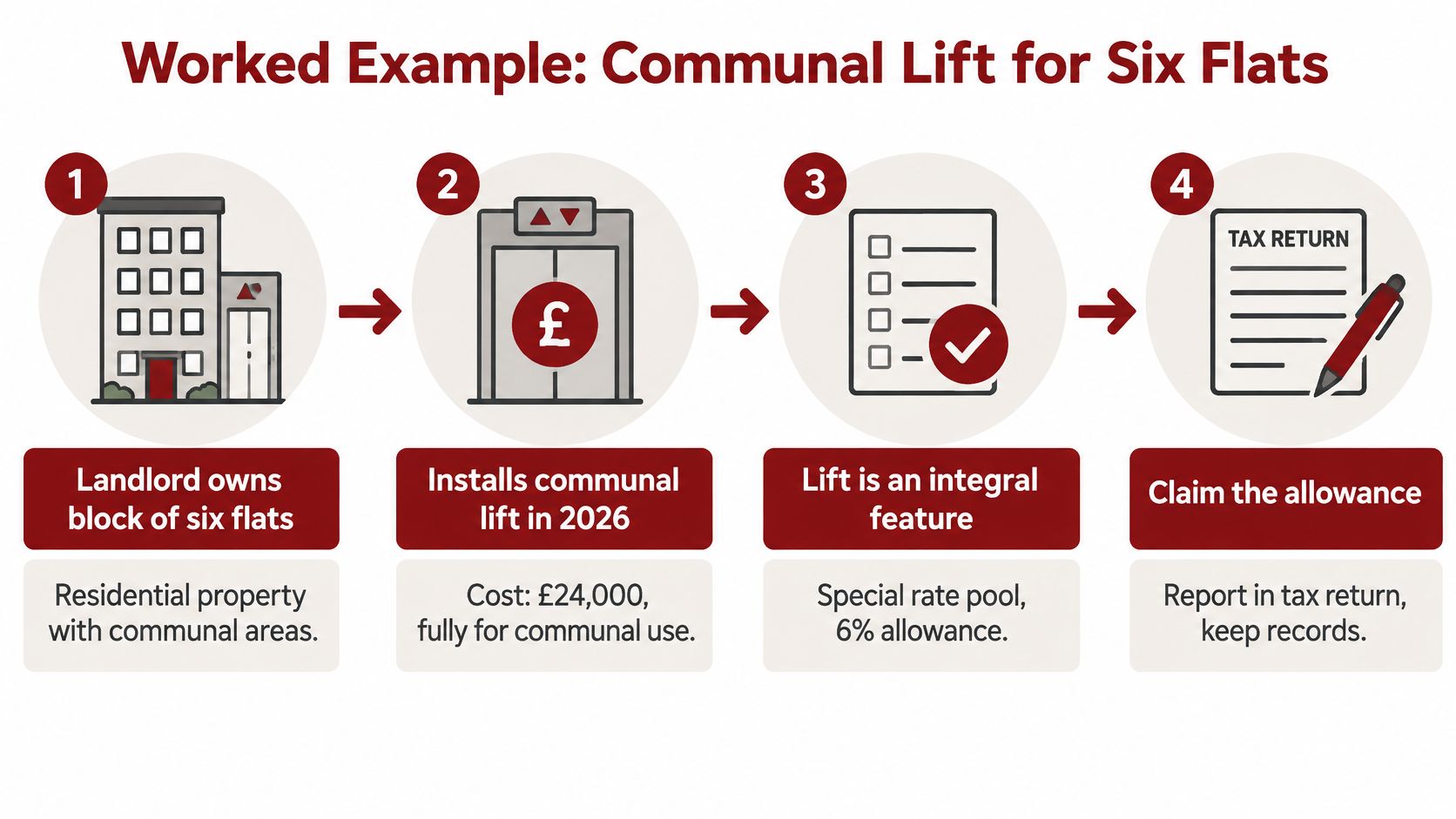
A landlord owns a block of six flats and installs a communal lift in 2026 costing £24,000, with the whole cost serving communal use. A lift is an integral feature, so it goes into the special rate pool at 6%. Year one gives an allowance of £1,440, leaving a written-down value of £22,560. Year two gives £1,353.60, leaving £21,206.40. The relief builds slowly, which is why the classification has to be right from the start.
Now contrast a fridge-freezer bought for one flat. It fails the dwelling-house restriction outright, so there's no capital claim on it at all. If it replaced an old fridge-freezer that was already in the let, it falls under replacement domestic items relief instead.
The claim itself runs in seven steps:
- Sort each item into communal, in-unit or integral feature, using the three groups from the system-sorting method.
- Apportion shared costs and keep the working paper, because an unaudited percentage is the first thing a reviewer will challenge.
- Assign each item to its pool, main or special rate, based on what the asset is.
- Record cost, date and pool in the asset register, one line per item.
- Claim the writing-down allowance in the UK property pages of your Self Assessment return, or in the Corporation Tax return where the landlord is a company.
- Keep invoices and apportionment workings for the relevant record-keeping period, so the claim can be reconstructed years later.
- Recalculate on sale with a balancing adjustment, which is where an unrecorded pool disappears.
Step five is where filings most often go wrong, because the property pages don't prompt you to split communal from in-unit spend. If you want to see how the allowance feeds through to the final bill, our breakdown of how much tax on rental income shows where the deduction lands.
Build a schedule for your own building using the same columns: item, cost, date, pool, communal share. Do it once, properly, and every future return becomes an update rather than a rebuild.
Records to Gather Before Your Next Return
A purchase date alone will not establish what qualifies for an allowance. Keep records that show what each asset is, where it sits and who uses it.
- A property schedule with each property's address and purchase date.
- The accounting basis used for each property.
- FHL history for a property sold, converted or previously let as a furnished holiday let, including when expenditure entered the pool.
- Invoices and cost breakdowns showing communal, in-unit and commercial items.
- Replacement records for domestic items, including details of the item replaced and its disposal.
Use the asset's location and use to decide what records matter. A domestic item inside an ordinary let may fall under replacement domestic items relief. A communal asset or integral feature may require an apportioned claim. Keep records of historic pools, and obtain specialist fixture analysis for mixed-use or commercial elements before filing.
Organised records make it easier to keep keeping rental books tax-ready. For landlords with several properties, rental accounts for each additional property cost £150 + VAT per property.
Action Accountants Limited prepares rental accounts and annual Self Assessment and Corporation Tax returns. Prospective clients can contact the firm to arrange a consultation in Colindale.