Reclaim Statutory Sick Pay: Can You Recover It in 2026?
Find out whether you can reclaim statutory sick pay in 2026, what the closed COVID scheme allowed, and how to record SSP accurately.
Ordinary Statutory Sick Pay cannot be reclaimed through PAYE in 2026, and the temporary COVID SSP rebate closed for claims on 24 March 2022. If you're still expecting HMRC to reimburse routine sick pay, remove that assumption from your payroll budget.
The expensive mistake isn't just submitting an invalid claim. It's forecasting cash you won't receive, confusing contractual sick pay with statutory entitlement, or paying the wrong amount because your absence records don't identify which rules apply.
Table of Contents
- Can You Reclaim Statutory Sick Pay in 2026?
- Calculating SSP for Absences from 6 April 2026
- Recording and Budgeting SSP as a Direct Cost
- Checking Past Claims and Correcting Overclaims
- Confirm Your SSP Position Before the Next Payroll Run
Can You Reclaim Statutory Sick Pay in 2026?
No, ordinary SSP isn't a recoverable statutory payment. For the 2025–26 tax year, HMRC's employer rates and thresholds guidance expressly excludes SSP from recovery, even though qualifying small employers can recover 100% of other covered statutory payments plus compensation.
That distinction matters. A payroll system can calculate several statutory payments without giving them identical recovery treatment. Don't assume that because you recover statutory maternity pay, you can reclaim Statutory Sick Pay through the same process.
Reclaim routes for SSP and their status in 2026
The historical routes explain why older advice can sound convincing. HMRC's history of SSP recovery records that the Percentage Threshold Scheme replaced Small Employers' Relief in April 1995 and was abolished in April 2014.
The temporary coronavirus scheme was different again. HMRC's coronavirus rebate scheme manual explains that the original scheme covered employers with fewer than 250 employees, allowed up to two weeks of eligible coronavirus-related SSP per employee, closed to new absences on 30 September 2021, and, following its temporary reopening, had a final claims deadline of 24 March 2022.
| Route | Status in 2026 | What it covered |
|---|---|---|
| Ordinary Statutory Sick Pay | Not reclaimable | Employer cost, paid in full by the business |
| Coronavirus SSP Rebate Scheme (2020-21) | Closed to new absences from 30 September 2021 | Up to two weeks of COVID-related SSP per eligible employee |
| Small Employers' Relief | Does not cover SSP | Other statutory payments plus compensation for qualifying employers |
| Percentage Threshold Scheme | Replaced Small Employers' Relief in April 1995; not a route for SSP in 2026 | SSP costs above a set share of Class 1 National Insurance |
Payroll reporting isn't reimbursement
Process SSP through payroll and check its treatment in your Full Payment Submission. Don't deduct ordinary SSP from the PAYE and National Insurance you owe HMRC. Reporting a payment doesn't create a right to recover it.
Keep the employment paperwork equally clear. Use samples of employment contracts to review how statutory entitlement and enhanced sick pay are described. For the policy distinction between sickness absence and holiday, Benely's employer guidance on paid time off provides useful context.
Practical rule: A payroll label is not evidence of reclaim eligibility. Check the payment type and the scheme rules before treating anything as recoverable.
If an adviser or old spreadsheet suggests a refund, ask which live scheme authorises it. An outdated recovery mechanism isn't a basis for reducing your HMRC payment.
Calculating SSP for Absences from 6 April 2026
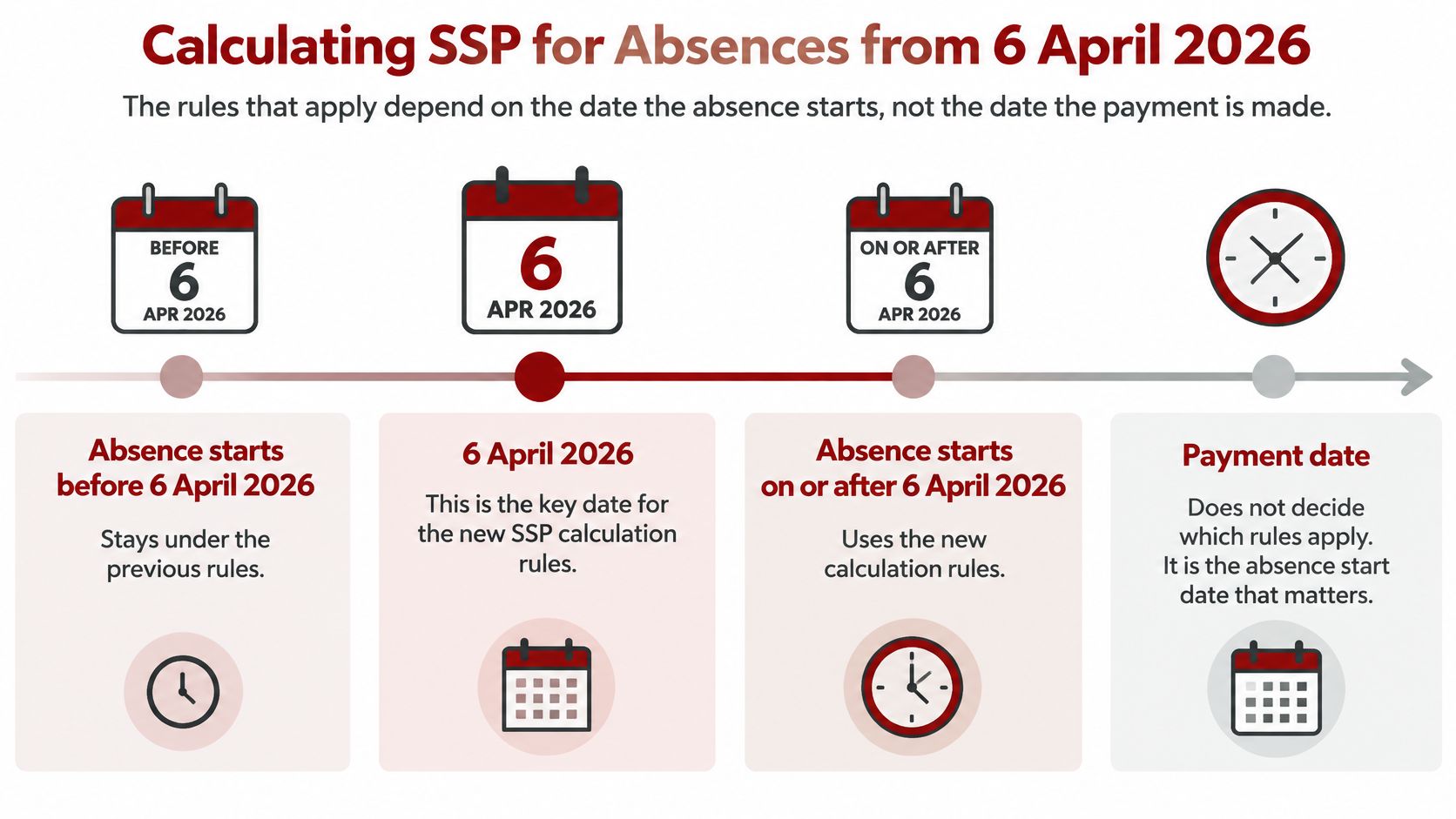
6 April 2026 changes the calculation, not the reclaim position. The government's SSP employer guidance states that, from that date, SSP is payable from the first full day of sickness, the three-day waiting period and Lower Earnings Limit are removed, and payment is generally 80% of average weekly earnings or £123.25 a week, whichever is lower.
Record the absence start date before calculating pay. For continuing absences that began before the change, check the applicable previous and transitional rules rather than automatically treating the payment date as the deciding factor.
SSP rules by absence start date
| Absence starts | Waiting period | Earnings test | Weekly payment |
|---|---|---|---|
| Before 6 April 2026 | Three-day waiting period under the previous rules | Lower Earnings Limit applies under the previous rules | Apply the previous rules and check transitional treatment for continuing sickness |
| On or after 6 April 2026 | None, paid from first full day | Lower Earnings Limit abolished | 80% of average weekly earnings or £123.25, whichever is lower |
Use the timeline as a prompt to check when the absence began, rather than when payroll processes it.
Calculate from the absence record
Start by confirming employee status and qualifying incapacity. Then work through the calculation in this order:
- Identify the start date. Keep the original sickness notification, not just the date someone entered it into payroll.
- Select the applicable rules. Flag continuing sickness for a transition check before approving payment.
- Calculate average weekly earnings. Use the statutory averaging method in current HMRC guidance, not an informal average of recent payslips.
- Apply the payment comparison. For new-rule absences, compare the earnings-based amount with the statutory flat rate.
- Allocate qualifying days. Check the employee's working pattern and the days payable within the payroll period.
- Save the calculation. Record the earnings inputs, applicable rule and resulting SSP alongside the absence.
Say a café employee works irregular shifts. Their manager's estimate of a normal week isn't an adequate earnings calculation. Payroll needs the relevant pay history and a documented working pattern before approving the amount.
Keep leave records and payroll inputs connected. SIX ERP's guide to running payroll and leave in ERP offers useful context for that operational link, while our payroll for small business guidance helps frame the administration involved.
Don't let software settings substitute for review. Test irregular workers, low-paid employees and continuing absences separately. Those are the cases where a superficially reasonable payslip can conceal the wrong rule or earnings input.
Recording and Budgeting SSP as a Direct Cost
Treat SSP as an operating cost, not a debtor balance awaiting HMRC reimbursement. The Work and Pensions Committee report records that employers paid the full cost of SSP in 2024, with no reclaim mechanism, and that the Department for Work and Pensions estimated proposed reforms would cost businesses approximately £1.6 billion per year.
That estimate isn't your business's forecast. Your own staffing patterns, absence history and contractual sick-pay commitments should determine the allowance you make.
Keep a usable absence ledger
For each sickness absence, retain:
- Sickness dates. Record the first and last day, updating an ongoing absence when the employee returns.
- Qualifying days. Identify the payable days against the employee's working pattern.
- Reason for absence. Keep an appropriate factual record with access restricted to those who need it.
- Employee identification. Check the National Insurance number against the payroll record.
- Payment details. Show SSP paid in each payroll period and keep the calculation supporting it.
These records aren't pointless because there's no refund. They let your accountant trace the expense and allow payroll to explain why an employee received a particular amount.
Use separate payroll codes for SSP, contractual sick-pay enhancements and ordinary wages. Where full sick pay includes statutory entitlement, document the components so the total isn't counted twice.
Forecast the payment and the staffing impact
Build the allowance from your absence history and current workforce. Translate expected qualifying absence days into payable SSP using the applicable calculation, then spread the expected cash requirement across your forecast.
Keep replacement cover separate. A construction business may face both sick pay and additional labour costs to keep work moving; combining them under one unexplained wage adjustment makes the pressure harder to identify.
Our cash-flow forecasting guidance can help organise those payment assumptions. For managing attendance consistently rather than reacting to absence, consider the attendance advice from Turn On Work.
Budget the statutory payment and the cost of covering the work separately. They affect cash together, but they need different management decisions.
Reconcile the SSP ledger to payroll reports monthly. Investigate unexpected changes while the manager still remembers the absence, rather than leaving unexplained balances for year-end.
Checking Past Claims and Correcting Overclaims
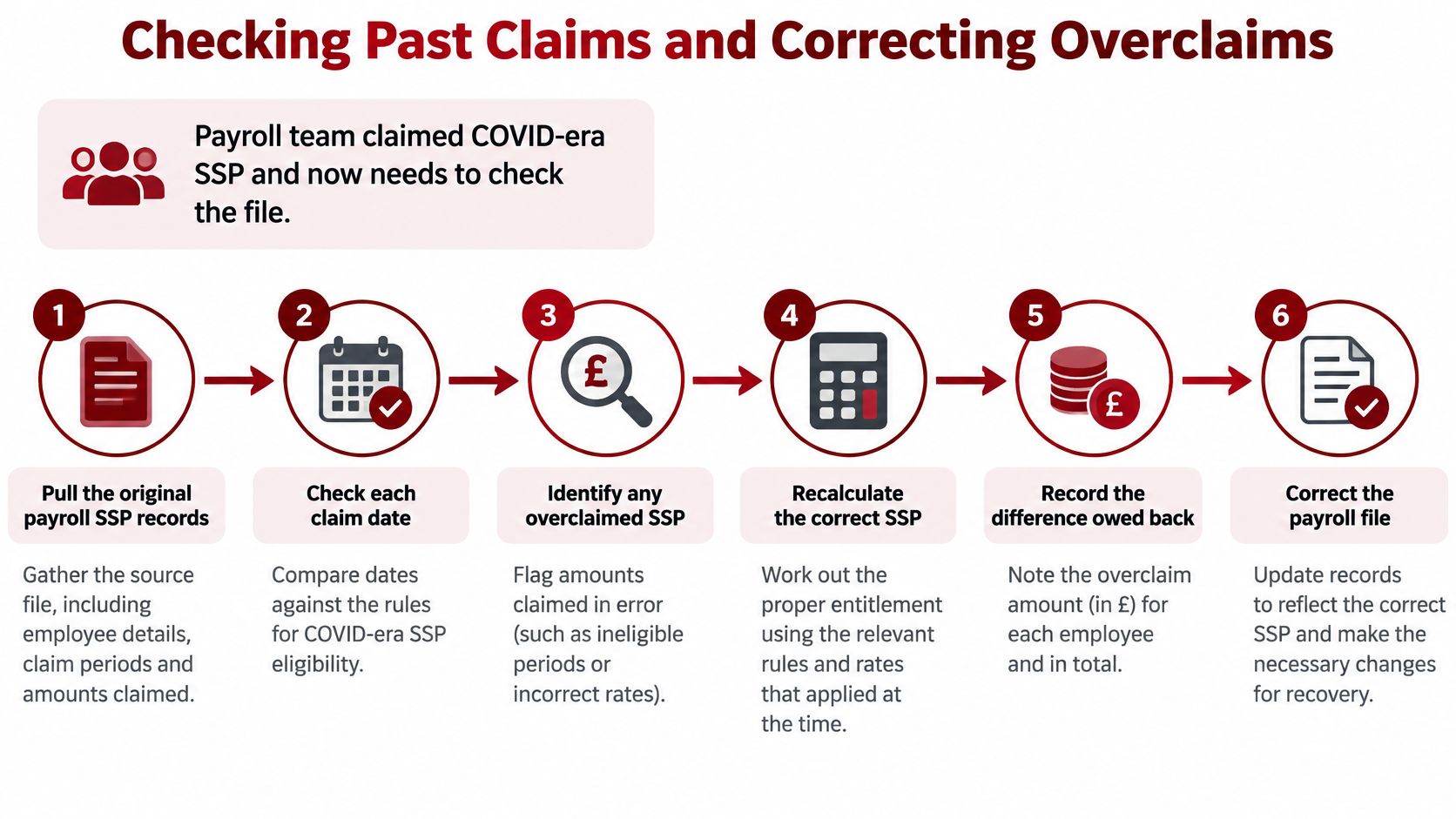
If your payroll team claimed COVID-era SSP, review the original claim file rather than trying to recreate it from today's payroll settings. You need to establish what was paid, what was eligible and what HMRC reimbursed.
HMRC's coronavirus SSP claim guidance required records to be kept for three years after reimbursement, with recovery capped at two weeks per employee and, under the earlier rules, £95.85 per week. Apply the rate and conditions that governed the claim, not a later payroll rate.
Review the claim against its original evidence
Pull the original payroll SSP ledger. Export employee-level entries, including corrections and reversals. The claim needs to reconcile to SSP paid, not an estimate prepared before payroll was finalised.
Map each absence to qualifying days. Compare the sickness dates with the employee's working pattern. Calendar days off sick and payable qualifying days aren't interchangeable.
Remove ineligible periods. Check the recorded reason for absence and the relevant scheme window. An absence appearing in payroll doesn't establish that it qualified for coronavirus reimbursement.
Recalculate the recoverable amount. Apply the historical employee limit and statutory rate. Exclude contractual enhancements, full wages and any duplicated amount.
Reconcile the claim to submissions and cash. Match the claim schedule to payroll reports, the relevant PAYE records and the bank receipt. Investigate differences instead of posting them to an unexplained balancing account.
Preserve the audit trail. Keep the submitted claim, reimbursement evidence and supporting employee records for the required retention period. Retain relevant unresolved correspondence while you establish how a discrepancy should be corrected.
The supporting employee file should identify absence start and end dates, National Insurance number, reason for incapacity and qualifying days. A spreadsheet total without those underlying fields is difficult to defend or correct.
Common claim errors and how to correct them
| Error | How it happens | Correction |
|---|---|---|
| Reclaiming contractual sick pay | Full wage coded as SSP in payroll | Re-code contractual pay and remove the non-statutory amount from the claim |
| Claiming above the statutory rate | Employer paid more and claimed the difference | Reduce the claim to the applicable statutory amount and correct with HMRC |
| Duplicate claims | Same absence entered in two payroll periods | Remove the duplicate line and reconcile to the PAYE submission |
| Missing National Insurance number | Employee record incomplete | Add the number, confirm the record and recheck the claim line |
| Unsupported absence reason | No evidence on file for the reason given | Establish and document the reason, or treat the period as ineligible and correct it |
| Claims outside permitted dates | Absence falls outside the scheme window | Remove the period and correct the overclaim |
Don't manufacture missing evidence. If you establish a reason retrospectively, record when and how it was confirmed. Don't present a newly created note as an original sickness notification.
Stop any attempted further submissions while you quantify the discrepancy. Prepare a correction schedule identifying affected employees, periods, amounts claimed and amounts properly recoverable, then contact HMRC about correcting the overclaim.
An unresolved historical rebate difference is a liability to investigate, not a credit to apply against a future payroll bill.
Include unresolved items in your year-end accounts checklist so they aren't lost when responsibility changes. Before closing the review, have another person check each claim line against the payroll report and sign off the reconciliation.
Confirm Your SSP Position Before the Next Payroll Run
Confirm your position before approving the next payroll, not after an employee queries their payslip. Give one named person responsibility for the calculation, another responsibility for approval, and make sure both can access the supporting records.
Sickness absence belongs in routine payroll planning. According to the Work Foundation at Lancaster University, UK workers lost an average of 4.4 working days per worker because of sickness or injury in 2024.
That's a workforce baseline, not a direct SSP multiplier. Different working patterns, eligibility and pay arrangements mean you shouldn't multiply headcount by an absence average and assume you've calculated the statutory bill.
Put approval controls in the right order
Resolve historical claim discrepancies. If an old rebate remains unreconciled, assemble the claim file and correction schedule. Don't describe an unresolved amendment as a claim that can still be submitted through a closed scheme.
Test the payroll configuration. Select sample absences covering new sickness, continuing sickness and irregular earnings. Compare the system result with a documented manual calculation, including the applicable transition treatment.
Approve the cash and records together. Confirm that the forecast includes the payment and that each absence has sufficient supporting information. A correct total without an audit trail still leaves the business exposed when someone needs an explanation.
Use a short approval sheet showing the employee, absence reference, calculation reviewer and any unresolved question. Keep the exception list visible until each item has an owner and a documented resolution.
Decide who owns payroll administration
You can retain payroll internally, but don't leave responsibility split between a manager's inbox, an absence spreadsheet and an unreviewed software calculation. Someone must own the complete record from sickness notification to final payment.
If you prefer specialist administration, our payroll service covers PAYE, National Insurance, statutory sick pay and statutory maternity pay. Our compliance support also includes payroll procedures covering Real Time Information and Pensions Auto Enrolment compliance.
The decision isn't whether to keep searching for a routine SSP refund. It's whether you can demonstrate that employees were paid correctly, the business forecast the cost and any historical reimbursement was justified.
Put the reform boundary in your payroll calendar, flag continuing absences for review and book the calculation check before payroll approval. Don't release the run with unexplained SSP adjustments.
Action Accountants Limited offers payroll administration covering PAYE, National Insurance and statutory sick pay, helping you manage the payment rather than chase an unavailable routine refund. Visit Action Accountants Limited to arrange a payroll review and discuss your SSP calculations, records and outstanding historical claim discrepancies before your next payroll run.