
How to Appoint a Director: Eligibility, Consent and Filing
Learn how to appoint a director in the UK, from eligibility and identity checks to the AP01 filing and the records you must keep.

Your co-founder needs to join the board, an investor wants a director appointed, or a departing colleague needs replacing before an important contract is signed. You've agreed on the person, and the Companies House filing looks straightforward. The temptation is to approve the appointment immediately and sort out the supporting documents afterwards.
Resist it. The fastest appointment can be the riskiest when nobody has checked eligibility, suitability or identity verification. Knowing how to appoint a director means getting those decisions right before fixing the effective date, then making sure the approval, filing and company records agree.
Table of Contents
- Who Can Be Appointed and Whether They Should Be
- Verifying Identity Before the Appointment Takes Effect
- How to Appoint a Director Step by Step
- Records to Keep and Mistakes That Cause Trouble
- Confirm Each Appointment Before the Director Acts
Who Can Be Appointed and Whether They Should Be
An appointment can be void, not merely incomplete. The Companies Act 2006 appointment provisions set the minimum age at 16, require every company to have at least one natural-person director, and require a private company to have at least one director; appointments breaching the minimum-age or natural-person requirements are void.
Don't start by drafting a resolution. Start by checking whether the proposed appointment is legally possible and whether the company's constitution permits the board structure you want.
Run the eligibility screen first
Use the following checks in order. The age, natural-person and board-size thresholds are the statutory requirements described above; written consent belongs in your appointment file alongside the eligibility evidence.
Eligibility requirements for a director appointment
| Requirement | Rule | What to check |
|---|---|---|
| Minimum age | Must be 16 or over | Date of birth; under 16 makes the appointment void |
| Natural person | Every company needs at least one director who is a natural person | Rule out a corporate-only board |
| Private company board | A private company must have at least one director | One director is lawful unless the articles require more |
| Disqualification | A person under a disqualification order cannot be appointed | Check disqualification status before the resolution |
| Written consent | The appointee must agree to act | Keep signed consent on file |
Check the candidate's actual details rather than relying on an introduction from a shareholder. Ask about disqualification directly, check the relevant public information, and resolve inconsistencies before anyone signs.
Read the articles and shareholders' agreement together. A company may meet the statutory minimum yet still breach its own governance arrangements by appointing someone through the wrong decision-maker or overlooking an agreed restriction.
Legal eligibility isn't a recommendation
Passing the legal screen doesn't establish that someone should manage your company. The Insolvency Service's enforcement outcomes show why directors' conduct deserves serious scrutiny, rather than treating appointment as an administrative favour.
Ask the candidate to explain their previous directorships. Review Companies House filing histories, investigate unexplained gaps and discuss any insolvency involvement without assuming that a failed business automatically proves misconduct.
Your suitability review should cover practical responsibilities:
- Financial oversight. Can the candidate read management accounts, question cash-flow assumptions and recognise when the company needs professional advice?
- Conflicts. Will they also represent a supplier, investor, relative or competing business?
- Bank access. What payment authority will they receive, and who will review their transactions?
- Compliance ownership. Do they understand who prepares accounts, monitors tax obligations and maintains company records?
- Independent judgement. Will they challenge a founder's decision when necessary, rather than sign what they're given?
Use our guide to the roles and responsibilities of a board of directors as a discussion document before asking for consent. A candidate who won't engage with the responsibilities isn't ready for the role.
Appointment test: Don't appoint someone merely because you trust them personally. Establish whether you trust their judgement when the company is under pressure.
Be particularly careful with nominee arrangements and cross-border comparisons. Chern & Co's resource on an Irish company with a nominee resident director concerns an Irish arrangement, not a substitute for checking UK appointment requirements or the proposed director's duties.
A family relationship, contractor agreement or nominee label doesn't make the position ceremonial. Before signing, ask yourself: would you trust this person with the company's bank account, and would you understand how they used it?
Verifying Identity Before the Appointment Takes Effect
Since 18 November 2025, new directors must verify their identity before, or as part of, incorporation or appointment and provide a Companies House personal code, according to the Companies House identity-verification guidance. Acting as a director without verification once duties begin is an offence.
That changes how you should organise the timetable. Verification belongs inside the appointment process, not on a list of administrative jobs to finish after the new director starts.
Commercial urgency doesn't remove the requirement. If the candidate is needed for a board decision, financing discussion or replacement appointment, begin verification as soon as they agree to join.
Match the process to the appointment
Different appointments create different scheduling problems. Use the table to decide what must be settled before you circulate final approval documents.
Verification needs by appointment situation
| Situation | Verify before | Filing point |
|---|---|---|
| Co-founder added at incorporation | Complete identity verification before or as part of incorporation | Include the personal code in the appointment information |
| Overseas director | Complete verification before duties begin | Confirm the personal code before filing |
| Replacement director at short notice | Complete verification before fixing the effective date | Use an effective date that doesn't precede verification |
| Director already on other companies | Confirm verified identity and provide the personal code for each role | Don't assume an existing company appointment completes the new role's filing |
An overseas candidate needs particular attention to document readiness and consistency. Ask them to check that the name and personal details they supply match their identity information, rather than discovering a mismatch while the appointment is being filed.
For a replacement director, resist promising a start date before checking readiness. A resignation, handover or urgent approval may need careful coordination, but backdating paperwork isn't a solution to an unfinished verification process.
Verification and role filing are different tasks
A director who already serves elsewhere may have completed identity verification. That doesn't mean your company can omit their personal code or assume the new appointment has automatically been linked to their verified identity.
Ask whether they have their code available and who will provide it for the filing. Keep it secure and share it only with the person responsible for the relevant submission.
Set the appointment date around completed compliance, not the date someone hoped to announce the appointment.
A sensible working sequence is to obtain agreement and consent, complete verification, confirm the effective date, make the authorised appointment decision and submit the filing. Keep evidence of the checks with the appointment documents.
If an accountant or formation agent is handling the submission, name the person responsible for confirming verification readiness. Don't confuse a routine filing service with permission for the candidate to start acting while a prerequisite remains unresolved.
How to Appoint a Director Step by Step
For a private company, use a documented process rather than a chain of informal messages. The Companies House AP01 guidance provides the appointment form and filing route, including consent confirmation, director particulars and current identity-verification information.
The sequence below separates the company's decision from the information sent to Companies House. Those are connected tasks, but completing either doesn't automatically complete the other.
Follow the approval and filing sequence
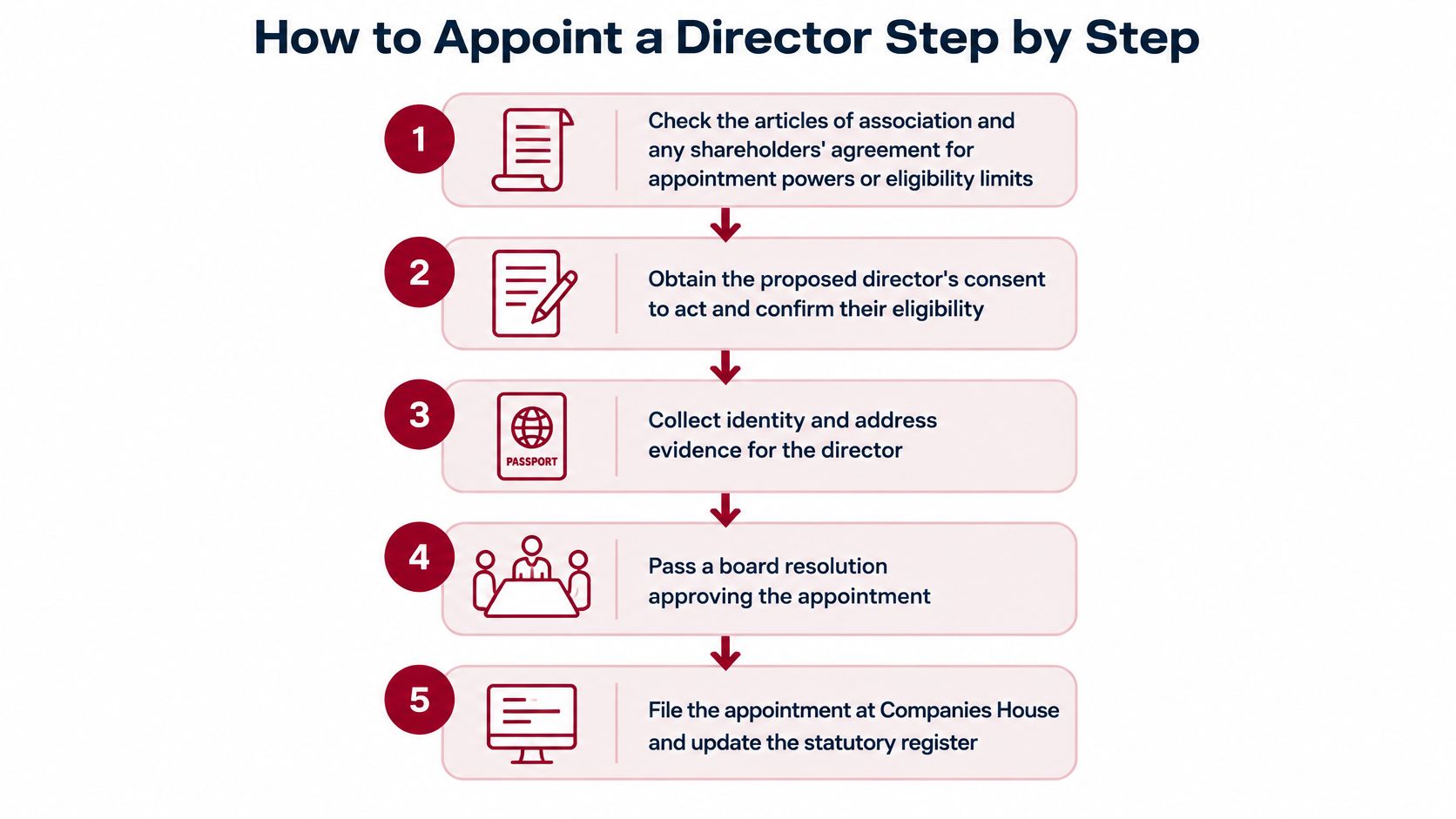
Check the articles and shareholders' agreement. Identify who has authority to appoint the director and whether appointment rights or eligibility restrictions apply. Don't assume the existing directors can approve the appointment just because they run the business.
Obtain written consent and confirm eligibility. Ask the candidate to sign consent to act, complete your eligibility checks and finish identity verification before fixing the appointment timetable. The common mistake is approving the appointment while the candidate's agreement or verification remains outstanding.
Pass the required resolution. Use the board or shareholder approval route authorised by the company's documents, and record the effective appointment date clearly in the minutes or resolution. Avoid vague wording that leaves the company unsure whether the person was appointed immediately or at a later date.
Collect and reconcile the statutory particulars. Assemble the full name, nationality, date of birth, service address, usual residential address and identity-verification details, including the personal code. Although the complete filing pack is assembled here, collect verification evidence earlier and resolve inconsistent spellings or addresses before submission.
Notify Companies House and complete the records. Submit AP01 or use the approved online process, then retain the submission evidence and check the outcome. Assign responsibility for the filing when the resolution is passed, diarise the applicable filing deadline and don't treat an internal approval as a public-register update.
Use this visual summary to coordinate the documents, checks and submission.
Give someone ownership of completion
The most useful control is a named filing owner. That person should know who approved the appointment, which effective date was authorised and where the candidate's confirmed details are stored.
Don't let different people maintain conflicting versions of the same information. If a founder collects the candidate's address and an accountant prepares the submission, use an agreed particulars sheet rather than forwarding fragments from separate email conversations.
The service address and usual residential address are distinct fields. Ask the candidate to confirm each deliberately, and handle residential and identity information through a restricted-access process rather than a widely shared board folder.
For a wider view of the administrative responsibilities involved, use our guide to company secretarial duties. It helps distinguish the appointment decision from the continuing work of maintaining accurate company information.
Prepare a reviewable appointment file
An accountant or auditor should be able to follow the appointment without reconstructing it from messages. Build a clear document trail:
- Authority evidence. Save the relevant appointment provisions or an explanatory note identifying the approval route.
- Candidate documents. Keep signed consent, confirmed particulars and evidence that eligibility checks were completed.
- Decision record. Retain the signed resolution or minutes showing the effective date.
- Verification record. Store appropriate evidence securely, with access restricted to those who need it.
- Completion evidence. Keep the filing outcome and the corresponding company-record updates.
Where the company is appointing a replacement, keep the outgoing director's paperwork separate but cross-reference the handover. An appointment and a termination are different events, even when they form part of the same commercial change.
If you're comparing outsourced help for a coordinated change, striveX Ltd's director appointment and termination services provide a relevant service reference. Whatever route you choose, insist on a complete approval and filing trail, not merely confirmation that someone submitted a form.
Records to Keep and Mistakes That Cause Trouble
Keep the signed consent, approval record, effective date, confirmed particulars, filing receipt and updated company information together. Add a short completion note identifying who checked the outcome, so the next person handling compliance doesn't have to guess whether the appointment was finished.
Companies House explains the continuing need to maintain company information and file a confirmation statement and annual accounts each year. An appointment therefore needs to fit into the company's ongoing compliance routine, rather than disappear into an incorporation folder.
Check the file against the common failures
Use this table as a review tool before closing the appointment task. If a row describes your current position, assign the fix to someone rather than leaving it as an observation.
Common appointment mistakes and fixes
| Mistake | Consequence | Fix |
|---|---|---|
| Treating the internal resolution as sufficient | Company information and the Companies House record stay out of date | File AP01 or the online equivalent and update the relevant company records |
| Skipping written consent | No evidence the appointee agreed to act | Obtain and file signed consent before passing the resolution |
| Acting before verification is complete | Acting as a director once duties begin is an offence | Complete identity verification first, then confirm the effective date |
| Leaving the effective date unrecorded | Unclear when duties and liabilities began | Record the effective date in the minutes and on the filing |
Don't confuse a submission acknowledgement with confirmation that the record is correct. Check the filing outcome, resolve any rejection and compare the recorded appointment with the authorised decision.
If the dates or particulars differ, investigate the discrepancy rather than editing internal documents merely to make them match. The objective is an accurate record of what happened, supported by properly authorised corrections where necessary.
Record-keeping rule: A filing receipt belongs with the decision that authorised the filing, not in an unrelated inbox.
Make the routine easy to maintain
Keep a separate folder for each director, with a consistent naming convention for consent, approval and filing documents. Store sensitive identity and residential information with narrower access than ordinary governance papers.
Diarise the confirmation statement review so someone checks director particulars and other company information before submission. Don't use that review as a reason to postpone an appointment filing that needs attention now.
Our guide to statutory registers provides useful context for organising company records. Maintain a clear distinction between working notes, approved documents and information submitted.
Use the video below as supporting material when briefing whoever handles your appointment administration.
A tidy folder isn't the end goal. The company should be able to establish who authorised the appointment, when it took effect and whether the resulting information was filed correctly, without depending on someone's memory.
Confirm Each Appointment Before the Director Acts
Before the candidate starts signing as a director or taking part in board decisions, confirm that the appointment is valid and its prerequisites are complete. Then track the filing through to completion rather than assuming that approval alone closes the task.
Don't confuse legal appointment, filing submission and filing acceptance. They are separate checkpoints, and your completion record should show where the company stands at each.
Use a clear release check
Before treating the candidate as ready to act, confirm:
- Consent is signed. The person has agreed to accept the office and understands the responsibilities.
- Eligibility and suitability are settled. No unresolved issue remains about their ability or fitness to serve.
- Identity is verified. The required verification details are ready for the appointment process.
- Approval is valid. The authorised decision-maker has passed the appropriate resolution.
- The effective date is recorded. The company can identify when the appointment begins.
After the decision, confirm that AP01 or the online filing has been accepted, the relevant company information has been updated and the supporting evidence has been filed. Keep any outstanding action visible until it's resolved.
An appointment also needs a practical handover. Agree what financial information the director will receive, how board papers are circulated and who they should contact about compliance questions.
For the decision-making responsibilities that follow appointment, our explanation of section 172 of the Companies Act 2006 is a useful starting point. Give the incoming director time to understand the role before expecting them to approve important transactions.
Decide whether the appointment needs a review
A straightforward company with clear articles, an eligible candidate and organised records can often handle the process itself. The sensible test isn't whether the filing looks easy, but whether anyone has identified uncertainty about authority, timing or the candidate.
A corporate shareholder may bring appointment rights that need checking. An overseas candidate may need more coordination around identity documents, while a rushed replacement can create avoidable confusion between resignation, appointment and handover dates.
We provide Company Secretarial services, including support with formation, filings and register upkeep. Based in Colindale, we serve North West London and also support clients across the UK; prospective clients can contact us to arrange a consultation.
Bring the articles, any shareholders' agreement, the proposed director's details and the intended timetable to that discussion. Those documents allow a focused review of the actual appointment rather than a general conversation about Companies House forms.
The decision should remain straightforward: don't appoint first and investigate afterwards. Eligibility, verification timing and suitability are the checks that deserve attention before urgency starts driving the process.
Action Accountants Limited offers company secretarial support for formation, director appointment filings and company-record upkeep. Visit Action Accountants Limited to arrange a consultation, and bring your articles, proposed appointment date and candidate details so we can discuss the checks your appointment needs.