
CIS Payment and Deduction Statement: Rules and Deadlines
Learn what a CIS payment and deduction statement must show, when to issue it, and the penalties for getting it wrong. Practical guide for UK contractors.
Two things land on the same morning near the end of the month. Your bookkeeper wants the CIS return finalised, and a subcontractor texts to ask where their statement is. You export a PDF from the invoice spreadsheet, send it, file the return, and get on with the job.
Six weeks later that subcontractor calls back. HMRC has queried the credit they claimed, because the deduction shown on your statement doesn't match the figure on your return. The statement was never a payslip. It's a control document tying three things together, and when one figure is wrong, all three break.
Table of Contents
- What a CIS Payment and Deduction Statement Must Show
- Tax Months and the Deadlines You Cannot Miss
- Electronic Statements and Keeping Records
- How to Issue a Statement Each Tax Month
- Penalties and Compliance Risks for Contractors
- Checking Your Statement as a Subcontractor
- Confirm Your Statements Before the Next Tax Month
What a CIS Payment and Deduction Statement Must Show
A valid CIS payment and deduction statement carries seven required items. Miss any one and the record is undermined, even when the money that reached the subcontractor's bank account is exactly right. The GOV.UK guidance on making CIS deductions fixes the fields; the layout is your choice.
On the surface the document reads like a payslip. Functionally it does more. It is the subcontractor's evidence of tax already paid over to HMRC, and it has to agree line for line with the monthly return you file. Where the two disagree, the subcontractor's credit gets queried and your phone rings.
The seven rows that make a statement valid
| Required item | Why it matters | Example entry |
|---|---|---|
| Contractor name and employer tax reference | Links the statement to the contractor's monthly CIS return | Name and PAYE reference as registered with HMRC |
| Subcontractor name and unique taxpayer reference | Identifies who received the payment and the deduction | Name and UTR as verified with HMRC |
| Tax-month end date | Shows which tax month the payments belong to | 5 June for a 6 May to 5 June tax month |
| Gross payment, excluding VAT | The full amount paid for the work before any deduction | £4,000 |
| Cost of qualifying materials | Reduces the amount subject to deduction | £800 |
| Amount liable to deduction | Gross payment less materials and permitted exclusions | £3,200 |
| CIS deduction at the applicable rate | The tax withheld, shown with the rate applied | £640 at 20% |
Take a registered subcontractor paid £4,000 for a month's work, with £800 of receipted materials. VAT sits outside the calculation entirely, so it never enters that gross figure, which is why statements built from invoice totals fail so often. Materials come off the top, leaving £3,200 liable to deduction. At 20% the deduction is £640, and the subcontractor receives £3,360.
A polished PDF is not automatically sufficient. A missing tax-month end date, an employer reference borrowed from a group company, or an invisible deduction calculation can undermine the record even when the net payment is correct. This bites hardest in small London contractors running statements off a spreadsheet and a messaging app, where nobody has written the template down.
If the rate itself is the part you're unsure of, this explanation of what a CIS deduction is covers the registration and verification rules behind the 20% and 30% figures.
Before the next payment run, pull your most recent statement and test it against all seven rows. Where a row is missing, change the template now, not after HMRC asks.
Tax Months and the Deadlines You Cannot Miss
A CIS tax month is not a calendar month. It runs from the 6th of one month to the 5th of the next, and confusing the two is where most late statements begin. Payments made between 6 May and 5 June fall in the tax month ending 5 June, and the statement for them must be issued by 19 June, within 14 days of the month closing, as the HMRC Construction Industry Scheme manual sets out.
The order of events repeats every month without variation, so map it once and reuse it.
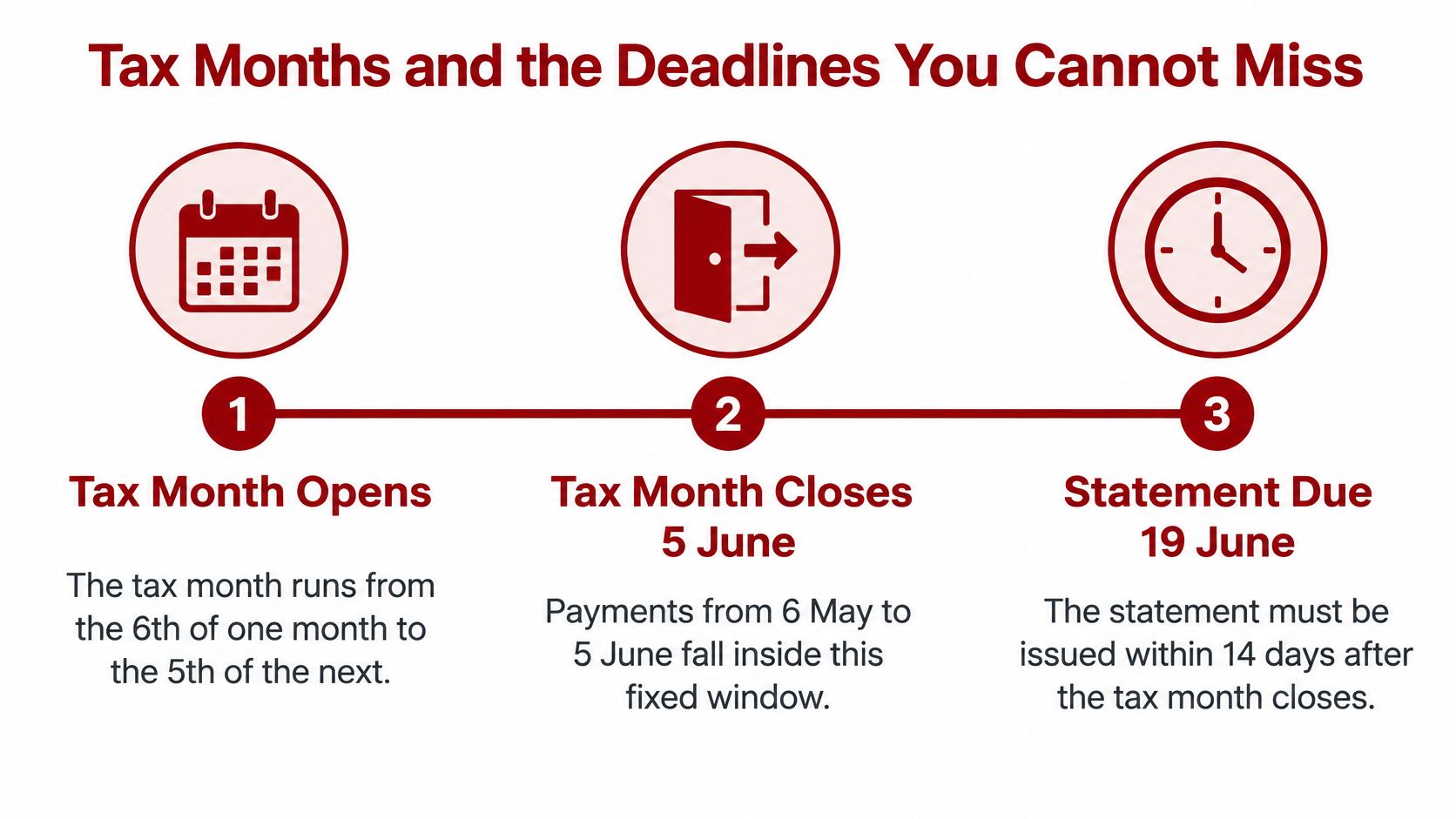
| Event | Deadline rule | Example for 6 May to 5 June |
|---|---|---|
| Tax month | Runs from the 6th to the 5th of the following month | 6 May to 5 June |
| Statement to subcontractor | Within 14 days after the tax month ends | Issue by 19 June |
| Deductions and monthly CIS return to HMRC | By the 19th after the tax month ends | Pay and file by 19 June |
| Electronic payment to HMRC | By the 22nd after the tax month ends | Pay by 22 June |
| Late monthly return | £100 fixed penalty from the day after the deadline | Penalty applies from 20 June |
Read the first two rows together, because the statement and the filing land on the same day. Miss the 19th and you lose the statement and the payment in one stroke, with the fixed penalty clock starting the next morning.
The month builds in one direction. Payments accumulate from the 6th, the window shuts on the 5th, statements go out to every subcontractor from whom a deduction was made, and then the return and the money follow. At least one statement is required for every month in which a deduction was taken, whether you issue a single monthly document or one per payment.
Practical rule: diary the 5th as the close and the 19th as the drop-dead date. Everything else in the CIS cycle fits between them, including any query a subcontractor raises.
The filing side of the cycle, including what goes on the return and how it is amended, is covered in our guide to CIS monthly returns.
Electronic Statements and Keeping Records
Two conditions make an electronic statement valid, and both have to be met. The contractor and subcontractor agree to electronic delivery, and the document arrives in a form the subcontractor can save and print, which is what HMRC's guidance for CIS subcontractors requires. A PDF attachment clears that bar. A table pasted into the body of an email does not.
Get the agreement in writing and file it beside the subcontractor's verification details. When a dispute surfaces a year later, that one line settles it.
| Format | When it works | What to check |
|---|---|---|
| One consolidated statement per tax month | Covers all payments in the month and meets the monthly minimum | Every payment in the month is listed |
| Separate statement per payment | Suits contractors who pay frequently | Each statement is issued within 14 days and the monthly minimum is still met |
| Electronic statement | Only where both parties have agreed to it | The document can be saved and printed by the subcontractor |
| Paper statement | Where electronic delivery has not been agreed | Proof of delivery is kept on file |
Format is the easy half. Control is where contractors slip. Lock the statement run to your payroll or accounts-payable close so it happens on a fixed day, and keep evidence of delivery, whether that is a sent email or a signed paper copy. Then reconcile every statement to the CIS300 before the return is filed. The statement, the return and the subcontractor's tax credit all draw on the same payment lines, so a wrong deduction figure travels. It lands on the return HMRC holds and on the credit the subcontractor claims, and one typo becomes three corrections.
A contractor paying three subcontractors by bank transfer on the 28th of each month needs very little kit. A shared folder holding the delivery emails, a reconciliation sheet matching each statement line to the bank payments and the CIS300, and a note of who agreed to electronic delivery. Any query gets answered in minutes because every record points at the same figures.
Keep CIS records for at least three years after the end of the tax year they relate to, including the statements themselves and the delivery evidence. For the wider archive, this guide to storing company records safely after six years covers the practical side of general business retention, and the same discipline sits behind our approach to bookkeeping for sole traders.
Write down the delivery method each subcontractor has agreed to this year. That one line prevents most disputes before they start.
How to Issue a Statement Each Tax Month
The cycle runs twelve times a year, so build a procedure once and run it on rails. Six steps, in this order, and the reason each one exists.
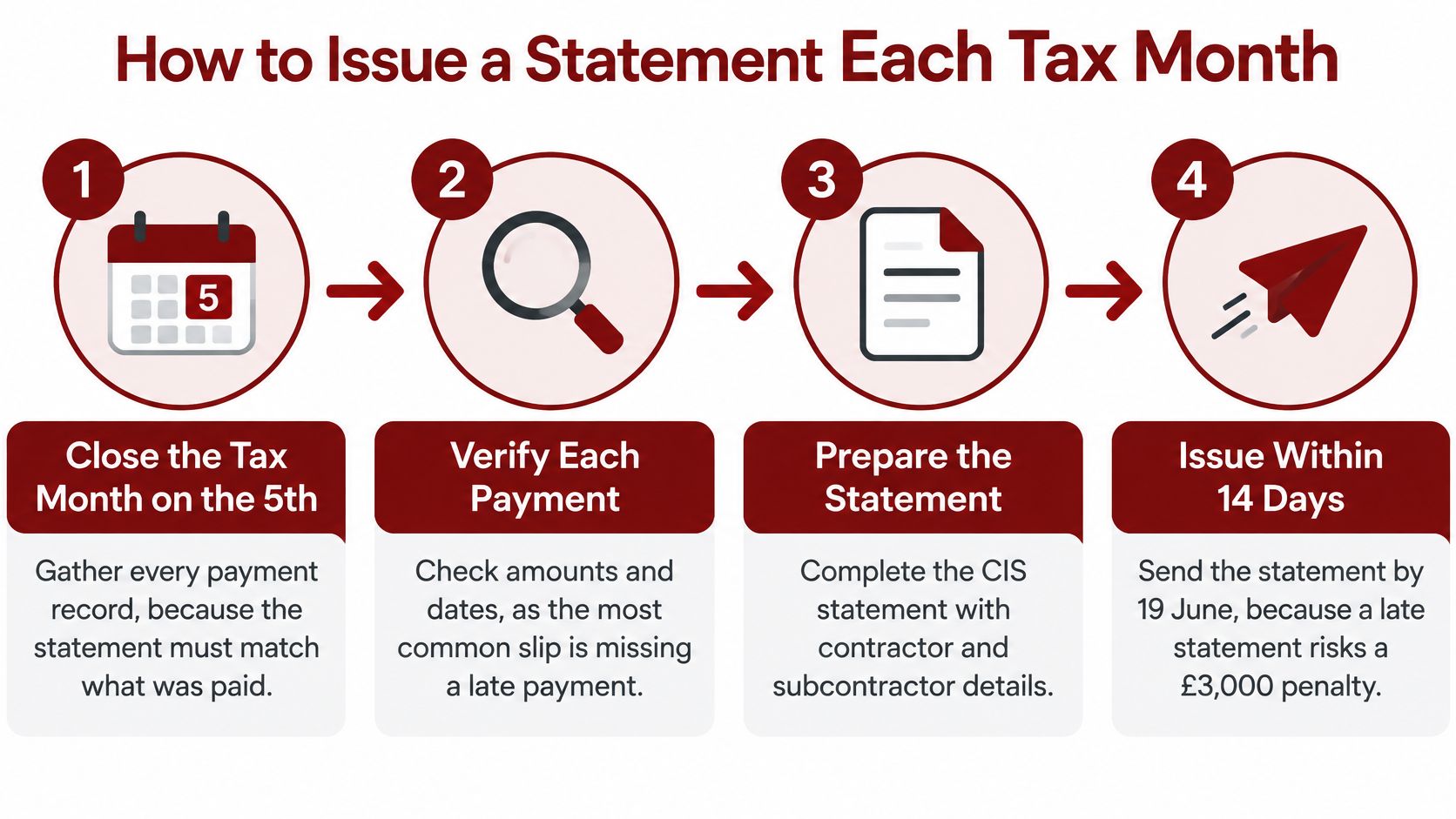
- Close the tax month on the 5th and gather every payment record. The statement must match what left your account, not what you invoiced. The common slip is a payment made on the 3rd posted to the wrong month.
- Total gross payments for each subcontractor, excluding VAT. VAT never sits inside the deduction base, so pulling totals straight from a ledger that includes it throws every figure out. Strip VAT before anything else.
- Deduct the cost of qualifying materials. Only direct materials the subcontractor paid for reduce the amount liable. The slip is a materials figure with no receipt or documented estimate behind it, which is exactly the figure HMRC challenges.
- Apply the correct rate. That's 20% for a registered subcontractor, 30% where they are unregistered or cannot be verified, and nothing where gross payment status is approved. The two errors that turn up most often are charging 20% to a subcontractor who holds gross status and charging 30% to one who was verified months ago.
- Prepare the statement with every required item, dated to the tax-month end. Not the invoice date, not the payment date. The document is anchored to the month, and the date on the page is what tells a reader which return it belongs to.
- Issue it within 14 days of the month ending, by the 19th at the latest. Send it before or alongside the monthly filing so the two are built from the same data and can't drift apart.
A finished statement shows every row filled, the arithmetic in the order it was applied, and dates a reader can follow without asking. If a subcontractor has to email you to ask how £640 was calculated, the statement isn't finished.
Penalties and Compliance Risks for Contractors
Treat a late or sloppy statement as minor admin and you've priced the risk wrong.

The HMRC CIS manual on deductions and penalties allows penalties of up to £3,000 where a contractor fails to provide required statements, cannot produce CIS payment records, or negligently or deliberately supplies incorrect information. That is a discretionary penalty with a cause attached to it: the records are missing or the information is false.
It is not the same animal as the fixed charge for a late monthly return, which lands automatically from the day after the deadline. One punishes late filing, the other punishes records that don't exist or don't tell the truth. Contractors routinely conflate them and budget for the cheaper one.
One missing statement cascades through the whole chain. The subcontractor can't evidence tax already deducted, the contractor's records no longer match the return, and repeated failures become something HMRC weighs when it reviews whether a contractor should keep gross-payment status.
Three pitfalls do most of the damage:
- The employer reference is wrong or absent. A group company quoting another entity's reference breaks the link to the return.
- Deductions calculated before materials come off. The sub pays 20% on money that should never have been in the base.
- Monthly totals that don't reconcile to the return. HMRC compares the two before granting any credit, and a mismatch stalls the claim.
The statement is the control document linking the subcontractor's payment, your monthly return and their tax credit. One error travels across all three, and it's your name on the paperwork.
Checking Your Statement as a Subcontractor
Check every statement before you rely on it. The figure on that page is the one HMRC expects to reconcile to your contractor's monthly return, and a difference between the two stalls your tax credit until it is corrected.
Start with the identities: contractor name and employer reference, your name and UTR, the tax-month end date, and the amounts. Then do the arithmetic yourself. On £4,000 gross with £800 of materials at 20%, the page should show £3,200 liable and £640 deducted. If that doesn't appear, ask.
- Match each statement to payments received in that tax month. Bank receipts are the test, not invoices.
- Check the rate against your registration. 20% applies to a registered subcontractor, 30% to an unregistered or unverified one.
- Record the deduction and enter the total in the CIS section of your self-assessment or company return to claim credit against income tax and National Insurance.
- Ask in writing if a statement is missing or wrong, and keep a copy of the request.
A mismatch is yours to chase. The credit clears only when your statement agrees with what the contractor filed, so a deduction you cannot evidence is a deduction HMRC will not credit.
Claim the credit from the statement, never from a bank balance. If you're unsure how the figures were reached, our walkthrough on how to calculate CIS deductions shows the order of the arithmetic. For costs that never enter the deduction base at all, this guide to claiming tools and equipment expenses explains where genuine business expenses are claimed on your return.
Common slip: assuming the materials line is a business expense claim. It isn't. It only reduced the amount CIS was worked out on.
Confirm Your Statements Before the Next Tax Month
Decide now whether you'll keep producing statements in-house behind a disciplined check, or have the run reviewed by someone who does it every month. Either is workable. Drifting on until HMRC picks up the mismatch is not.
The pre-issue check takes ten minutes per statement. Confirm the contractor name and employer reference, the subcontractor name and UTR, the tax-month end date, the gross figure excluding VAT, the materials cost with evidence behind it, the amount liable, and the deduction with its rate. Then confirm the whole set is out by the 19th and reconciles to the return you're about to file.
We handle CIS returns, subcontractor payslips and gross-status support as part of our construction and CIS service at Action Accountants Limited, and our construction accountancy experience covers the CIS regulations, the amounts due and the allowable expenses that sit behind them.
A review in practice looks like this. We sample three recent statements, reconcile each one to the invoices and the bank payments behind it, confirm the rates and the gross-status evidence, and correct any reporting before the next 19th arrives. You can run the same check alone with the list above. The difference is who signs it off.
One action this month. Pull the last three statements you issued and test each one against the checklist. Fix what fails.
Your statements shouldn't be the weakest link in your CIS compliance. Action Accountants Limited prepares and issues subcontractor payment and deduction statements, handles monthly CIS returns, and supports gross-status applications, so the document, the return and the subcontractor's credit all draw on the same figures. If you'd rather have your current statement templates and filing checked by construction specialists before the next deadline, visit Action Accountants Limited and book a review.