Financial Accounting vs Management Accounting Guide
Understand financial accounting vs management accounting — purpose, users, rules, KPIs and when SMEs and contractors need each. Make smarter decisions.

Your statutory accounts are filed, the profit and loss account looks respectable, and yet the bank balance feels uncomfortably low. Meanwhile, a construction project is using more labour than planned, subcontractor costs are moving faster than invoices, and the year-end figures won't arrive in time to fix the margin.
That situation is common among London SMEs and contractors. Financial accounting tells you what has happened for external reporting. Management accounting helps you decide what to do next. Treating them as competing systems misses the practical issue. The question is whether your finance process turns reliable bookkeeping into useful decisions quickly enough.
A contractor may need statutory accounts for Companies House, HMRC, shareholders or a lender. The same underlying transactions should also help answer operational questions: which job is profitable, whether labour is running over budget, when cash will arrive, and whether subcontractor deductions have been handled correctly. If the information needs to be rebuilt manually for every report, the business pays twice in time and risks inconsistent numbers.
This guide takes a practical view of financial accounting vs management accounting. It explains the different users, purposes, reporting rhythms and levels of detail, then applies those differences to SMEs, start-ups and CIS-registered construction businesses. The recommendation is straightforward: maintain one controlled source of financial data, then produce the external and internal reports your business needs.
By the end, you'll be able to decide whether statutory accounts are enough for your current stage, when management accounts should become a priority, and how to combine both without creating a duplicate bookkeeping burden.
Table of Contents
- What Each Type of Accounting Really Does
- Head to Head Comparison Across the Criteria That Count
- KPIs Tools and Reporting That Drive Decisions
- Real World Use Cases for SMEs and Contractors
- How to Choose and Combine Both Without Duplicating Work
- Your Next Steps to Stronger Financial Control
What Each Type of Accounting Really Does
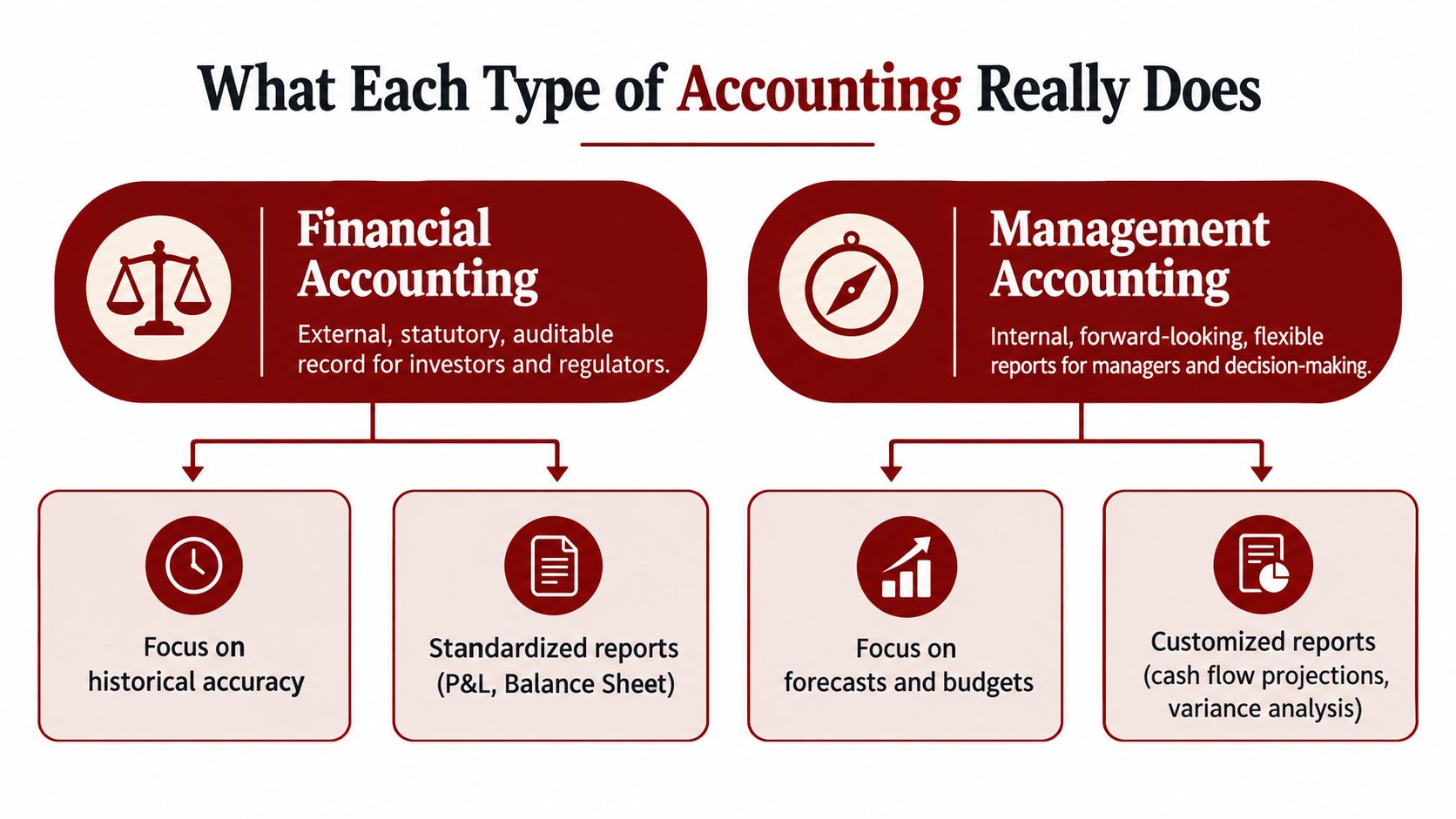
Financial accounting and management accounting use many of the same transactions, but they perform different jobs.
Financial accounting creates the formal record of a company's financial performance and position. In the UK, it serves outside users such as shareholders, lenders, HMRC and Companies House. The reports must be prepared under the relevant statutory and accounting framework, including UK GAAP and FRS 102 or IFRS where applicable, and they need to be supported by an auditable trail. The ICAEW professional syllabus describes the external reporting responsibilities that sit within the UK accountancy profession.
That external purpose explains the emphasis on consistency. UK financial reporting developed through company-law milestones, including the Joint Stock Companies Act 1844 and the Companies Act 1929. Those changes pushed companies towards proper books, annual balancing, audited balance sheets and clearer disclosure of liabilities, creating information that shareholders could compare and scrutinise. The historical development is discussed in UK financial reporting history.
If you need a practical explanation of the filing obligations and contents of company accounts, Action Accountants' guide to statutory accounts is a useful reference.
Financial accounting is built for trust outside the business
A statutory profit and loss account normally presents the business at company level. It records revenue, expenses and profit using prescribed accounting treatments. A balance sheet presents assets, liabilities and equity. The format is designed for accountability and comparability, not for telling a site manager which project needs intervention this week.
Financial accounting also works backwards. It confirms the results of completed periods, subject to accounting adjustments and review. That historical record matters, because lenders, shareholders and tax authorities need dependable information, but it may arrive after an operational problem has already affected cash or profit.
Management accounting is built for action inside the business
Management accounting developed from industrial cost control and internal planning. UK evidence traces integrated cost and financial accounting systems back to industrial practice, including a documented example at Staveley ironworks in 1690. Research covering the period from 1900 to 1950 also shows professionally qualified accountants becoming more involved in business finance and management, supporting the development of management accounting as an internal discipline. The historical evidence appears in research on British cost accounting.
Management accounting can show performance by project, customer, department, site or service line. It can combine financial figures with operational information such as hours worked, quantities delivered, utilisation, project progress and subcontractor commitments. The format is flexible because the audience is internal and the purpose is decision support.
For readers who want to connect general ledger information with operational profitability, this resource on transforming accounting data into profit offers useful context on combining financial and analytical accounting.
The practical difference: financial accounting proves what the business has recorded. Management accounting helps the people running the business decide what to change.
Head to Head Comparison Across the Criteria That Count
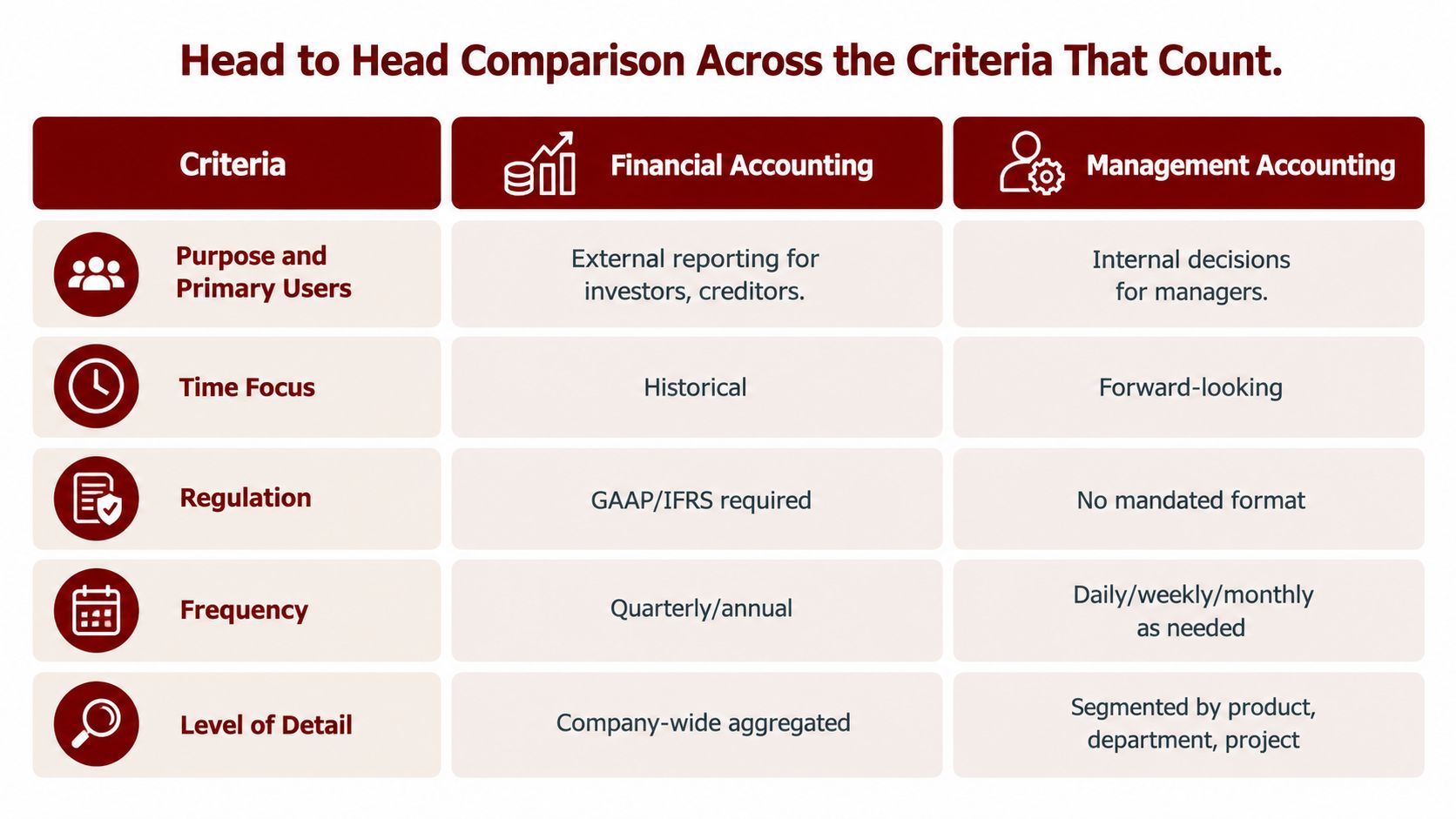
The cleanest way to compare the two disciplines is to use the same questions for each. That avoids the usual oversimplification that presents financial accounting as “compliance” and management accounting as “strategy” without explaining how the reports work in practice.
| Criterion | Financial Accounting | Management Accounting |
|---|---|---|
| Purpose | External reporting and formal financial record | Internal planning, control and decision support |
| Primary users | Shareholders, lenders, HMRC and Companies House | Owners, directors, project managers and operational teams |
| Time focus | Historical performance and financial position | Current performance, forecasts and future choices |
| Regulation | UK GAAP, FRS 102 or IFRS, depending on the reporting requirement | No single mandated format |
| Frequency | Usually annual for statutory accounts, with interim reporting for listed entities | Weekly, monthly or whenever the decision requires it |
| Level of detail | Company-wide, standardised and aggregated | Segmented by product, department, site, customer or project |
| Evidence standard | Formal records with an auditable support trail | Decision-useful estimates, assumptions and operational measures |
| Typical outputs | Profit and loss account, balance sheet and statutory disclosures | Budgets, cash forecasts, variance reports and management packs |
Purpose and users
Financial accounting answers questions from people outside day-to-day operations. Can the lender understand the company's financial position? Have the directors prepared the required accounts? Does the reported performance support the tax and statutory obligations?
Management accounting answers questions from people making decisions. Which job needs a corrective action? Can the business afford another vehicle or employee? Are overheads rising faster than sales? Should the company reprice a service, delay spending or accelerate collection of outstanding invoices?
The two reports may draw from the same ledger, but they shouldn't be forced into the same format. A lender needs a consistent set of external statements. A director needs a clear explanation of movement and a practical action list.
Regulation, frequency and format
Financial accounting follows reporting rules and external deadlines. The reports must be prepared consistently enough for external review and comparison. Management accounting has no equivalent universal format, so a small business can choose the structure that helps its decisions.
That flexibility makes management reporting more useful, but it also creates responsibility. The director must define the reports, assumptions and review rhythm. A flexible report without clear ownership can become a spreadsheet that nobody trusts.
Detail and time orientation
A statutory profit figure can hide important operational differences. One profitable project may offset another project that is losing money. A company-wide gross margin may look acceptable while one team is spending excessive hours on rework.
Management accounting separates those drivers. It can pair actual costs with budgets, commitments and forecasts, then highlight the exceptions that need management attention. For businesses exploring how financial information supports wider strategic execution with OKRs, the same principle applies. Measures should connect activity with a decision, not populate a dashboard.
Auditability versus actionability
Financial accounting prioritises reliable, standardised reporting. Management accounting prioritises timely information that supports a decision, even when some figures remain estimates and later require refinement.
Compliance protects the record. Actionable reporting protects the next decision. A growing SME needs both, but it shouldn't wait for the annual reporting cycle to manage cash or margins.
A deeper review of profitability, liquidity and operational performance can start with financial ratio analysis, provided the ratios are interpreted alongside the business context rather than treated as automatic answers.
KPIs Tools and Reporting That Drive Decisions
Management accounting earns its place when it changes behaviour. A monthly report that arrives after the owner has already committed cash is not management information. It's history with a shorter delay.
For an SME or contractor, the useful measures usually sit closer to operations than statutory profit. The aim isn't to measure everything. The aim is to identify the figures that show whether work, resources and cash are moving as planned.
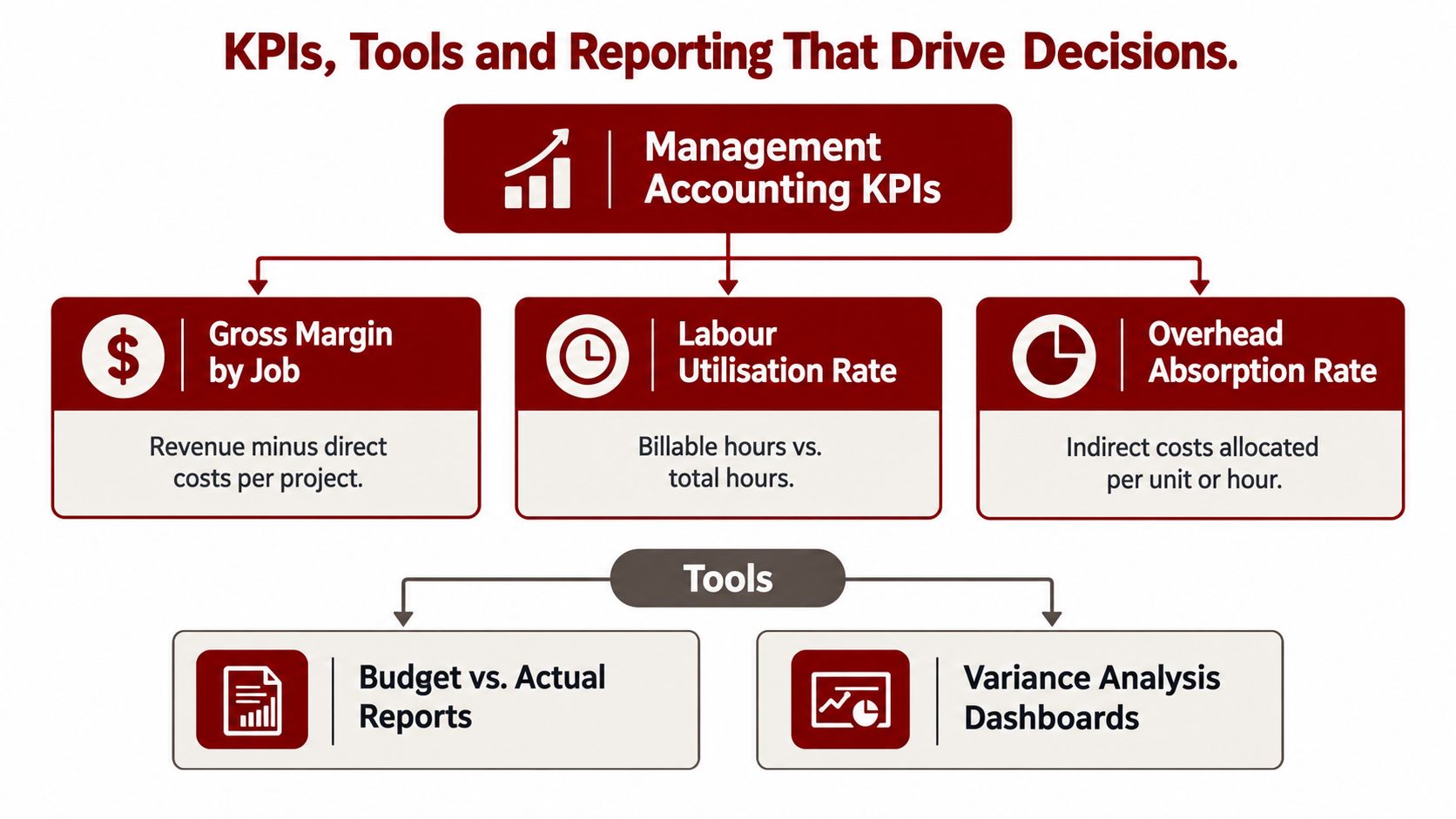
Start with project and service economics
A contractor should track gross margin by job, not just total company profit. That means comparing project revenue with direct costs such as materials, labour and subcontractor charges. If the margin changes, the report should help identify whether the cause is underpricing, extra hours, procurement costs, variations or incomplete billing.
Labour utilisation adds another operational layer. The business needs to understand how much paid time produces billable or productive work, while recognising that the right measure depends on the trade and delivery model. Hours recorded without job codes won't tell you which project absorbed the capacity.
Overhead allocation can also improve pricing and project review. Rent, software, vehicles, supervision and administration don't always sit directly against a single job, but management reporting can allocate them using a consistent basis. The result won't replace statutory accounts. It gives the owner a clearer view of the resources required to deliver work.
Use a small reporting pack consistently
A practical management pack might include:
- Budget versus actual: Show where revenue, labour, materials and overheads differ from plan.
- Variance analysis: Explain the cause of material movements, rather than merely displaying a red or green status.
- Cash forecast: Map expected receipts, supplier payments, payroll, VAT and tax commitments against available cash.
- Reforecast: Update the expected outcome when confirmed information changes the original plan.
- Exception reporting: Direct attention to overdue invoices, unusual costs, margin deterioration or unapproved commitments.
- Non-financial measures: Include hours, project progress, headcount, utilisation, work in progress or customer activity where those measures explain financial performance.
UK public-sector management information guidance also emphasises budgets, forecasts, variance analysis, exception reporting and non-financial data, rather than relying only on historical ledger totals. The principles are set out in management information guidance from Parliament.
Prioritise speed with control
Management reports don't need to wait for every year-end adjustment. They do need clear definitions, reconciled bank data, sensible cut-off rules and visible assumptions. A fast report built on unreliable transactions creates false confidence.
This is SME financial reporting automation at its most useful, especially when bookkeeping, payroll, invoicing and bank feeds connect to the same accounting records. Automation doesn't remove the need for review. It reduces repeated data entry and gives the accountant more time to investigate exceptions, explain movements and improve the forecast.
For businesses reviewing their systems, accounting software integration is the practical foundation. The software should support the reporting process, not dictate a complicated reporting structure that nobody uses.
Real World Use Cases for SMEs and Contractors
The right balance depends on the decision in front of you. A newly formed company seeking external finance has a different reporting priority from an established contractor trying to protect the margin on several live projects.

A start-up preparing for funding
A start-up needs a clean financial record before it asks a lender or investor to trust the business. Financial accounting provides the formal statements and supporting records that external parties expect. It also forces discipline around classification, reconciliations, liabilities and the separation of business and personal transactions.
Management accounting becomes useful as soon as the founder must choose how to deploy limited resources. A cash runway view, budget by activity and scenario analysis can show whether the business can hire, invest in marketing, increase stock or delay a purchase. These internal reports don't replace the formal accounts. They answer questions the formal accounts aren't designed to answer.
An SME managing a cash squeeze
An SME can report a profit and still face a cash problem. Customers may pay late, suppliers may require payment sooner, and tax or payroll commitments may fall due before receipts arrive. Statutory accounts record the resulting financial position, but a cash forecast helps the director decide which invoices to chase, which spending to defer and whether funding discussions need to start.
The report should connect the bank position with expected receipts and payments. It should also show whether the problem is temporary timing, weak collection, excessive stock, rising costs or a project that is consuming cash without producing invoices.
A contractor managing CIS and project margin
Construction businesses need more than a company-wide profit and loss account. CIS compliance, subcontractor payments, labour costs, materials, variations and retention timing can all affect the outcome of a job. A contractor may appear profitable overall while an individual project has lost margin through unrecorded hours, rework or subcontractor costs that weren't included in the original estimate.
A contractor should ask, “Which live job is consuming cash and margin right now?” The annual accounts won't answer that quickly enough. A job-level management report can.
A proper process should link subcontractor records and CIS treatment with project codes, approved costs and payment status. The statutory accounts then receive dependable totals, while the management report gives the project team an earlier warning. Contractors can review specialist considerations through accounting for contractors and construction businesses.
A growing service business
A professional services firm may need to understand profitability by client, consultant or service line. Financial accounting reports the company's overall results. Management accounting can expose low-margin work, excessive non-billable time, weak pricing or an unproductive delivery model.
The report becomes useful when the director can act on it. That might mean changing a fee structure, revising staffing, stopping a service or renegotiating a contract before the next reporting period closes.
How to Choose and Combine Both Without Duplicating Work
The wrong choice isn't always “financial accounting only”. The bigger mistake is running two disconnected systems that produce different versions of the truth.
Use this decision matrix:
| Business situation | Minimum requirement | Recommended approach |
|---|---|---|
| Simple business with stable operations and limited external needs | Accurate bookkeeping and statutory accounts | Add basic cash monitoring |
| Business with regular hiring, borrowing, projects or material spending decisions | Statutory accounts plus internal forecasts | Monthly management accounts and cash forecasting |
| Contractor with live jobs, CIS obligations and subcontractor activity | Statutory compliance plus job-level control | Integrated project costing, CIS-aware bookkeeping and frequent exception review |
| Business facing cash pressure or uncertain margins | Reliable records and immediate visibility | Short-cycle cash reporting, variance analysis and reforecasting |
Financial accounting alone may be enough for a very small business with straightforward transactions, limited operational complexity and no urgent decision-making requirement. That isn't a permanent solution. The moment the owner takes on staff, projects, finance, subcontractors or multiple revenue streams, delayed insight becomes a business risk.
Management accounting becomes essential when decisions can't wait for the annual close. It should show the owner what has changed, why it changed and what action is available. It doesn't need to reproduce every statutory adjustment at the same level of detail, but it must reconcile to a controlled accounting base.
Build one source of truth
Start with a chart of accounts and coding structure that supports both reporting purposes. Project, department, customer and cost categories should be agreed before transactions accumulate. Bank feeds, purchase invoices, sales invoices, payroll and CIS records should flow into the same accounting system wherever possible.
Then set a close timetable. Reconcile the bank, review debtor and creditor movements, post recurring items, check payroll and CIS information, and identify missing invoices. After that, produce the management pack from the same records, adding forecasts and operational data rather than re-keying the ledger into a separate spreadsheet.
UK research involving 418 organisations with 10 to 500 employees reports that senior leaders can lose up to four days a month to manual finance administration. The finding is reported by IT Brief's coverage of UK finance administration. The lesson for founders is practical: measure the time spent reconciling and rebuilding reports, not just the fee for preparing accounts.
Recommendation: automate the movement of data, keep human review over classifications and assumptions, and use management reporting to investigate exceptions rather than reproduce the entire ledger.
Action Accountants Limited can be considered alongside other accountants where a business needs annual accounts, tax compliance, bookkeeping and financial forecasting connected in one process. The important test isn't the label on the service. It's whether the reporting cycle gives the owner dependable information early enough to act.
Your Next Steps to Stronger Financial Control
Financial accounting gives external stakeholders a reliable record. Management accounting gives directors operational visibility. The first protects compliance. The second improves time-to-decision and cash-flow control.
Use the next reporting cycle to check four points:
- Set a close timetable: Decide when bookkeeping, bank reconciliation, payroll, VAT and CIS reviews must be complete.
- Define the management pack: Include cash, budget versus actual, key variances, debtor movement and the operational measures that explain margin.
- Assign responsibility: Name the person who checks project coding, approves costs and explains unusual movements.
- Create a review rhythm: Hold a short monthly review, with more frequent cash or job monitoring where operations require it.
- Trace every report to source data: A management figure should be explainable from the accounting system and supporting records.
Don't wait for year-end accounts to discover that a profitable-looking business has weak cash control or an underperforming project. Review the reports you receive now, identify which decisions arrive before the information, and fix the data flow at its source.
Action Accountants Limited provides bookkeeping, statutory accounts, tax compliance and financial management support for London SMEs and contractors, including CIS-aware reporting for construction businesses. Visit Action Accountants Limited to discuss a reporting process that connects one reliable accounting record with timely management insight.