
Your 2026 UK Year End Tax Planning Checklist
A practical UK year end tax planning guide for 2026. Get actionable steps on allowances, pensions, and CIS to reduce your tax bill before the 5 April deadline.

You've reached the familiar point in the year. The accounts aren't fully reconciled, a dividend decision is waiting, equipment may need replacing, and pension paperwork is still sitting in your inbox. Meanwhile, 5 April is approaching, and every unresolved decision reduces the choices available to you.
Effective UK year end tax planning isn't about obscure loopholes or spending money for the sole purpose of creating a deduction. It's about knowing what income and gains you're likely to have, identifying which allowances may be lost, and completing the right actions while the deadline still gives you control. This guide is written for company directors, sole traders, contractors, landlords and growing SMEs that want a practical plan rather than a last-minute compliance exercise.
Table of Contents
- Why Your Year End Tax Planning Starts Now
- The Three Pillars of Effective Tax Planning
- Maximising Your Personal Allowances and Reliefs
- Strategic Business Tax Moves for SMEs and Startups
- Specialist Planning for Contractors and Landlords
- Your Final Pre-Deadline Action Checklist
Why Your Year End Tax Planning Starts Now
A contractor reviewing company cash, a landlord considering a disposal, or a director deciding on a dividend can lose useful choices by waiting. The UK personal tax year runs from 6 April to 5 April, a structure linked to the 1752 change from the Julian to the Gregorian calendar, when Parliament moved the year end from 25 March after adding 11 days. That date still governs decisions involving annual allowances, pension contributions, capital gains, dividends and bonuses, as explained in the Government's report on the UK tax year end date.

The Self Assessment filing deadline comes later, but it cannot reopen a closed tax year. You may correct records and submit figures, yet a late filing does not usually allow you to make a pension payment, use an ISA allowance, change dividend timing, or complete a transaction that needed to happen before 5 April. The Self Assessment deadline guidance helps with filing obligations, but filing and planning are separate tasks.
An early review gives you room to compare salary, dividends, pension contributions and retained profits against expected results. Landlords can examine property income and potential disposals before committing to a transaction. Contractors can check CIS deductions, allowable expenses and company cash before deciding how much income to extract. These decisions involve trade-offs, including personal cash needs, available reliefs and the effect on future tax.
HMRC's compliance analysis shows that ordinary process failures make up a substantial part of the tax gap. Incomplete records, missed elections and payments made too late can create avoidable problems, even where the underlying tax position is straightforward. Good year-end planning therefore depends on acting early and keeping evidence.
Practical rule: A tax-saving idea that isn't completed, documented and reported correctly isn't a successful strategy.
Book a review well before 5 April. That gives your accountant time to test the figures, explain the trade-offs and complete actions while they remain available.
The Three Pillars of Effective Tax Planning
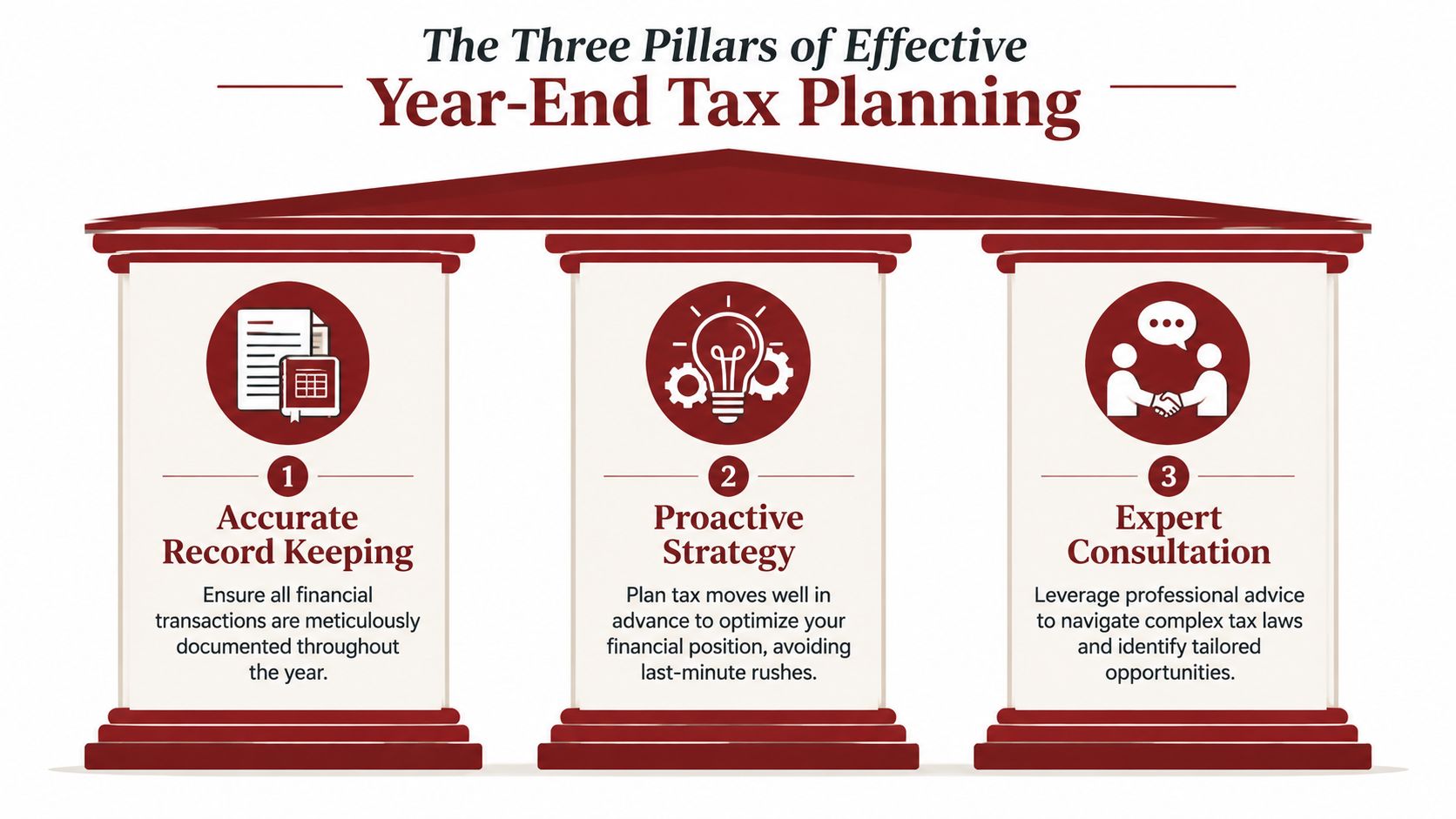
Good year end tax planning rests on three connected disciplines. Records tell you what happened, timing determines what can still be changed, and forward planning shows whether a decision helps beyond the current tax year. Remove any one of those pillars and the advice becomes guesswork.
Accurate records come first
You need a reliable picture of income, expenses, business assets, dividends, pension payments, loans and capital transactions. That means reconciling bank accounts, checking unpaid invoices, reviewing purchase invoices and separating personal spending from company costs.
For a company, the accounting year end may fall on a date other than 5 April. That date governs the company's accounts and Corporation Tax process. The personal tax year still runs from 6 April to 5 April, so directors must consider both calendars. A company purchase made before its accounting year end may affect corporate results, while a dividend or pension payment may also affect the director personally.
A simple year-end file should include:
- Income evidence: Sales invoices, payroll records, dividend paperwork, interest and property income.
- Expense support: Supplier invoices, receipts, mileage records and business-use explanations.
- Asset information: Purchase dates, costs, finance agreements and intended business use.
- Personal planning figures: Pension contributions, investment disposals, charitable gifts and other income.
Timing turns information into action
A transaction's tax treatment depends on when it occurs and which taxpayer makes it. Arranging a pension contribution isn't enough if the payment hasn't left the relevant account by the cut-off. Similarly, a proposed bonus or dividend needs proper approval, supporting records and correct payroll or accounting treatment.
Don't assume that an accounting year-end and the personal tax deadline are interchangeable. Ask which deadline applies to each proposed action before you authorise it.
Look beyond the current return
The strongest decisions compare the current position with the next tax year. Bringing forward spending may help if current profits are unusually high, but it can damage cash flow or leave fewer deductions for a stronger future year. Delaying income may help in some circumstances, but it can create a later spike or interfere with cash needs.
A useful review asks:
- What income and gains have already arisen?
- What transactions can still be completed before 5 April?
- Which allowances or reliefs may be lost?
- What will the business and personal income position look like next year?
- What evidence will support the treatment?
The small business accountant support guide is useful when you need help turning bookkeeping, payroll and tax information into decisions rather than a completed return.
Maximising Your Personal Allowances and Reliefs
Personal allowances help only when you understand their limits and complete the required action before the relevant deadline. For directors and owner-managers, the practical question is often “How will this decision change my adjusted net income?”
The Personal Allowance taper reduces the allowance by £1 for every £2 of adjusted net income above £100,000, until it reaches zero at £125,140. A bonus, dividend, benefit or investment gain can therefore affect more than the tax on that additional amount. If your adjusted net income is close to £100,000, model the effect before approving a payment.
That makes bonus timing, dividend decisions and pension contributions part of the same calculation. Compare the combined result rather than treating each item as an isolated year-end task.
Review allowances that expire
The ISA allowance doesn't carry forward, so check whether you have used the available subscription for the tax year before the deadline. The capital gains annual exempt amount is £3,000 for 2025/26, while the dividend allowance is £500, according to this tax year end planning guide.
Selling an investment solely to create a tax result can produce unnecessary dealing costs and change your portfolio. Review assets you already intend to rebalance, dispose of or use to realise a gain. Where gains and losses exist, check the order and timing of transactions with an adviser. Keep purchase records, sale statements and evidence of allowable costs.
Business owners raising capital should keep personal tax planning separate from investment promotion. If you are comparing funding routes, this guide to search for angel and VC investors may help you research potential options. Commercial suitability should determine an investment decision, rather than a hoped-for tax outcome.
Pension timing needs proof
Pension contributions can reduce adjusted net income and may help protect part of the Personal Allowance. The calculation should include existing contributions, annual allowance headroom and any available carry-forward. Model the position before committing cash, particularly if the business also needs funds for payroll, VAT, Corporation Tax or working capital.
The payment date determines the tax year. A contribution counts when the payment is made, not when it is arranged. If the payment leaves the account after midnight on 5 April, it may fall into the following tax year. Keep the transaction confirmation, provider receipt and relevant correspondence.
The tax benefit is only one side of the decision. Pension contributions tie up cash and may not suit a business owner who needs funds for payroll, VAT, Corporation Tax or working capital.
For directors near the income threshold, compare several outcomes instead of selecting the largest possible contribution. Review salary, dividends, employer pension payments and retained profits together. An employer pension contribution may affect personal income differently from a dividend, but it still must be affordable, properly approved and correctly recorded.
Strategic Business Tax Moves for SMEs and Startups
A profitable year can still leave an SME short of cash if tax planning focuses only on relief. Start with the business case. Confirm that planned spending supports operations, then check how its timing and treatment affect the company. A tax deduction does not make an unnecessary purchase sensible.
Review capital expenditure before the company's accounting year end. Equipment, technology and machinery may qualify for capital allowances, depending on the asset, its business use, the acquisition date and the rules applying to the company. Bringing forward a purchase that the business already needs may help. Buying solely for relief can leave the company with less cash and an asset it did not require.
Decisions for directors and employees
Director bonuses need coordination between payroll, the company accounts and the director's personal tax position. Agree and record the decision, obtain the required approval, process payroll correctly and assess whether payment in the current period creates an unwanted personal income spike.
Company pension contributions belong in the same remuneration review. Check that the company can fund the payment without affecting payroll, VAT, Corporation Tax or working capital. Record the contribution properly and retain evidence of the transfer. A planned payment is not complete merely because it appears in a board discussion or cash-flow forecast.
Use the year-end review to check:
- Unpaid invoices: Assess recoverability and identify debts requiring appropriate accounting treatment.
- Accrued costs: Record valid expenses relating to the period, supported by suitable documentation.
- VAT records: Reconcile VAT control accounts and investigate unusual balances before filing.
- Inter-company balances: Check loans, management charges and transfers between connected entities.
- Innovation claims: Confirm that genuine qualifying development work has been documented sufficiently for an R&D claim.
Weak processes can create avoidable tax exposure. HMRC's figures for the 2024 to 2025 tax gap attributed 35% to failure to take reasonable care and 16% to error, according to the tax gap information. Accurate records support claims, expose cash pressure and reduce the need to correct mistakes later. They also give the accountant evidence to test whether an expense, provision or claim belongs in the period.
Founders reviewing overseas investment relief should treat foreign examples with care. Material on Section 1202 for FedEx ISP owners may provide background, but Section 1202 is not a UK planning rule. Its treatment should not be applied to a UK company without specialist advice.
A business tax planning service can bring together Corporation Tax, VAT, payroll, investment decisions and cash-flow constraints before the company period closes. The practical test is simple: document why the company is making the payment, who approved it, when it was made and how it will be reported.
Specialist Planning for Contractors and Landlords
Contractors and landlords face decisions that generic ISA and pension checklists often miss. Their income may come from several sources, their records may be split between personal and business activity, and rule changes can affect the value of a transaction completed near year end.
For contractors, begin with the income extraction review. Compare salary, dividends, employer pension contributions and retained funds in the company. The right mix depends on profit, available cash, payroll records, National Insurance considerations, personal income and the director's wider tax position. A dividend is not merely a cheaper salary. It must come from distributable profits and needs proper minutes and vouchers.
Construction contractors should also reconcile CIS deductions against subcontractor statements and company records. Missing deductions can distort tax calculations and cash-flow forecasts. Keep invoices, deduction statements, payroll information and evidence of materials or other relevant costs together.
If your work is based in North West London or you need specialist support, the contractor accountant service is designed around contractor and CIS-related requirements.
Property decisions need a rule-change review
The furnished holiday lettings regime was abolished from 6 April 2025, and most double-cab pick-ups were reclassified as cars for tax purposes from April 2025, according to this year-end tax planning guide for property and business owners. That changes the question landlords and contractors should ask. It isn't enough to ask whether an allowance remains available. You must establish whether the asset or income stream still qualifies for the treatment you expected.
For a landlord, review:
- Property income and expenses by property.
- Financing costs and the way they're reflected in the tax calculation.
- Planned acquisitions, disposals and refinancing.
- The impact of the FHL change on existing furnished holiday properties.
- Records supporting repairs, improvements and periods of personal use.
For a contractor or business owner considering a double-cab pick-up, assess business use, private availability, financing, running costs and the vehicle's classification before signing an order. A purchase made for a tax deduction can create an expensive asset that doesn't suit the business.
Property investors can use a land transfer tax calculator as an initial transaction-planning aid, but it shouldn't replace a UK tax review. The calculator may help frame acquisition costs, while an accountant considers ownership structure, income tax, Corporation Tax, capital gains and reporting obligations.
Don't accelerate a disposal simply because a rule has changed. Model the tax, cash, financing and commercial outcome together before committing.
Your Final Pre-Deadline Action Checklist
The final review should produce decisions, not another folder of unresolved questions. Work through the list early enough to complete payments, obtain approvals and correct records before the tax year closes.
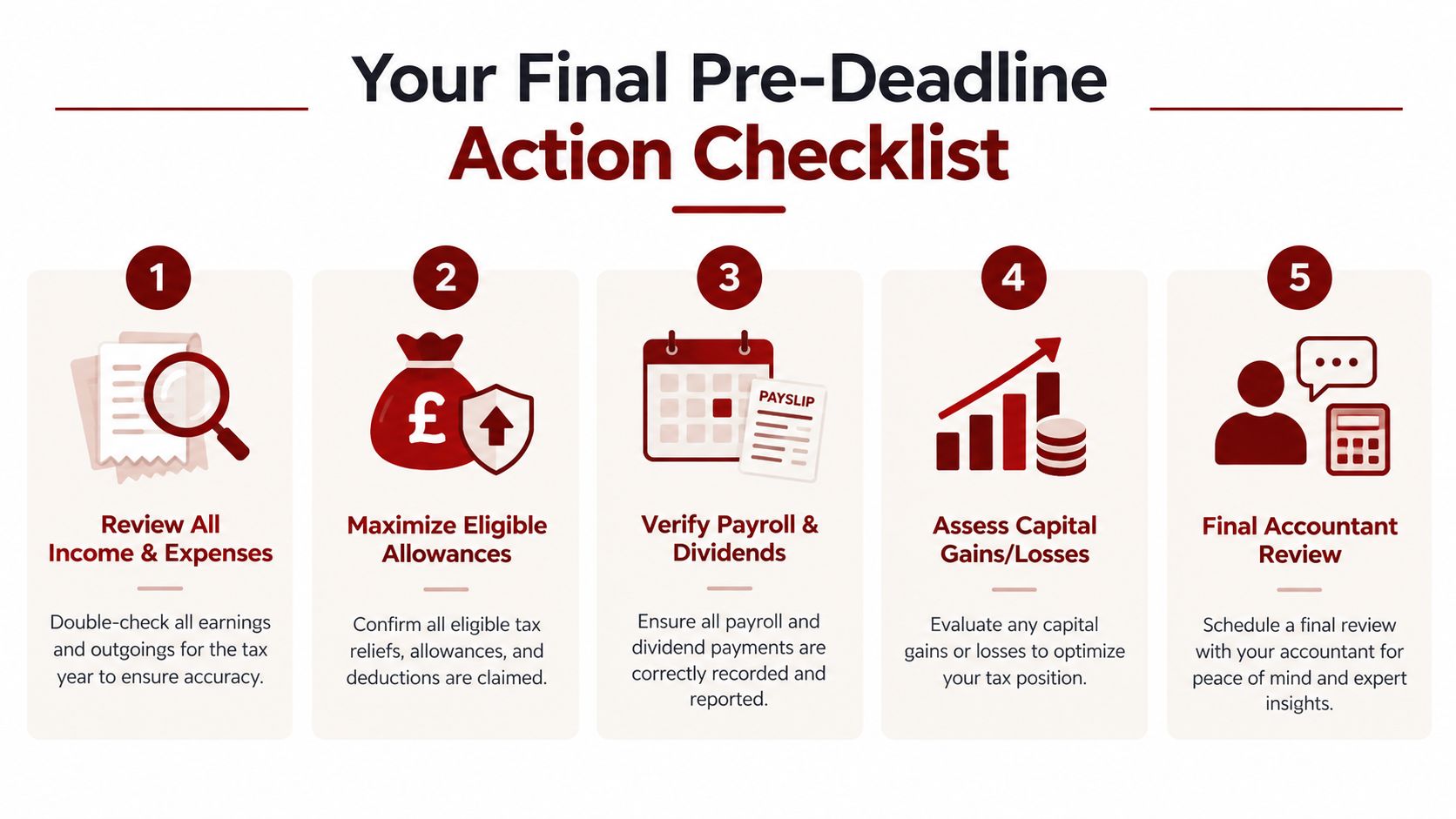
Personal position
- Check total income: Include salary, dividends, bonuses, property income, interest and expected gains.
- Test the £100,000 threshold: Model adjusted net income and the possible effect on the Personal Allowance.
- Review allowances: Check ISA usage, the capital gains annual exempt amount and the dividend allowance.
- Confirm pension payments: A contribution counts for relief when paid, not when arranged. If cash leaves the account after midnight on 5 April, it may not qualify for the year ending then. HMRC's Self Assessment deadline is 31 January after the tax year end, but that later filing date doesn't extend the payment deadline, as reflected in HMRC's statistics and guidance information.
Business position
- Reconcile records: Match bank accounts, invoices, expenses, payroll and VAT balances.
- Review planned purchases: Bring forward only necessary equipment or vehicles after checking the relevant capital allowance treatment.
- Verify dividends and bonuses: Confirm distributable profits, approvals, payroll entries and personal tax consequences.
- Check CIS deductions: Reconcile contractor and subcontractor statements to the accounting records.
- Plan the next period: Compare expected profits, cash requirements and income extraction decisions for the next tax year.
Investments and property
- Assess gains and losses: Review intended disposals, allowable costs and supporting evidence.
- Revisit property treatment: Consider the FHL regime change, vehicle classification and any proposed disposal or restructuring.
- Protect liquidity: Don't spend £1 to save a fraction of that amount in tax.
- Schedule a review: Ask an accountant to test the proposed actions, dates, documentation and reporting requirements.
The most common mistake is treating the checklist as complete when a payment or approval is still pending. Mark each action as planned, authorised, paid and evidenced. That simple status check can prevent a well-intentioned strategy from missing the deadline.
Action Accountants Limited provides practical year-end tax planning, bookkeeping, payroll, VAT, personal and corporate tax support for directors, SMEs, contractors and landlords. Visit Action Accountants Limited to arrange a review of your records, deadlines and proposed tax decisions before 5 April.